Ancient
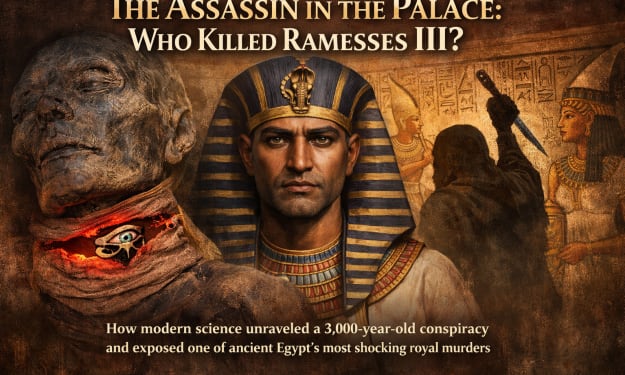
Who Killed Ramesses III?
For centuries, the death of Pharaoh Ramesses III—one of ancient Egypt’s last great rulers—remained shrouded in mystery. Historians knew he died around 1155 BCE, but whether his death was natural or the result of foul play was unclear. Ancient texts hinted at intrigue, betrayal, and a palace conspiracy, yet definitive proof remained elusive. It wasn’t until the 21st century that science finally uncovered the truth, revealing a chilling tale of assassination at the heart of the royal court.
By Irshad Abbasi 2 days ago in History
From Parlors to Phantoms
In the late 19th century, amid velvet curtains and candlelit drawing rooms, a curious form of entertainment began to captivate the Western world. It wasn’t music, nor cards, nor storytelling—it was communication with the dead. What would later become known as the Ouija board started as a novelty, a playful curiosity rooted in a society obsessed with the afterlife. Yet over time, this seemingly harmless parlor game would evolve into one of the most feared objects in popular culture.
By Irshad Abbasi 2 days ago in History
Unraveling the Mysterious Death of Edgar Allan Poe
Edgar Allan Poe, the master of macabre and creator of some of the most enduring tales of horror and suspense, died on October 7, 1849, under circumstances that have puzzled historians and literary scholars for over a century. Known for his dark imagination and tortured life, Poe’s demise has spawned countless theories ranging from murder to madness, alcoholism, and even bizarre medical conditions. Yet, the exact cause of his death remains shrouded in mystery, as if one of his own gothic tales had leapt off the page into real life.
By Irshad Abbasi 2 days ago in History
How Endurance Was Lost—and Found Again After a Century
More than a century ago, the legendary ship Endurance vanished into the frozen wilderness of Antarctica, leaving behind one of the greatest survival stories in human history. For decades, its resting place remained a mystery buried beneath thick sea ice—until a team of modern explorers finally uncovered it, remarkably preserved in the icy depths.
By Irshad Abbasi 2 days ago in History
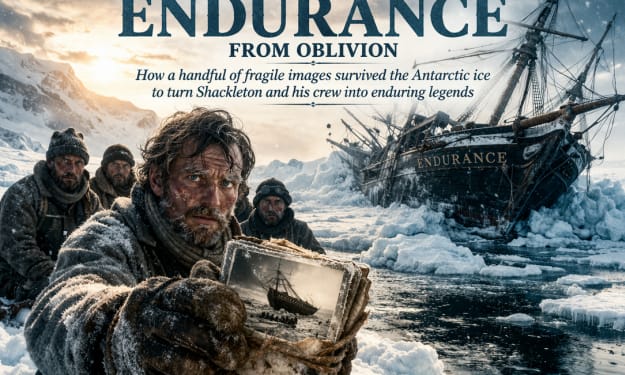
The Photographs That Saved the Endurance Expedition from Oblivion
In the most unforgiving place on Earth, where temperatures plunge far below freezing and survival itself becomes a daily battle, a collection of photographs nearly vanished forever beneath the Antarctic ice. These images—captured during the ill-fated voyage of the Endurance—were not just visual records. They were silent witnesses to one of the greatest survival stories in human history. Against all odds, they endured, transforming a near-tragedy into a timeless legend.
By Irshad Abbasi 2 days ago in History
Beneath the Führer’s Shadow
Deep within the dense forests of northeastern Poland once stood one of the most heavily guarded and secretive military complexes of the Third Reich: the Wolf’s Lair. Known in German as Wolfsschanze, this sprawling wartime headquarters served as the primary command center for Adolf Hitler during much of World War II. While the ruins above ground still draw visitors today, it is what lies beneath the surface that continues to intrigue historians, archaeologists, and conspiracy theorists alike.
By Irshad Abbasi 2 days ago in History
The Enigmatic Death of Jane Austen
The death of Jane Austen, one of the most cherished authors in English literature, continues to puzzle historians and medical experts more than two hundred years later. Best known for her timeless works such as Pride and Prejudice and Sense and Sensibility, Austen left behind not only a literary legacy but also a lingering mystery surrounding her untimely death at the age of 41.
By Irshad Abbasi 2 days ago in History
The Master of Escape
Few names in history are as synonymous with magic and mystery as Harry Houdini. Known as the “King of Escape,” Houdini transformed stage illusion into a thrilling spectacle of danger, skill, and suspense. His life was as dramatic as his performances—and his death, which occurred on Halloween, only deepened the legend surrounding him.
By Irshad Abbasi 2 days ago in History
The Crusades
On July 15, 1099, after five weeks of siege, Christian Crusaders breached the walls of Jerusalem and embarked on a massacre so extreme that eyewitnesses reported riding horses through streets where blood reached the stirrups, slaughtering every Muslim and Jewish resident they could find regardless of age or gender, and one chronicler recorded that the killers then washed the blood from their hands and walked barefoot to the Church of the Holy Sepulchre to pray and give thanks to God for their victory, seeing no contradiction between worship and genocide.
By The Curious Writer2 days ago in History
The Peloponnesian War
In 430 BCE, the golden age of Athens ended not with a military defeat but with a mysterious plague that killed a quarter of the population including the great statesman Pericles, turning the world's most advanced civilization into a city of corpses stacked in temples and burning in the streets while survivors abandoned morality and law because they believed they were all going to die anyway, and the description by historian Thucydides remains so detailed that modern epidemiologists are still trying to identify what disease destroyed Athens from within while Sparta waited patiently outside the walls.
By The Curious Writer2 days ago in History
Iran’s Mosaic Doctrine Rising
The Mosaic Doctrine: Is Iran Following Israel’s Strategic Playbook? From Defense to Pre-Emptive Intelligence Power In modern geopolitical warfare, few strategic doctrines have shaped intelligence operations like the Mosaic Doctrine, more widely known as the Begin Doctrine. Originally developed by Israeli leadership, this doctrine focuses on preventing enemies from becoming powerful enough to threaten national security — even if that requires covert operations, sabotage, or pre-emptive strikes.
By Wings of Time 2 days ago in History