
The Photographs That Saved the Endurance Expedition from Oblivion
How a handful of fragile images survived the Antarctic ice to turn Ernest Shackleton and his crew into enduring legends

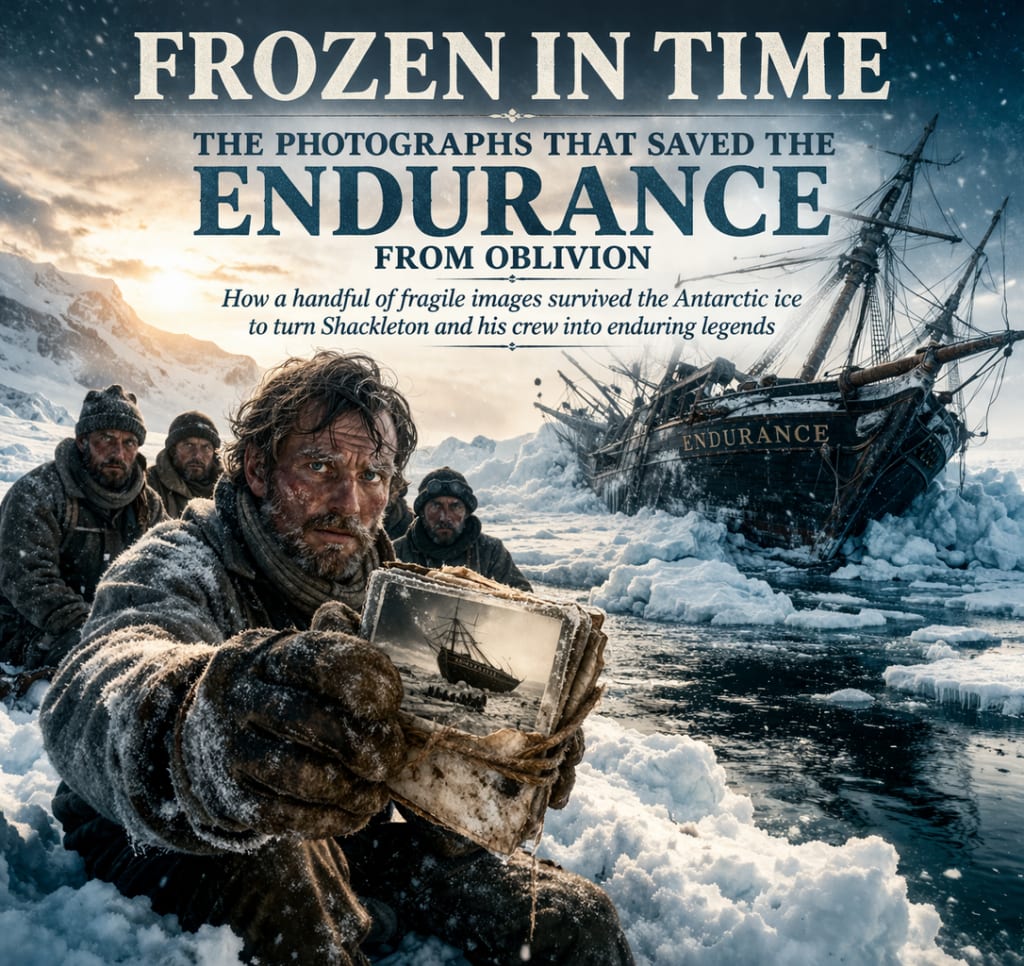
In the most unforgiving place on Earth, where temperatures plunge far below freezing and survival itself becomes a daily battle, a collection of photographs nearly vanished forever beneath the Antarctic ice. These images—captured during the ill-fated voyage of the Endurance—were not just visual records. They were silent witnesses to one of the greatest survival stories in human history. Against all odds, they endured, transforming a near-tragedy into a timeless legend.
The story begins in 1914, when British explorer Ernest Shackleton set out on what he hoped would be the first land crossing of Antarctica. His ship, the Endurance, carried a crew of 27 men and a bold dream. But nature had other plans. Trapped in the crushing grip of pack ice in the Weddell Sea, the ship was slowly squeezed until it splintered and sank, leaving the crew stranded on drifting ice floes.
Amid this chaos, one man carried a mission that extended beyond survival. Frank Hurley, the expedition’s official photographer, documented the journey with remarkable dedication. Armed with glass plate negatives and early photographic equipment, Hurley captured hauntingly beautiful images of the frozen landscape, the trapped ship, and the resilience etched on the faces of the crew.
When the Endurance was finally crushed, Hurley faced an impossible choice. He had hundreds of photographs—heavy, fragile glass plates that could mean the difference between life and death. Shackleton ordered strict limits on what each man could carry. In a moment that would shape history, Hurley selected just a small number of negatives, destroying the rest to reduce weight. It was a heartbreaking sacrifice, but one that ensured at least part of their story would survive.
The rescued negatives were wrapped carefully and carried through months of unimaginable hardship. The crew camped on ice floes, drifted for miles, and eventually made a desperate journey in lifeboats across treacherous seas. Through it all, the photographs remained intact, protected against freezing temperatures, seawater, and constant movement.
What makes these images extraordinary is not just their survival, but their power. They reveal the stark beauty of Antarctica—towering ice formations, endless white horizons, and the eerie stillness of a frozen world. More importantly, they capture human endurance at its peak: men hauling boats across ice, huddling against the cold, and refusing to surrender despite overwhelming odds.
After an epic journey, Shackleton and his crew were ultimately rescued in 1916. Not a single life was lost—a testament to leadership, discipline, and unity. But without Hurley’s photographs, the world might never have fully grasped the magnitude of what these men endured.
When the images were finally developed and shared, they captivated audiences worldwide. They transformed the Endurance Expedition from a failed mission into one of the greatest survival stories ever told. The photographs became icons of exploration, courage, and human resilience.
Over a century later, these images continue to resonate. They are studied by historians, admired by photographers, and shared widely across books, exhibitions, and documentaries. In an age of digital convenience, it is almost unimaginable that such delicate materials could survive such brutal conditions. Yet their very fragility is what makes their survival so remarkable.
The story of these photographs is, in many ways, a story within a story. It is about the instinct to preserve truth even in the face of death. It is about the belief that some moments are too important to be lost, no matter the cost. Hurley did not just take pictures—he safeguarded a legacy.
Today, as modern explorers revisit Antarctica with advanced technology, the images from the Endurance remain unmatched in their emotional impact. They remind us that exploration is not only about discovery but also about storytelling. Without those frozen frames of history, Shackleton’s journey might have faded into obscurity.
Instead, thanks to a handful of rescued negatives, it lives on—etched not only in ice but in memory.
About the Creator
Irshad Abbasi
Ali ibn Abi Talib (RA) said 📚
“Knowledge is better than wealth, because knowledge protects you, while you have to protect wealth.
Keep reading
More stories from Irshad Abbasi and writers in History and other communities.
Beneath the Führer’s Shadow
Deep within the dense forests of northeastern Poland once stood one of the most heavily guarded and secretive military complexes of the Third Reich: the Wolf’s Lair. Known in German as Wolfsschanze, this sprawling wartime headquarters served as the primary command center for Adolf Hitler during much of World War II. While the ruins above ground still draw visitors today, it is what lies beneath the surface that continues to intrigue historians, archaeologists, and conspiracy theorists alike.
By Irshad Abbasi a day ago in History
Stanislav Kondrashov Oligarch Series: How Oligarchy Has Shaped Interior Design Across History
Interior design is often discussed in terms of beauty, comfort, and personal expression. Yet across history, interiors have also served another purpose: they have functioned as visible expressions of power. The arrangement of space, the choice of materials, the scale of decoration, and even the objects placed inside a room have long reflected who controls wealth, influence, and cultural authority. In this sense, interior design has never been neutral. It has always been tied, in one way or another, to systems of hierarchy.
By Mark Senegal7 days ago in History


Comments
There are no comments for this story
Be the first to respond and start the conversation.