
Unraveling the Mysterious Death of Edgar Allan Poe
A deep dive into the last days of the literary genius whose death remains one of America’s most perplexing literary mysteries

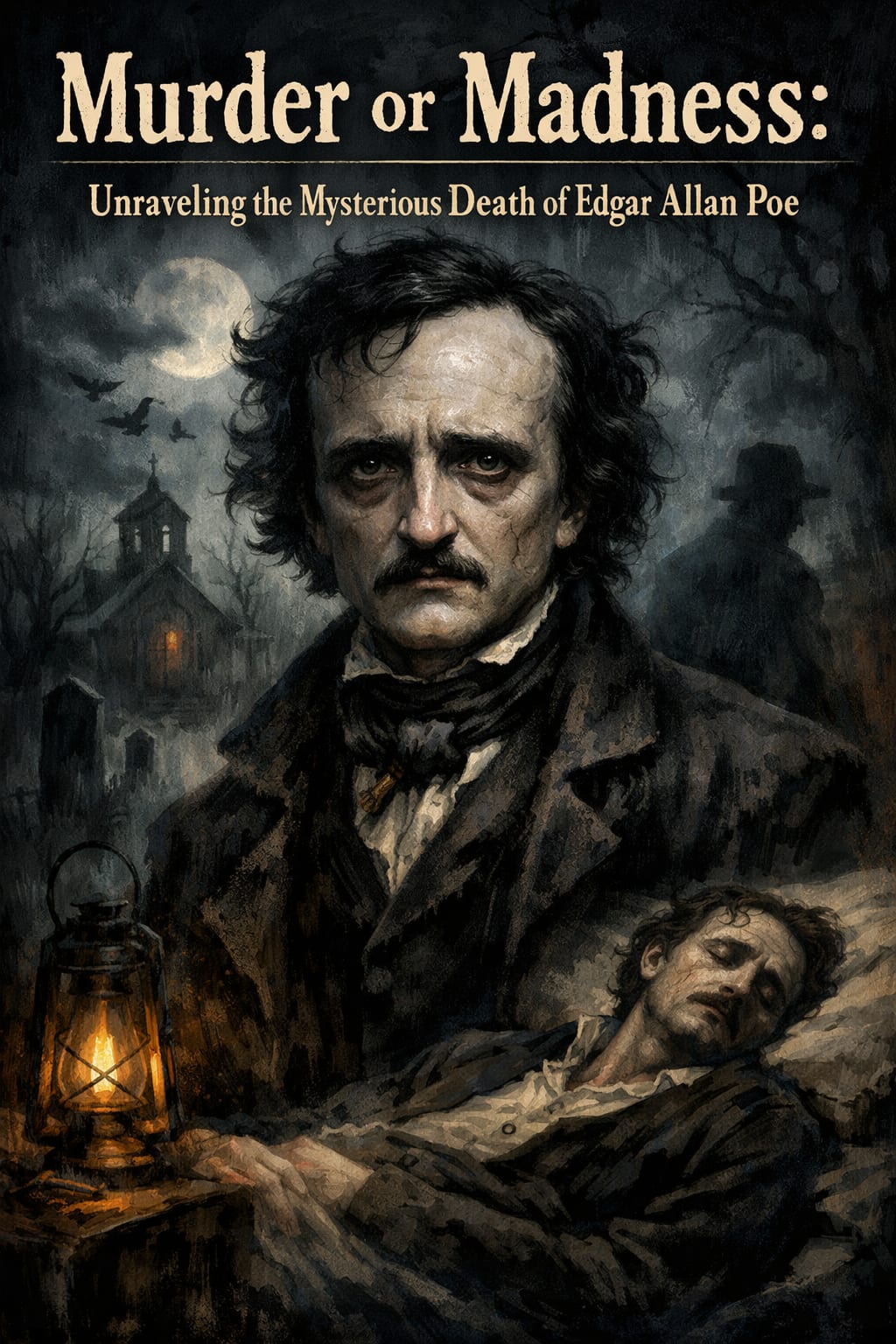
Edgar Allan Poe, the master of macabre and creator of some of the most enduring tales of horror and suspense, died on October 7, 1849, under circumstances that have puzzled historians and literary scholars for over a century. Known for his dark imagination and tortured life, Poe’s demise has spawned countless theories ranging from murder to madness, alcoholism, and even bizarre medical conditions. Yet, the exact cause of his death remains shrouded in mystery, as if one of his own gothic tales had leapt off the page into real life.
Poe’s final days were marked by confusion and distress. He was found delirious on the streets of Baltimore, wearing clothes that were not his own, and reportedly in a state of great distress. He was taken to Washington College Hospital, where he lingered for four days, never regaining full consciousness, before succumbing to an unknown illness. Poe himself was unable to explain his condition, reportedly calling out the names of people long dead or talking incoherently. His last words, as recorded by those present, were simply: “Lord, help my poor soul.” Such an enigmatic end has fueled speculation ever since.
Among the most persistent theories is that Poe fell victim to what was known at the time as cooping, a form of voter fraud common in the 19th century. Cooping involved kidnapping individuals and forcing them to vote multiple times under different disguises. Poe was found on Election Day, and his appearance in unfamiliar clothing lends some weight to this theory. The violent and disorienting nature of cooping could explain his delirium and physical state when discovered. However, definitive evidence linking Poe to such a scheme has never been found.
Another theory points to alcohol abuse. Poe had a well-documented struggle with drinking, though the extent of his alcoholism is debated among scholars. Some reports suggest that he had been relatively sober in the months leading to his death, while others insist that he might have experienced a relapse. Alcohol poisoning or withdrawal could plausibly account for the confusion, fever, and eventual death that he suffered. Yet, contemporary accounts of his behavior suggest a more complex picture, one not fully explained by alcohol alone.
Medical explanations also abound. Some experts suggest that Poe may have died from rabies, a condition consistent with the acute delirium, hydrophobia, and confusion reported by witnesses. Others have proposed diabetes, heart disease, tuberculosis, or epilepsy as potential causes. Given the rudimentary medical diagnostics of the 19th century, it is virtually impossible to verify these theories, leaving them as plausible but unconfirmed possibilities.
The notion of murder or foul play has also intrigued researchers. Poe had his share of enemies, both personal and professional. Some speculate that he could have been deliberately poisoned or attacked, although no evidence has ever surfaced to substantiate such claims. The chaotic scene in Baltimore on Election Day, combined with Poe’s wandering and vulnerable state, makes this theory tantalizing but inconclusive.
Poe’s personal life may offer some insight into his mysterious end. The writer endured significant personal tragedy, including the early deaths of his mother, foster mother, and wife, Virginia. These losses, coupled with financial struggles and mental health challenges, have led some to believe that his death might have been the tragic result of psychiatric illness, possibly compounded by physical frailty. His work itself, often exploring the macabre, the melancholic, and the psychologically disturbed, mirrors the intensity of his own life experiences, blurring the line between art and autobiography.
Despite the uncertainty, Poe’s death has only added to the legend surrounding him. His demise is as enigmatic as his stories, leaving literary historians, medical experts, and fans alike to speculate endlessly. The mystery is a testament to Poe’s enduring influence—his life and death intertwined in a narrative as compelling as any he penned. Whether his end was caused by murder, madness, illness, or circumstance, the truth remains elusive, like a shadow in the dim light of his gothic imagination.
In the end, Edgar Allan Poe’s death reminds us that some mysteries resist resolution. Just as his tales continue to haunt readers with their clever blend of horror and insight into the human psyche, so too does the question of how the man himself met his final, mysterious fate. Perhaps Poe would have appreciated the enduring enigma, a real-life tale as dark and haunting as any he ever wrote.
About the Creator
Irshad Abbasi
Ali ibn Abi Talib (RA) said 📚
“Knowledge is better than wealth, because knowledge protects you, while you have to protect wealth.
Keep reading
More stories from Irshad Abbasi and writers in History and other communities.
How Endurance Was Lost—and Found Again After a Century
More than a century ago, the legendary ship Endurance vanished into the frozen wilderness of Antarctica, leaving behind one of the greatest survival stories in human history. For decades, its resting place remained a mystery buried beneath thick sea ice—until a team of modern explorers finally uncovered it, remarkably preserved in the icy depths.
By Irshad Abbasi a day ago in History
The London Plague a Disease of Class
At the moment, where I live, we have an unprecedented number of meningitis cases. It is all anyone talks about. The anxiety hangs heavy in the air, making it easy to imagine what it must have been like 360 years ago when you walked past a door and saw that jagged red cross slashed across it.
By Sam H Arnoldabout 8 hours ago in History
Fake Film, Real Escape: CIA's Rescue Operation in IRAN
On November 4, 1979, in the heart of Tehran, thousands of protesters stormed the United States Embassy, climbing over its gates and walls. Their target was the Americans inside. The embassy security surrendered, and within hours, 52 American diplomats and workers were taken hostage.
By Imran Ali Shah6 days ago in History


Comments
There are no comments for this story
Be the first to respond and start the conversation.