
Fake Film, Real Escape: CIA's Rescue Operation in IRAN
Real Escape

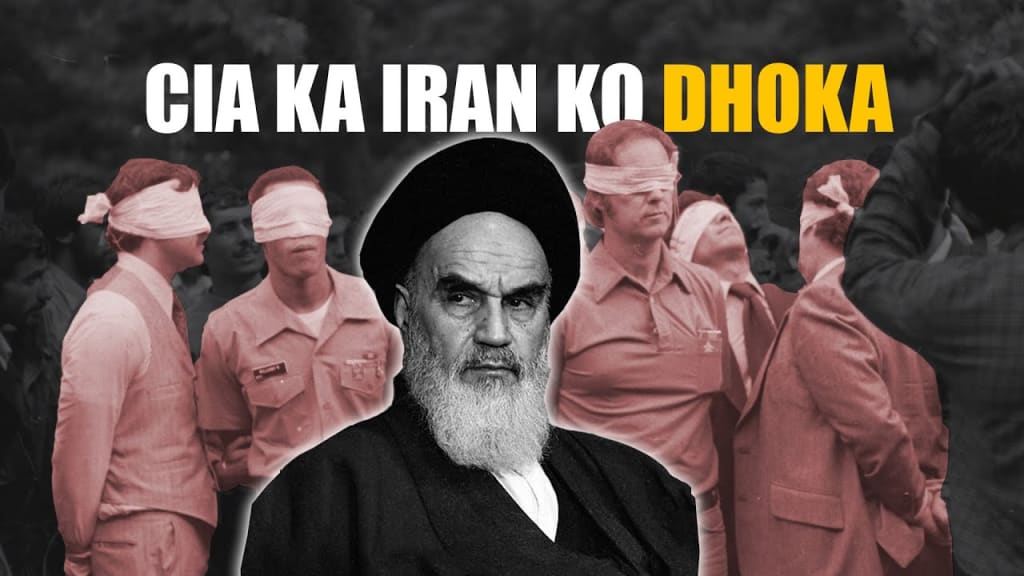
On November 4, 1979, in the heart of Tehran, thousands of protesters stormed the United States Embassy, climbing over its gates and walls. Their target was the Americans inside. The embassy security surrendered, and within hours, 52 American diplomats and workers were taken hostage.
The protesters had one demand: return the Shah of Iran, or face the consequences.
Amid the chaos, six American diplomats managed to escape through a secret back door of the embassy. For the next several days, they hid, moved from place to place, and changed their appearances. With each passing day, the risk of being caught increased. Getting them out of Iran alive seemed like an impossible mission.
This mission was assigned to the CIA.
By November 1979, Iran was in extreme political turmoil. Earlier that year, in January 1979, Shah Mohammad Reza Pahlavi had fled the country under public pressure. His 38-year rule had strong support from the United States, but the Iranian people had grown tired of him. While the Shah lived a life of luxury, most Iranians were becoming poorer. Many saw him as an American puppet.
His secret police, SAVAK, was feared across the country for brutally suppressing opposition.
During this unrest, Ayatollah Ruhollah Khomeini returned from exile. As a religious leader, he gained massive public support and led the Islamic Revolution. Within weeks, Iran’s system changed from a monarchy to an Islamic Republic. Anti-West and especially anti-American sentiment grew rapidly.
Public anger intensified when it became known that the Shah had been given refuge in the United States. Protesters demanded his return and planned to take action against America.
On November 4, thousands gathered outside the U.S. Embassy in Tehran and stormed inside, taking 52 Americans hostage. However, they were unaware that six diplomats had escaped through a secret exit.
These six had no plan, no protection, and no safe way out. Tehran had become extremely dangerous for foreigners. They avoided crowds and communication, knowing their appearance could easily expose them. Any small mistake could cost them their lives.
They sought shelter at several embassies, but most refused out of fear. Finally, Canadian Ambassador Ken Taylor took the risk and secretly gave them shelter in his residence, despite pressure from his own government.
The six diplomats remained hidden there for nearly three months, completely out of sight.
When the United States learned that six diplomats had escaped, it kept the information top secret to avoid increasing danger for both them and the 52 hostages.
The CIA assigned Tony Mendez to rescue them. Several plans were considered, such as smuggling them out in trucks or disguising them as locals, but all were extremely risky.
Then Mendez proposed an unusual idea: create a fake Hollywood movie.
The plan was to pretend that a film crew had come to Iran to scout locations for a science fiction movie. This would give them a believable reason to be there and a legal way to leave the country.
The fake movie was named “Argo.”
To make the plan convincing, the CIA set up a real-looking office in Hollywood, created scripts, posters, and promotional material, and even leaked fake news about the film. Each of the six diplomats was given a role in the film crew, such as writer, director, or technician.
They were provided with fake Canadian passports and trained carefully on how to behave, speak, and respond like real film professionals.
In January 1980, Tony Mendez entered Tehran under the cover of a Canadian film producer. He met the six diplomats and prepared them for the escape.
At Tehran airport, everything depended on confidence. The group acted like a normal film crew, calm and professional. Although their passports lacked entry stamps, the situation in Iran at the time was chaotic, and such details were sometimes overlooked.
At one checkpoint, an officer became suspicious, but their strong cover story and confident behavior convinced the authorities.
Finally, they were allowed to board a Swiss Air flight. Even then, they stayed calm until the plane had safely left Iranian airspace.
After reaching safety, they were quietly taken back to the United States. The mission remained secret for 17 years until it was declassified in 1997.
Meanwhile, the 52 American hostages remained in captivity for 444 days and were finally released on January 20, 1981.
The Shah of Iran died in exile on July 27, 1980.
This mission later became known as the “Canadian Caper” because of Canada’s crucial role. Ambassador Ken Taylor was honored as a national hero.
The story later inspired the film “Argo,” though some parts were dramatized.
It remains one of the most daring rescue operations in history, where a fake movie helped save real lives.
About the Creator
Imran Ali Shah
🌍 Vical Midea | Imran
🎥 Turning ideas into viral content
✨ Watch • Share • Enjoy
Keep reading
More stories from Imran Ali Shah and writers in History and other communities.
If the Great Pyramid Was Built Today — What Would It Cost?
In the history of engineering, humans have achieved incredible milestones. We’ve set foot on the Moon, built the tallest buildings on Earth, and even constructed tunnels beneath oceans to connect entire continents.
By Imran Ali Shah7 days ago in History
Unraveling the Mysterious Death of Edgar Allan Poe
Edgar Allan Poe, the master of macabre and creator of some of the most enduring tales of horror and suspense, died on October 7, 1849, under circumstances that have puzzled historians and literary scholars for over a century. Known for his dark imagination and tortured life, Poe’s demise has spawned countless theories ranging from murder to madness, alcoholism, and even bizarre medical conditions. Yet, the exact cause of his death remains shrouded in mystery, as if one of his own gothic tales had leapt off the page into real life.
By Irshad Abbasi a day ago in History
On the Ancient Silk Road, a Walk Shadowed by a Mystery
The Silk Road has long been celebrated as one of history’s most important arteries of commerce and culture. Stretching thousands of miles from East Asia to the Mediterranean, it was not a single road but a vast network of interconnected routes that carried silk, spices, ideas, religions, and people across continents. Yet beneath its legacy of exchange and prosperity lies a quieter, more haunting story—one of mystery, disappearance, and unanswered questions.
By Irshad Abbasi 6 days ago in History
The Devil's Lettuce
We're all sitting here in a world where you can buy cannabis infused seltzer at a boutique shop that looks like an Apple store... but for about 80 years, the government treated this plant like it was a literal demon from the seventh circle of Hell. Why? Was it because it was actually dangerous? Please. If being dangerous was the criteria, we would have also banned lawn darts and gender reveal parties decades ago.
By Sara Wilson6 days ago in Potent



Comments
There are no comments for this story
Be the first to respond and start the conversation.