ptsd
Post Traumatic Stress Disorder; The storm after the storm.
You Are Not Empty, You Are Overloaded
You are not empty. You are not broken. You are not dull. - You are overloaded. - People often describe certain mental states as “having nothing in their head,” but that description is almost always inaccurate. What feels like emptiness is usually saturation. The mind has not stopped producing content. It has lost spare capacity. The system is busy allocating energy toward coping, regulating, or enduring, and there is little left over for reflection, synthesis, or creativity. This distinction matters, because mistaking overload for emptiness leads people to judge themselves harshly for conditions that are largely structural and biological.
By Peter Thwing - Host of the FST Podcast2 months ago in Psyche
Are Psychedelic Mushrooms Addictive? Here’s What You Need to Know
The world of psychedelic mushrooms has become a subject of intense interest, especially with growing discussions surrounding their therapeutic uses. With the increasing popularity of psilocybin—the active compound in psychedelic mushrooms—many are wondering: are psychedelic mushrooms addictive? Can they be misused or lead to dependency like other substances?
By The Shroom Groove2 months ago in Psyche
The Power of Positive Thinking
How are you doing? How is life treating you at the moment? Life doesn't need to crash completely for you to feel "down on your luck." A failed promotion, or work project that didn't go as planned, or a missed opportunity can set you back months.
By Elizabeth Woods2 months ago in Psyche
Mirror, Mirror - Who Do You See?
Hey, how are you feeling today? Have you taken some time for yourself today? If you are a trauma survivor, the answer is probably not. As survivors, the last person we think about is ourselves because we have spent years being suppressed into believing that we don't exist, that we are nothing, and that we deserve nothing.
By Elizabeth Woods2 months ago in Psyche
I Live With Telephone Phobia Every Day!
Warning: Contains some distressing themes. I never used to have a problem using the telephone. When I was in my teens, there was nothing I enjoyed more than the dramatic ring of our bright red Bakelite. To me, it was a very welcoming and social sound.
By Simon Aylward3 months ago in Psyche
My Experience on Silencing Autism
I wanted to do an educational article on something that has recently come up in my attention. I was having lunch with some of my peers - and one of the ladies spoke briefly about someone she provides care for: "You know, so-and-so still is so loud and needs to learn to not make everyone miserable just because she is miserable." The so-and-so is an autistic individual and I wanted to say something then, but bit my tongue.
By The Schizophrenic Mom3 months ago in Psyche
The Night I Understood Football
I didn’t go to the game expecting hope. It was a cold November Thursday. My brother had just lost his job. My nephew hadn’t spoken in days after a school incident. The world felt heavy, and the last thing I wanted was to watch a mismatch—our hometown team facing a dynasty that hadn’t lost in months.
By KAMRAN AHMAD3 months ago in Psyche
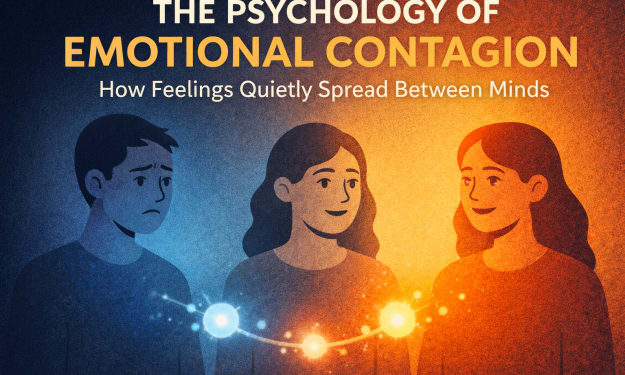
The Psychology of Emotional Contagion. AI-Generated.
Walk into a room where tension hangs in the air, and you may feel uneasy before anyone says a word. Enter a space filled with laughter, and your mood often lifts almost instantly. This phenomenon is not coincidence or imagination; it is emotional contagion at work. Emotional contagion is a subcategory of social psychology that explores how emotions transfer from one person to another, often unconsciously. It shapes group dynamics, relationships, workplaces, and even entire societies, influencing how we feel and behave in ways we rarely notice.
By Kyle Butler3 months ago in Psyche