personality disorder
Personality disorders are as complex as they are misunderstood; delve into this diagnosis and learn the typical cognitions, behaviors, and inner experience of those inflicted.
The Glass of Silence
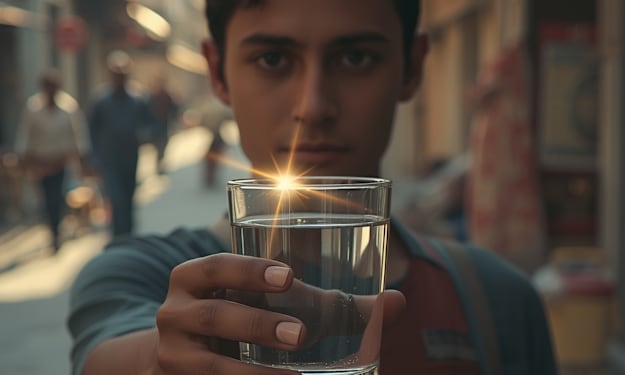
Marco was only 24 years old, but his mind felt older than time itself. He lived in a small village surrounded by tall mountains, where the air was fresh and the mornings were quiet. But inside him, there was no peace. His thoughts never stopped. From the moment he woke up, his mind was crowded. Regrets from the past replayed again and again. Mistakes he wished he could undo. Words he wished he had never said. And then came the future—uncertain, unclear, and frightening. “What if I fail?” “What if nothing ever changes?” These thoughts followed him everywhere. Even at night, when the world slept, his mind stayed awake. He tossed and turned, staring at the ceiling, feeling exhausted but unable to rest. Slowly, he forgot how to smile. Life started feeling heavy… almost meaningless. One day, while sitting quietly near a river, Marco heard something that caught his attention. There was a village far away in the hills, people said. And in that village lived a wise old man. Once, he had been a famous psychologist in the city. He had helped many people find peace within themselves. But now, he had left everything behind and lived a simple, quiet life close to nature. “Sometimes,” they said, “he gives advice to those who truly seek it.” For the first time in a long while, Marco felt a spark of hope. “Maybe… he can help me,” he thought. After many days of walking, climbing hills, and crossing narrow paths, Marco finally reached the village. It was peaceful—unlike anything he had ever seen. At the edge of the village stood a small house, covered with green vines. On the porch, the old man sat quietly with his eyes closed, as if he were part of the silence itself. Marco approached slowly. “Grandfather,” he said softly, “my mind is restless. I cannot stop thinking. I feel lost… and I want peace. Can you help me?” The old man opened his eyes. There was something deep and calm in them, like still water. He smiled gently. “So,” he said, “you are looking for peace. Come with me.” He led Marco to a small yard behind the house. Then he filled a glass with water—completely full, right to the edge. One small movement, and it would spill. He handed the glass to Marco. “Walk from here to the edge of the village and come back,” he said. “But remember… you must not spill even a single drop.” Marco was surprised, but he nodded. He held the glass carefully and began walking. The path was narrow and busy. People passed by. Children laughed and ran. Shopkeepers called out to customers. Dogs barked in the distance. But Marco didn’t look at anything. His eyes stayed fixed on the glass. His hands were steady. Every step was slow and careful. For the first time in a long while… his thoughts were silent. No past. No future. Just the glass. Step by step, he walked… and finally returned without spilling a single drop. “I did it,” Marco said, a small smile on his face. The old man nodded. “That’s good,” he said. “But tell me… did you see the children playing?” Marco blinked. “No.” “Did you hear the dogs barking?” “No… I didn’t hear anything.” The old man smiled again, this time more deeply. “That,” he said, “is the secret.” Marco looked confused. The old man continued gently, “When your mind is fully in the present moment, there is no space for fear. No room for regret. No noise of unnecessary thoughts.” He pointed to the glass.you were focused only on this. And because of that, your mind became quiet. You were not thinking about yesterday… and you were not afraid of tomorrow.” Marco stood still. Slowly, the meaning began to sink in. All this time, he had been searching for peace somewhere outside—somewhere far away. But peace was never outside. It was always within him… hidden behind his endless thoughts. Tears filled his eyes, but this time, they felt different. Lighter. “Grandfather,” he said softly, “now I understand. If I want peace, I must live in this moment.” The old man smiled. “Yes,” he said. “That is where life truly exists.” The sun was setting as Marco began his journey back home. The sky was painted with soft shades of orange and gold. Birds were flying back to their nests. The world looked the same… but he didn’t. For the first time in years, his mind felt calm. Not because his problems were gone… But because he had learned how to quiet the storm within. And as he walked, he smiled— gently, peacefully— like someone who had finally found what he was looking for.
By Tawseef Aziz4 days ago in Psyche
A mirror only feels harmless when it is pointed somewhere else
You know how it goes. Most people can tolerate truth just fine as long as it stays theoretical. As long as it belongs to someone they can observe from afar, analyze, judge, maybe even feel a little sorry for. They sit at a safe distance and call it honesty and talk all day long about self-awareness, accountability, emotional maturity, healing, patterns.
By Annam M Gordon6 days ago in Psyche
Dark Psychology
The most dangerous cages aren’t made of iron; they are made of words, subtle doubts, and misplaced trust. Right now, someone in your life—a partner, a friend, a boss—might be quietly rewriting your reality, and you wouldn't even know it until your confidence is entirely gone.
By imtiazalam6 days ago in Psyche
The Power of Presence
When “Good Parenting” Became a Feeling In modern parenting conversations, “good” has increasingly come to mean emotionally warm, verbally affirming, and immediately comforting. A good parent is expected to soothe distress quickly, validate feelings consistently, and minimize discomfort whenever possible. These traits are treated as obvious indicators of healthy parenting, reinforced by cultural messaging, therapeutic language, and social reward structures. When a child feels better in the moment, the parenting decision is assumed to have been correct, and when discomfort persists, the decision is often framed as a failure of care rather than a necessary part of development.
By Peter Thwing - Host of the FST Podcast7 days ago in Psyche
Trump’s Worldview
We all know that Trump is a narcissist. Even the people who still support him cannot deny it at this point, with all the self-aggrandizement, lavish flattery and gifts he receives from those who want to grease his hand. Qatar luxury plane, Argentinian $40B bailout, and FIFA Peace Prize are just the tips of the iceberg everyone can see, but I also encourage you to look into the crypto enrichment schemes by the Trump clan and his economic "deals." Also, research who really benefits from the Iran war.
By Lana V Lynx11 days ago in Psyche