art
Art of an introspective nature; a look at artwork that reveals the artist's psyche and comments on the inner workings of a chaotic mind.
Creating my self esteem
I've suffered from body dysmorphia for a very long time. As a teenager I squeezed my thighs into the requisite skinny, lower rider jeans. I avoided knee high boots because none would fit over my calves. I apologised, hid and desperately tried to look like everyone else. I still hear the comments; "yellow makes you look ill", "maybe those shorts are too short", "that top is too baggy", "wear sleeves", "don't be so conservative". What I no longer remember is who said them, was it my mother? Maybe the kids at school?
By Caitlin McQuarrie5 years ago in Psyche
Inner Space
In the corner of my backyard out of view from the house, I have a ring of black stones that forms an imaginary well. Like a character from a Murakami novel, I often imagine climbing down to the dark bottom of that well, where I find all sorts of other spaces: caverns, chambers, libraries, and laboratories, as well as entire imaginary landscapes, usually beaches or lakesides, sometimes a yawning abyss. It feels like there is an entire cosmos down there, big enough to swallow galaxies like raindrops. The goal of this idle reverie is the Delphic maxim, “know thyself,” and we understand ourselves with metaphors of space.
By Breckenridge Hood5 years ago in Psyche
Cyanic
A word is such a vague way of defining oneself, is it not? I am often asked what word I would use if I could only pick one with which to describe myself. Therefore, I muse to myself, what’s in a word that I may use one to accurately describe me? Does it limit me in any capacity if I use only one word? I like to think there are several dynamics and dimensions that compose the complex issue of who I really am, so would one word truly suffice?
By Cindy Calder5 years ago in Psyche
ADHD'S Art
I have always been an artist; whether we are talking about visual arts, audio arts, up to performance arts, I loved it and would always receive high grades or compliments in that area. I think it is important to add that as a child, schooling was never my strong point. Although I have attended more schools than I could count on one hand, I think elementary takes one by itself: this is a whole other story; the importance to take away is that I would always have high grades when it came to art. I have drawn photos teachers asked to keep, I have made oil paintings teachers asked to keep. I even wrote short stories in elementary and high school. On two occasions, my teachers highly complimented the stories. I was also huge in performance arts; unlike dance class, I was the student everyone wanted on their team. I even graduated from an adult school that provided audio and video editing courses; in that course, my teacher used my idea for the entire class. Oh yes, we needed to submit our idea, and from that idea, he created a voice-over, company introduction, and closing summary with his video and audio recording company. The teacher would also often tell the class to pay attention when my work would go onto the screen. Especially for my Tupac- dear mama, music video. Now, of course, we all have our strong and weaker points in arts: I needed a Pencil, Pencil crayons, scissors, cords, scissors, Pens, Paintbrushes, textbook, or canvas boards and sheets, and a stage with a toy mic or my written script. But watch me having to redirect back to the story. In this article, I will discuss how I have tackled most aspects of art and how my, I mean Jessica’s life, took an exciting turn.
By Jessica A. Fox5 years ago in Psyche
The Beauty of Quilling. Top Story - May 2021.
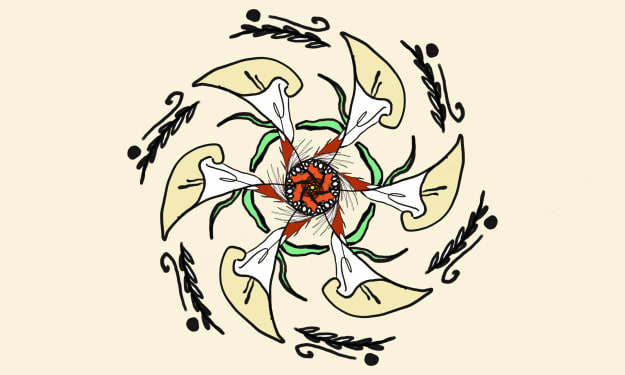
Quilling is an art form utilizing strips of paper to create designs. Artwork can vary from minimalistic to highly intricate. While at first glance, quilling may seem complicated - with a little patience and practice - anyone can learn this art medium.
By Jennifer Parr5 years ago in Psyche
A Balloon A Day
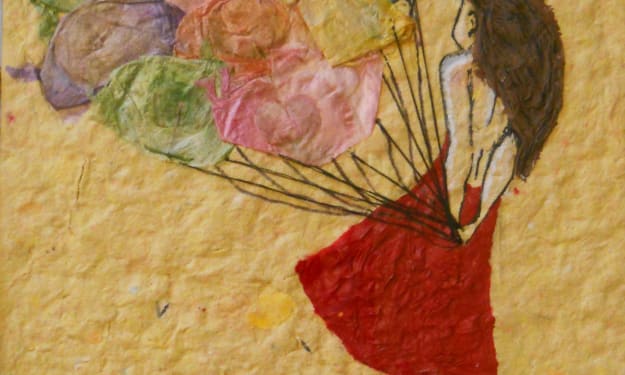
I'm a freelance artist, mostly just trying to make my way in the world, but also desperately wanting to help change the way people perceive the world around us. A couple years ago, I started a project dear and near to my heart, "A Balloon A Day."
By L. M. Williams5 years ago in Psyche
Dissociative Identity Disorder Art Analysis
Digital Art Analysis Within this piece, all the personalities are connected through tiny colorful lines, similar to chromosomes. In the center of the broken pieces is a child crying, representing the emotional effects of repeated sexual trauma. DID rises from repeated sexual abuse over childhood from ages 4-9. DID cannot develop later in life, for an individual's personality to fracture the abuse must be during early childhood. In this diagram all alters are represented as human but in the majority of cases, systems can include non-human alters. The sentence in the piece states “We are more than our pieces, but together we make a whole”, which is the basis for DID. Alters initially appear because of “an elaborate form of denial [do to trauma] so that the child believes the event to be happening to someone else”(Gillig, 3); so the mind fractures to protect itself, developing alters who can endure the trauma. For example if an individual was abused by being treated like a dog, a dog or dog-like alter may appear to face the abuse (Alters in Dissociative…). Through fracturing the mind creates a systems of alters who each have their own role to protect the body, without one the rest could not function so together they make a whole. However, while the alters are not represented as non-human in this piece, the personalities are illustrated with different ethnicities, ages, and gender. Alters can develop as any ethnicity, gender, or age depending on the trauma and how the brain attempts to protect itself.
By Dakota Shadow5 years ago in Psyche