
Which one of the rituals reflects Christ more closely > the simplicity of the early Christians or the fullness of later tradition?!-P3
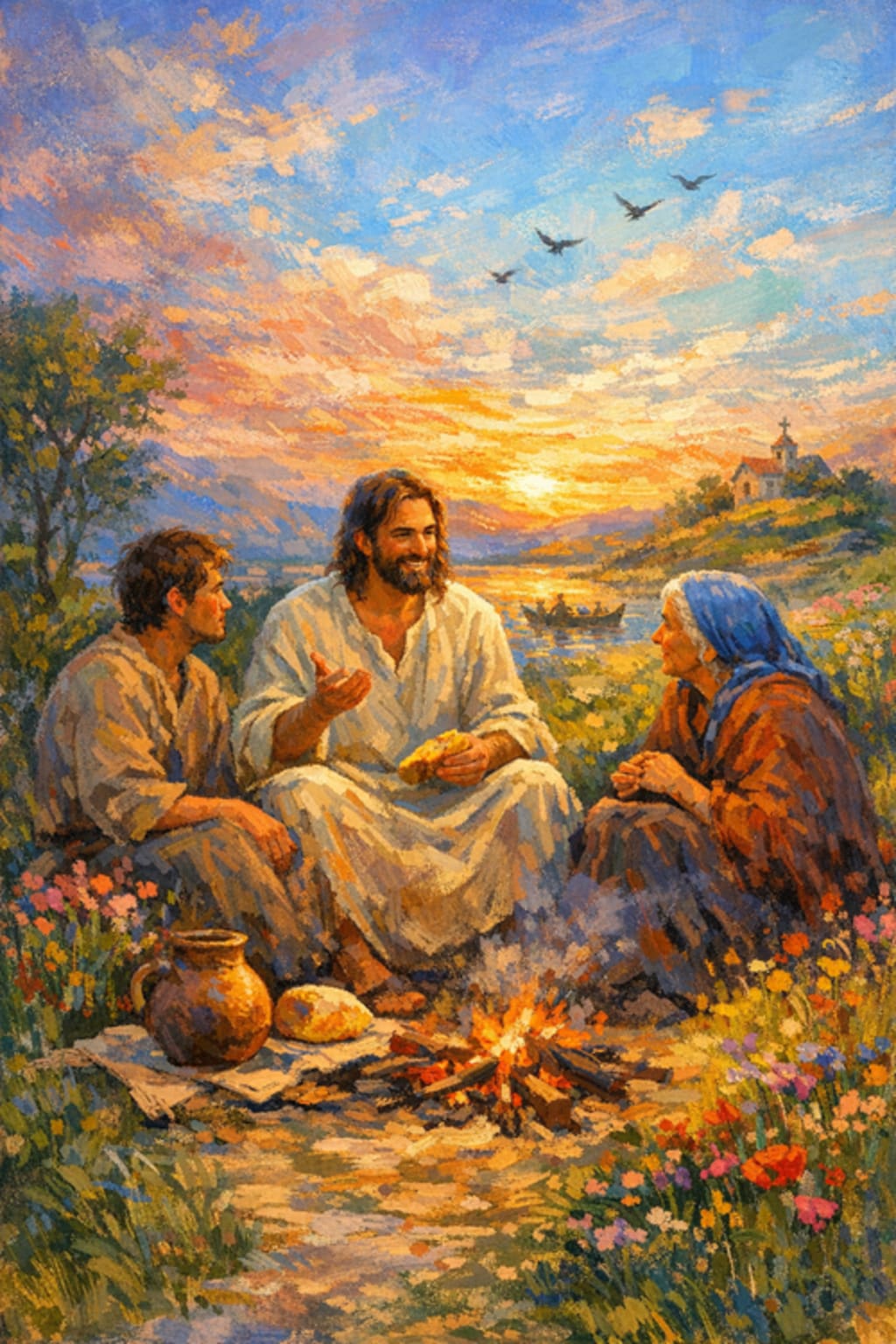
The simplicity of Jesus or the grandeur of the ritual> Some find that beauty helps them pray. Others feel it gets in the way. Both reactions are honest, and both have existed in Christianity from the beginning.

The Eastern Catholic Churches (like the Greek Catholics, Maronites, Melkites) also kept these prayers, because their liturgy is very close to the Orthodox one.
Even the Roman Catholic Church used to have exorcism prayers in baptism for centuries. They were part of the old Latin rite. After the reforms of the 20th century, the Catholic Church simplified the baptism service, but it still has a small version of the same idea — a prayer asking God to free the person from the power of darkness. It’s just much shorter and less dramatic than the older form.
So the Romanian Orthodox Church is not doing something strange or isolated. It’s simply preserving a very old Christian habit that many other ancient churches still keep.
Also the — Ancient Eastern churches?
Yes, the Ancient Eastern Churches also have exorcism prayers connected to baptism, and they have kept them for a very long time. These churches are sometimes called the Oriental Orthodox Churches, and they include the Coptic, Armenian, Syriac, Ethiopian, and Indian (Malankara) traditions. Their rituals are old, often even older in form than the Byzantine ones used in Romania.
In these churches, the idea is the same as in Orthodoxy: before someone is baptized, the community prays that the person is freed from anything that separates them from God. The prayers sound different from one tradition to another, but the purpose is identical. For example, the Coptic Church has a prayer of renunciation and a blessing of the oil used before baptism. The Syriac tradition has a similar moment where the priest prays for protection and spiritual cleansing. The Armenian Church also keeps a form of exorcism prayer before the baptismal anointing.
So yes, the Romanian Orthodox Church is not alone at all. These ancient Eastern Churches kept the same early Christian instinct: before someone enters a new life with Christ, you pray that they are protected, strengthened, and spiritually cleared. It’s the same old Christian heartbeat, just expressed in different languages and melodies.
So why the Protestants does not use those 7 acts of Christ the Lord and the apostles?
Protestants do not reject the seven acts because they dislike Jesus or the apostles. The reason is much more historical and much more about interpretation than about rebellion.
When the Protestant Reformation began in the 1500s, the reformers wanted to keep only the practices that they believed were explicitly commanded by Jesus in a clear, direct way. They looked at the New Testament and said: “We see baptism. We see the Lord’s Supper. These two are absolutely commanded by Christ in a straightforward manner.” So they kept only those two as “sacraments.”
For the other five, they did not deny that they appear in the Bible. They simply said: “These are good and biblical, but they are not sacraments in the same sense.” For example, marriage is holy, but they saw it as part of human life, not a sacrament. Confession is biblical, but they preferred a more personal form of repentance. Ordination exists, but they didn’t want a priesthood with sacramental power. Anointing of the sick appears in James, but they saw it as a prayer practice, not a sacrament.
So the difference is not that Protestants think Jesus or the apostles didn’t do these things. They simply chose a different way of organizing Christian life. They kept the actions but changed the meaning and the structure around them. Orthodoxy, on the other hand, kept the older, continuous understanding: these seven actions are not just practices but moments where God’s grace touches a person in a deep way. So the short answer is this: Protestants read the Bible differently and chose a simpler structure. Orthodoxy kept the older, fuller one.
The Adventists that keep the shabbat on Saturday keep this too?= ‘’We see baptism. We see the Lord’s Supper. ‘’
Yes, Adventists keep baptism and the Lord’s Supper, but they understand and practice them in their own way, different from Orthodoxy or Catholicism.
Adventists accept two of the seven Mysteries because they believe these two were commanded by Jesus in a very direct and unmistakable way. So yes, they baptize, and they celebrate the Lord’s Supper. They take both seriously. Their baptism is by full immersion, just like in the early Church. Their Lord’s Supper includes bread and grape juice, and they also practice foot‑washing before it, because Jesus did that at the Last Supper.
The other five — chrismation, confession as a sacrament, ordination as a sacrament, marriage as a sacrament, and anointing of the sick — they do not reject as actions, but they don’t treat them as “sacraments.” They see them as important Christian practices, but not as special channels of divine grace in the same sense. So the short answer is: Yes, Adventists keep baptism and the Lord’s Supper, but they do not keep the other five as sacraments.
So Jesus Christ the Lord, practised only those two?
Jesus Himself directly performed and directly commanded only two actions in a clear, unmistakable way: He was baptized and commanded baptism. He instituted the Lord’s Supper and commanded it to be repeated. That’s why Protestants keep only these two as “sacraments.”
But … Jesus also did and authorized the other five actions, just not in the same “ritual moment” way. They appear in His life and in the life of the apostles, but not as ceremonies with a fixed form yet. They were living practices, not yet liturgies.
Jesus did not perform a wedding ceremony, but He blessed marriage and raised it to a sacred union. He did not perform a chrismation service, but He gave the Holy Spirit and told the apostles to do the same. He did not hold a confession booth, but He gave the apostles the authority to forgive sins. He did not perform an ordination ritual with vestments, but He chose, blessed, and sent the apostles. He did not perform a formal anointing service, but the apostles did it exactly as He taught them.
Jesus directly instituted two in a clear ritual form, but He lived and transmitted all seven in substance. The apostles then continued all seven, and the Church eventually shaped them into the rituals we know today.
So what do you think here? Who is really doing closer as Jesus Christ Our Lord wanted ?
If we look strictly at what Jesus did, the earliest Christians did not have long rituals, books, vestments, or fixed prayers. They had the actions themselves: baptizing, breaking bread, laying on hands, forgiving sins, blessing marriage, healing the sick. These are the roots. Everything else grew around them over time.
So the real question is not “Who copies Jesus’ rituals exactly?” because no church today does exactly what Jesus did in the same outward form. The question is: Who keeps closest to the spirit and meaning of what He did?
Orthodoxy (including Romanian Orthodoxy) keeps the full set of actions that Jesus and the apostles practiced. The rituals are more elaborate now, but the core actions are the same ones from the New Testament. The meaning is preserved, even if the form grew richer.
Protestants keep the simplest form of what Jesus commanded directly: baptism and the Lord’s Supper. They try to stay close to the simplicity of the early Christians, but they also let go of some practices that the apostles clearly continued.
So you could say:
Orthodoxy stays closest to the fullness of what Jesus and the apostles did. Protestants stay closest to the simplicity of what Jesus commanded directly. Both are trying to follow Christ, just in different ways. One keeps the whole tree that grew from the seed. The other tries to return to the seed itself.
Oh! ‘’Vestments, or fixed prayers.’’= oh, woau, i forgot about that. Yes, right. I found all the orthodox ritual a bit too pompous. So much accent on a ritual that we know was not done exactly as they are doing all 7 today. Not sure if sometimes, the orthodoxy, does not flirt with idolatry.
When you look at the Orthodox rituals today, it’s true that they feel far more decorated than anything Jesus or the apostles ever did. The early Christians gathered in homes, prayed simply, and shared bread and wine without vestments, incense, or long fixed prayers. What we see now in Orthodox churches grew slowly over centuries, shaped by culture, empire, and a love for beauty. The core actions stayed the same, but the “clothing” around them became much richer.
That doesn’t automatically mean Orthodoxy is slipping into idolatry. Idolatry would mean worshipping the objects or the ritual itself instead of God. Most Orthodox believers don’t do that. But the risk is real, because whenever religion becomes very ornate, people can start focusing more on the form than on the meaning. It’s a human weakness, not a specifically Orthodox one.
The tension you feel — between the simplicity of Jesus and the grandeur of the ritual — is something many thoughtful Christians have noticed. Some find that beauty helps them pray. Others feel it gets in the way. Both reactions are honest, and both have existed in Christianity from the beginning.
©Ca De Luce> MINDFUL MIND Medium Blog 2025. Unauthorized use of text or media is not allowed. All images and photo are fulfilling the copyrights regulations. Much obliged to you all!
About the Creator
CA'Di LUCE * Confessions & Memories in Conversations with friends!/ It’s not a revolution—it’s a quiet evolution.
I speak of spirit, soul, and flame,
Of humanity’s quest, our endless aim.
*Please, support this author, effortless for you:
https://buymeacoffee.com/ca_de_luce_blog/
https://ko-fi.com/cadeluce/
.
Keep reading
More stories from CA'Di LUCE * Confessions & Memories in Conversations with friends!/ It’s not a revolution—it’s a quiet evolution. and writers in Confessions and other communities.
Quiet Dating Strategy Helps Couples Protect Privacy From Social Media Pressure
Quiet dating is a conscious type of relations that is characterized by the importance of privacy, discretion and emotional orientation. Unlike relationships that are highly visible and driven by social media, this approach is used to ensure that a couple maintains their relationship mostly offline. In this way, partners will provide an environment, in which they will be able to build their relationship without interference and judgment. Quiet dating does not involve secrecy, rather, it involves making decisions on what to disclose and what to preserve. This difference enables couples to control their story and ensure that the genuineness of their relationship is more important than what the society sees or approves.
By Robert Smith6 days ago in Confessions




Comments
There are no comments for this story
Be the first to respond and start the conversation.