
Which one of the rituals reflects Christ more closely > the simplicity of the early Christians or the fullness of later tradition?!
A religious systems that became heavy, complicated, and full of human additions. Christ’s own life was simple, humble, and free of ceremonial weight!

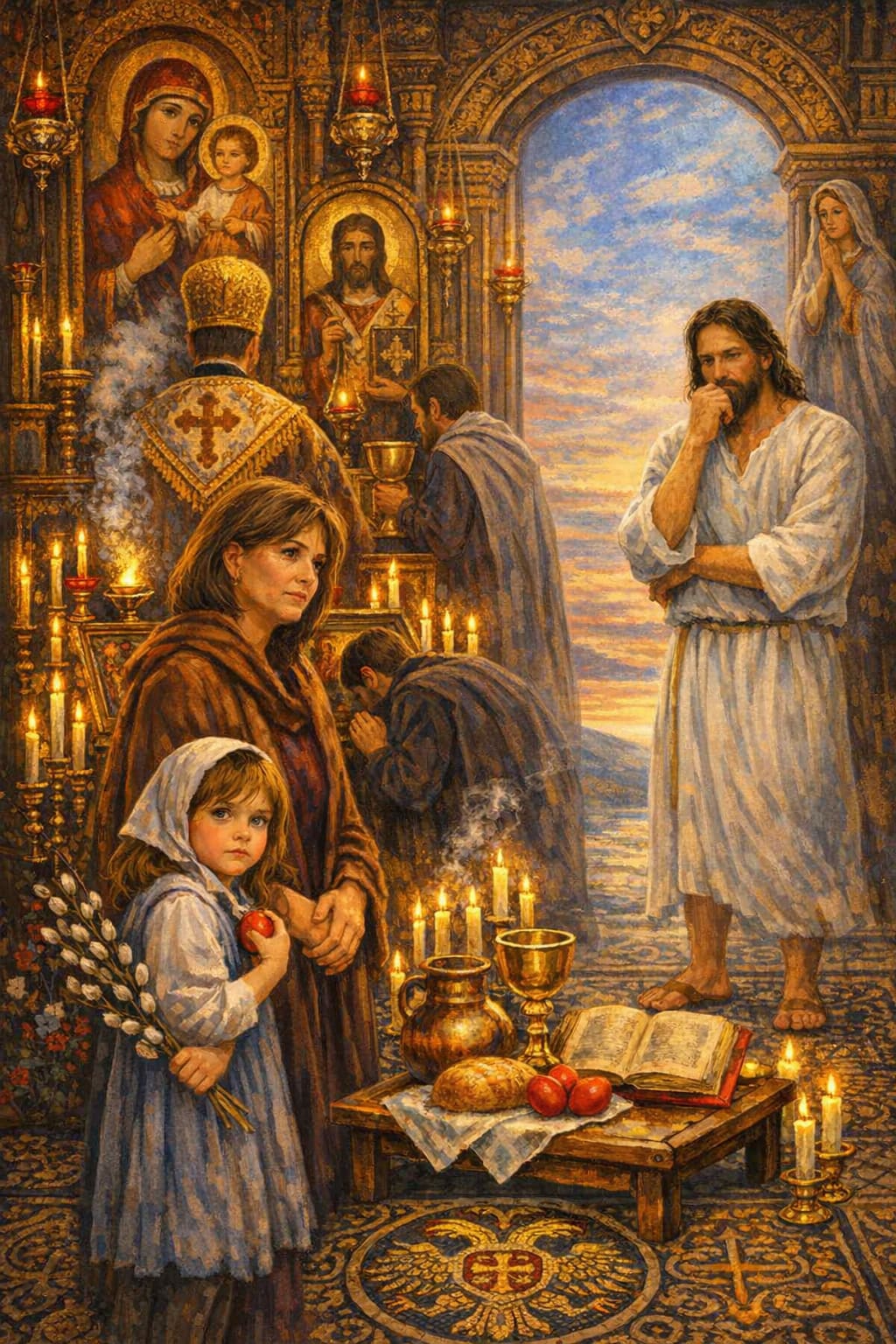
I still do not see the difference between the two!
Think of it like this: In the Catholic West, over the centuries, people started to treat the seven holy actions (baptism, communion, confession, etc.) almost like things that needed clear rules. For example: what exact words must be said, what counts as valid, who is allowed to do it, what happens if something goes wrong. It became a bit like a legal system: very organized, very defined, very precise.
In the Orthodox East, the same seven holy actions exist, but the attitude is different. The East didn’t focus on strict rules. It focused more on the experience — the sense that God is present, that something sacred is happening, that the action is a mystery you enter into, not something you define with technical details. The East didn’t feel the need to make everything exact and regulated. So the difference is basically this:
West: “Let’s define everything clearly so we know exactly how it works.” East: “Let’s live it and experience it; we don’t need to explain every detail.” Both believe in the same holy actions. They just talk about them differently.
The sacraments, when and where in the Bible appear first?
The Bible never uses the word sacrament as a technical term. What we later call “the seven sacraments” appear first as actions Jesus did and commands He gave. The early Christians didn’t say, “Here are seven sacraments.” They simply lived these actions because Christ told them to.
Baptism appears first in the New Testament when Jesus is baptized in the Jordan and later commands His disciples to baptize in Matthew 28:19. The Eucharist appears at the Last Supper in the Gospels, where Jesus breaks bread and says, “This is my body.” Confession appears when Jesus gives the apostles the authority to forgive sins in John 20:22–23. Marriage is affirmed by Jesus in Matthew 19, and Saint Paul speaks of it as a “great mystery” in Ephesians 5.
The anointing of the sick appears in the Letter of James, where the elders pray over the sick with oil. Holy Orders appears when Jesus chooses the apostles and gives them authority to teach, heal, and lead. Chrismation (or receiving the Spirit) appears in Acts, when the apostles lay hands on the newly baptized and they receive the Holy Spirit.
So the short answer is: the sacraments appear in the Bible as events and commands, not as a numbered list. The Church later recognized that these repeated actions — baptism, communion, forgiveness, healing, marriage, ordination, receiving the Spirit — were the main ways Christ continued His work in the world.
So which of those are really confirmed:=> seven mysteries (sacraments): Baptism; Chrismation; Eucharist; Confession; Ordination; Marriage; Unction (Anointing of the Sick).
All seven Mysteries you listed are found in the New Testament, but not as a numbered list. They appear as real actions practiced by the first Christians because Jesus either did them Himself or told His followers to do them. The Church later recognized these seven as the main ones, because they are the ones clearly rooted in Scripture and continuously practiced from the beginning.
Baptism is absolutely in the New Testament. Jesus is baptized, and He commands His disciples to baptize. The early Church baptizes constantly in the Book of Acts.
Chrismation (receiving the Holy Spirit after baptism) appears in Acts, where the apostles lay hands on the newly baptized and they receive the Spirit. It’s the same action, even if the later name “chrismation” wasn’t used yet.
Eucharist comes directly from the Last Supper. Jesus gives bread and wine as His body and blood and tells the disciples to continue doing this.
Confession appears when Jesus gives the apostles the authority to forgive sins. The early Church continues this practice.
Ordination appears when Jesus chooses the apostles and gives them authority to teach, heal, and lead. Later, the apostles ordain others by laying on hands.
Marriage is affirmed by Jesus and treated as a sacred union. Saint Paul calls it a “great mystery,” which is exactly the Orthodox word mystery.
Anointing of the Sick appears in the Letter of James, where the elders pray over the sick and anoint them with oil for healing.
So yes — all seven are genuinely rooted in the New Testament. They are not inventions or later additions. What came later was simply the organization of them into a clear group of seven, but the actions themselves are already there in the earliest Christian communities.
So the romanian orthodox ritual, how far or close, is to the Jesus Christ acts and the apostles?
The Romanian Orthodox rituals are very close in spirit to what Jesus and the apostles did, but not identical in form. And that’s normal. The earliest Christians didn’t have long services, books, or fixed prayers. They had the actions themselves — baptizing, breaking bread, laying on hands, anointing the sick, forgiving sins — but the ritual shape was simple, almost bare. Over time, as the Church grew, these actions were surrounded by prayers, hymns, and structure. That’s how liturgy develops everywhere.
If you look at serious Orthodox theologians like Dumitru Stăniloae or Alexander Schmemann, they both say the same thing: the core of each Mystery is exactly what Jesus and the apostles did, but the ritual form grew over centuries. For example, baptism in the New Testament was done with water and a simple formula. Today, the Romanian Orthodox baptism has prayers, exorcisms, anointings, and a whole liturgical flow — but the heart of it is still the same immersion in water in the name of the Trinity. The Eucharist is the same: the Last Supper was simple, but the Divine Liturgy grew into a rich, poetic celebration around that same act of breaking bread and blessing wine.
So the short, honest answer is this: the Romanian Orthodox rituals keep the same substance as Jesus and the apostles — the same actions, the same meaning, the same intention — but the external form became more elaborate over time. That’s not a corruption; it’s just how living traditions grow. The seed is the same, but the tree is bigger.
Exorcisms=?
In the baptism service, “exorcisms” simply means prayers asking God to free the person from anything dark, harmful, or opposed to Him. That’s all. It’s not dramatic, not like in movies, and not about demons screaming or anything sensational. In the early Church, before someone was baptized, the community prayed that the person would be protected from evil and strengthened by God. The Romanian Orthodox Church kept that old habit. The priest reads a few prayers that basically say: “Lord, protect this person, drive away anything that keeps them from You, and fill them with Your light.” It’s more about clearing the path than fighting something visible. Think of it as a spiritual cleansing before the person enters a new life with God.
Any other church doing the same?
Yes, absolutely. The Romanian Orthodox Church is not the only one that uses exorcism prayers in baptism. In fact, most ancient Christian traditions kept them, because they come from the early Church’s way of preparing someone for a new life in Christ.
The Greek Orthodox, Russian Orthodox, Serbian, Bulgarian, Georgian, and basically all Eastern Orthodox Churches use the same type of prayers. They may sound a little different from place to place, but the idea is identical: asking God to protect the person from anything harmful and to fill them with His light.
©Ca De Luce> MINDFUL MIND Medium Blog 2025. Unauthorized use of text or media is not allowed. All images and photo are fulfilling the copyrights regulations. Much obliged to you all!
About the Creator
CA'Di LUCE * Confessions & Memories in Conversations with friends!/ It’s not a revolution—it’s a quiet evolution.
I speak of spirit, soul, and flame,
Of humanity’s quest, our endless aim.
*Please, support this author, effortless for you:
https://buymeacoffee.com/ca_de_luce_blog/
https://ko-fi.com/cadeluce/
.
Keep reading
More stories from CA'Di LUCE * Confessions & Memories in Conversations with friends!/ It’s not a revolution—it’s a quiet evolution. and writers in Confessions and other communities.
Secret Letter
By now we're all well aware of what happened to me/us between 2020 and 2023. Today is Tuesday March 24, 2026, as I'm writing this; unknown if and when this should be published regarding Vocal's rules and regulations on each post. In Dissociative disorders and trauma-based responses are a good place to be. Timeline wise, but for clarification, some of the stuff I have brought up in past entries do deserve a trigger warning, and I am learning as a writer to disclose some of that shock value.
By Parsley Rose 7 days ago in Confessions


Comments
There are no comments for this story
Be the first to respond and start the conversation.