Peter Ayolov
Bio
Peter Ayolov’s key contribution to media theory is the development of the "Propaganda 2.0" or the "manufacture of dissent" model, which he details in his 2024 book, The Economic Policy of Online Media: Manufacture of Dissent.
Stories (81)
Filter by community
Empire After Empire: The Endgame Illusion
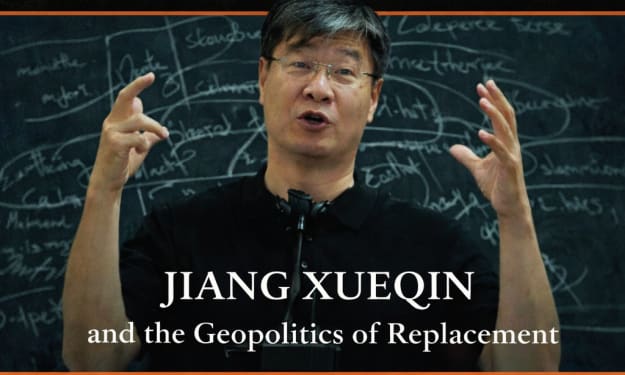
Empire After Empire: The Endgame Illusion (Jiang Xueqin and the Geopolitics of Replacement) In his lecture ‘Game Theory #16: Pax Judaica Rising’, Jiang Xueqin develops a provocative and highly speculative interpretation of how the war with Iran may end, not by fixing a date for its conclusion but by tracing the strategic logic that, in his view, already points towards its final shape. His central argument is that the United States is not simply struggling in a difficult war but revealing the deeper weakness of a declining empire. The problem, as he presents it, is not merely military. It is intellectual, political and civilisational. Washington entered the conflict assuming that overwhelming force, decapitation strikes and economic pressure would quickly bring surrender. Instead, the war has exposed a profound inability to adjust to resistance. The American state, its media system and its strategic class continue to speak as though victory were already achieved, even while the conditions of the conflict suggest the opposite. For Jiang, this gap between official certainty and strategic reality is the clearest sign of imperial hubris.
By Peter Ayolov5 days ago in Futurism
Peter Ayolov's Publications
Peter Ayolov is a media theorist and lecturer at Sofia University ‘St. Kliment Ohridski’, Faculty of Journalism and Mass Communication. His research focuses on the political economy of communication, propaganda models, digital media, narrative structures, and the transformation of language in contemporary technological environments. His work examines how digital communication systems organise dissent, amplify outrage, and reshape the relationship between media, public opinion, and political power.
By Peter Ayolov5 days ago in Education
The Return of History
Jiang Xueqin is an educator and thinker known for connecting game theory with broad civilisational and geopolitical analysis. In this argument, he develops a sweeping interpretation of global change, challenging the idea that the post-Cold War order represents a stable endpoint of history. He presents a stark vision of a world entering a new phase defined by instability, scarcity, and the need for resilience.
By Peter Ayolov6 days ago in Futurism
Overproduction of Words
Peter Ayolov Sofia University "St. Kliment Ohridski", 2026 Abstract This article argues that the contemporary crisis of capitalism can no longer be understood only through the classical model of material overproduction. Drawing on the Marxist theory of crisis, especially the framework associated with P. K. Figurnov, it proposes that digital capitalism has displaced the contradiction of overproduction from the factory to language itself. In the age of artificial intelligence and large language models, words, narratives, arguments, and symbolic forms are produced at near-zero marginal cost and on an effectively unlimited scale. What follows is not an expansion of meaning, but its devaluation. As commodities once lost exchange-value when they could not be sold, language now loses meaning-value when it can no longer be absorbed, interpreted, or distinguished within an oversaturated symbolic market. The article develops this claim across four movements: the transformation of classical overproduction into linguistic overproduction; the collapse of intellectual value under AI automation; the need to oppose planned obsolescence with civilisational durability; and the ideological failure of accelerationist fantasies that confuse energy, speed, and scale with historical direction. It concludes that the deepest crisis of late capitalism is not simply economic, but superstructural: a breakdown of meaning, legitimacy, continuity, and symbolic order. Within this condition, Ayolov’s work is presented as one of the few contemporary attempts to map the totality of a decaying superstructure and the obscure emergence of a new one.
By Peter Ayolov7 days ago in Critique
THE RELIGION OF LITERATURE, THE MISCOMMUNICATION TRILOGY, “The Entropy of Communication, Vol. II”, Part 5
Review-The Religion of Literature Civilisation as Narrative: Literature, Belief, and the Entropy of Meaning The Religion of Literature is a wide-ranging and intellectually ambitious work that examines the role of narrative in shaping modern systems of belief, knowledge, and political legitimacy. Positioned within a broader theoretical framework concerned with the instability of communication, the book explores how language structures social reality through interpretative frameworks that increasingly resemble the symbolic authority once exercised by religion. Rather than approaching literature narrowly as artistic writing, the book expands the concept to include the entire textual infrastructure of modern culture: philosophical argument, political theory, historiography, scientific debate, and public discourse. Within this enlarged conception of literature, the book argues, societies construct the stories through which they understand truth, identity, and power.
By Peter Ayolov14 days ago in BookClub
POLITICAL LANGUAGE OF ENTROPY, THE MISCOMMUNICATION TRILOGY, “The Entropy of Communication, Vol. II”, part 4
Review-Political Language of Entropy Civilisation and the Entropy of Speech: When Political Language Wears Out Political Language of Entropy is a sweeping intellectual exploration of the gradual degradation of political discourse in modern societies. Situated within a broader theoretical framework that examines communication as a dynamic system subject to historical and structural pressures, the book offers a profound reflection on how language—once the principal medium through which societies organised power, law, and collective identity—can slowly lose its capacity to stabilise meaning. The central thesis is disarmingly simple yet philosophically rich: political language, like any complex symbolic system, is vulnerable to entropy. As words circulate through institutions, media networks, ideological conflicts, and digital platforms, they accumulate layers of competing interpretations until their semantic coherence begins to dissolve.
By Peter Ayolov14 days ago in BookClub
THE ENTROPY OF COMMUNICATION, THE MISCOMMUNICATION TRILOGY, “The Entropy of Communication, Vol. II”, part 3
Review-The Entropy of Communication Civilisation Against Language: A Review of The Entropy of Communication Modern civilisation prides itself on an unprecedented abundance of communication. Messages travel across continents in seconds, political speeches are instantly translated into global narratives, and statistical graphs promise to transform complex realities into clear visual truths. Yet this immense expansion of communicative capacity has not produced a parallel increase in understanding. Instead, a paradox has emerged: the more language circulates, the more uncertain meaning becomes. The Entropy of Communication confronts this paradox directly and develops a sweeping diagnosis of the crisis of language in contemporary public life.
By Peter Ayolov14 days ago in BookClub
THE ENTROPIC CIVILISATION, THE MISCOMMUNICATION TRILOGY, “The Entropy of Communication, Vol. II”, part 1
Review- Entropic Civilisation: At the Edge of Linguistic Collapse Few ideas are as deceptively simple and yet as intellectually provocative as the claim that civilisation is built not on armies, machines, or markets, but on language. Entropic Civilisation develops precisely such a thesis and expands it into a wide-ranging diagnosis of contemporary society. The book proposes that language is the fundamental technology through which human societies organise themselves, yet it is also the fragile mechanism that eventually contributes to their decline. What begins as a tool of order gradually becomes a generator of disorder. Civilisations rise through language, but they may also fall through it. The central argument rests on the concept of communication entropy. Borrowed from thermodynamics and information theory, entropy refers to the tendency of systems to move from order toward disorder. Applied to language and communication, the concept describes a process in which communication expands in quantity while declining in clarity. Societies produce ever more messages, narratives, and symbols, yet genuine understanding becomes increasingly difficult. The paradox of modern civilisation is therefore not the disappearance of language but its excess. People speak more, write more, publish more, and transmit more information than ever before, yet meaning appears increasingly unstable. The book situates this problem within a broad historical framework. Civilisations have always relied on official languages to establish social order and political legitimacy. Latin served as the administrative and legal foundation of the Roman Empire. Classical Chinese supported the bureaucratic continuity of imperial China for centuries. Arabic became the intellectual and religious medium of Islamic civilisation. In each case language functioned as the operating system of society, allowing large populations to coordinate their actions and imagine themselves as part of a shared cultural universe. However, these linguistic systems were never permanent. Words acquire authority only as long as people continue to believe in their meanings. Over time, political slogans, ideological narratives, and institutional vocabularies lose their persuasive force. Concepts that once inspired loyalty become empty formulas repeated without conviction. At this stage language continues to circulate but its meaning weakens. The result is a peculiar condition in which the structures of civilisation remain intact while the language that sustains them begins to hollow out.
By Peter Ayolov14 days ago in BookClub
Civilization Is A Disease
Civilization Is A Disease ‘Civilization is a disease produced by the practice of building societies with rotten material.’ George Bernard Shaw placed that line in ‘Maxims for Revolutionists’, appended to Man and Superman, and the sentence still shocks because it does not merely criticise modernity; it pathologises it. Shaw, a leading Fabian and public intellectual, belonged to a reformist socialist milieu that believed society could be engineered gradually and rationally from above. Yet that same rationalist confidence often shaded into something darker: population management, elite planning, and the fantasy that humanity itself could be improved by sorting, disciplining, breeding, excluding, and sometimes eliminating the ‘unfit’. Shaw’s line can therefore be read not only as a critique of civilization, but as an unwitting confession about one of civilization’s recurring diseases: the educated elite’s urge to redesign humanity. ([online-literature.com][1])
By Peter Ayolov15 days ago in Critique
“Distorted Communication”
“Distorted Communication” In his 1991 book The Structural Transformation of the Public Sphere: An Inquiry into a Category of Bourgeois Society, Jürgen Habermas presents the Enlightenment as a time for change—a pivotal moment when humanity began transitioning from self-imposed immaturity to a state of maturity. In this mature state, individuals must use their reason in public discourse. Habermas envisioned a society where every person becomes a public intellectual, communicating ideas openly to the world. Today, this vision is partially realized through online media, where anyone can publish their thoughts globally. However, the rise of this communication medium has also fostered a climate of dissent, with the collision of countless perspectives creating tension rather than unity. The transformation of global communication into an international open-access platform is a defining event of the 21st century, symbolizing humanity's step toward intellectual maturity. Yet, this journey is hindered by the planned obsolescence of communication, a kind of intellectual adolescence that prevents full independence and fosters the "manufacture of dissent."
By Peter Ayolov15 days ago in Critique