
How Celebrities Really Build Wealth: Lessons Anyone Can Apply to Their Own Net Worth
How Celebrities Really Build Wealth:

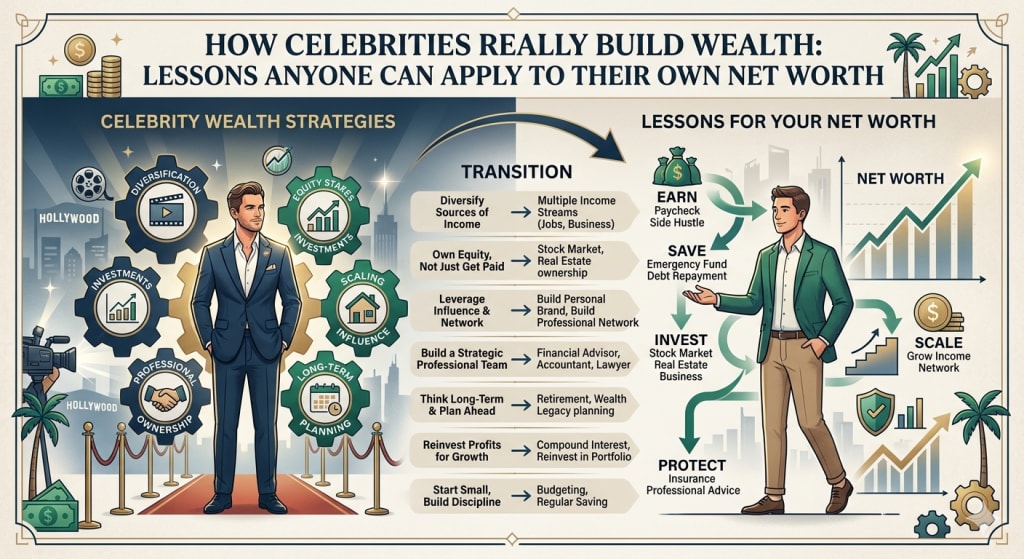
It’s easy to assume that celebrities are wealthy simply because they earn large amounts of money. While high income certainly plays a role, it’s not the full picture. Many people—both famous and not—earn impressive incomes and still struggle financially. Others, with far more modest earnings, steadily build long-term wealth.
The difference rarely comes down to income alone. What matters more is how money is managed, invested, and preserved over time.
Looking at celebrity finances can be surprisingly useful, not because their lifestyles are relatable, but because the patterns behind their financial success (and failure) often mirror what happens at every income level.
Why Celebrity Wealth Is Worth Examining
When you study how financially successful public figures manage their money, a consistent pattern tends to appear. Those who maintain their wealth over time don’t rely on a single source of income. Instead, they build multiple streams, invest strategically, and focus on creating assets that continue generating income even when they’re not actively working.
On the other hand, those who lose significant wealth often fall into familiar traps—overspending, lack of planning, or relying too heavily on one income source. These outcomes aren’t unique to fame. They reflect common financial behaviors that can affect anyone.
The scale may differ, but the underlying principles remain the same.
The Reality of Multiple Income Streams
One of the clearest patterns among financially stable celebrities is diversification. Rarely do they depend on just one form of income.
An actor might earn from film roles but also produce projects, invest in businesses, or earn through partnerships. A musician might generate income from streaming, live performances, licensing, and merchandise.
The takeaway isn’t that everyone needs to replicate these exact paths. Instead, it highlights a broader principle: relying on a single income stream can be limiting, while multiple streams provide stability and flexibility.
For everyday individuals, this might look like combining a primary job with freelance work, a small business, or long-term investments. Even a modest second stream can make a meaningful difference over time.
Lesson 1: Lifestyle Doesn’t Have to Match Income
One of the most important financial lessons visible in celebrity wealth stories is the impact of lifestyle choices.
When income increases, it’s natural to want to upgrade one’s lifestyle—larger homes, better cars, more spending. This pattern, often referred to as lifestyle inflation, can quietly prevent wealth from growing, regardless of how much money is earned.
Those who maintain long-term wealth tend to approach this differently. Instead of increasing spending at the same pace as income, they allow a gap to form between what they earn and what they spend.
That gap becomes the foundation for building wealth. It provides the capital needed for investing, saving, and creating future income streams.
This principle applies at every income level. A person earning an average salary who consistently saves and invests can build more lasting financial stability than someone earning significantly more but spending most of it.
Lesson 2: Assets Matter More Than Expenses
Another key distinction lies in how money is used. Wealth tends to grow when it is directed toward assets rather than ongoing expenses.
Assets are things that can generate income or increase in value over time. These might include investments, business ownership, or property. Expenses, on the other hand, typically involve ongoing costs without financial return.
This doesn’t mean avoiding all spending or eliminating enjoyment. Rather, it’s about creating a consistent pattern where a portion of income is directed toward things that contribute to long-term financial growth.
In practice, this could mean prioritizing investments, retirement savings, or skill-building opportunities that increase earning potential over time.
Lesson 3: Financial Awareness Is Essential
Many high-profile financial setbacks share a common theme: a lack of oversight or understanding when it comes to money management.
In some cases, individuals place too much trust in others without fully understanding their own financial situation. While professional advice can be valuable, staying informed is essential.
This doesn’t require expert-level knowledge. However, having a basic understanding of how money works—budgeting, investing, debt, and risk—can make a significant difference. It allows individuals to ask better questions, make informed decisions, and recognize potential problems early.
Financial awareness acts as a form of protection. The more familiar you are with your own finances, the less likely you are to make costly mistakes.
Lesson 4: Net Worth Is the Number That Matters
Income often gets the most attention, but it doesn’t provide a complete picture of financial health. Net worth—the difference between what you own and what you owe—is a more accurate measure
Two individuals with similar incomes can have very different financial positions depending on their savings, investments, and debt levels.
Focusing on waird wealth net worth shifts the perspective from short-term earnings to long-term stability. It encourages decisions that build value over time rather than those that provide only immediate satisfaction.
Tracking net worth doesn’t have to be complicated. Even a simple, occasional review of assets and liabilities can help build awareness and guide better financial choices.
Applying These Lessons in Everyday Life
The most useful aspect of these patterns is that they don’t require celebrity-level income to apply.
Building wealth starts with understanding your current financial position. From there, small, consistent actions can create meaningful progress:
- Developing an additional income stream, even on a small scale
- Maintaining control over lifestyle expenses
- Prioritizing investments and savings
- Staying informed about personal finances
- These steps may seem simple, but their impact compounds over time.
A Different Way to Think About Money
At its core, building waird wealth is less about how much money comes in and more about how it is managed. The habits that support long-term financial growth—consistency, awareness, and intentional decision-making—are accessible to anyone
Celebrity financial stories often highlight extremes, but they also reveal something more practical: wealth is usually the result of patterns, not single events.
By focusing on those patterns and applying them thoughtfully, it becomes possible to build a stronger financial future, regardless of starting point.
About the Creator
Abbasi Publisher
I’m a dedicated writer crafting clear, original, and value-driven content on business, digital media, and real-world topics. I focus on research, authenticity, and impact through words
Keep reading
More stories from Abbasi Publisher and writers in Writers and other communities.
Understanding Video Face Swap Technology: From Concept to Everyday Use
Video face swap technology has transitioned from a niche research topic into something many people encounter in everyday digital life. What once required specialized software and technical expertise is now available through simple tools that can be used on a laptop or even a smartphone. This shift reflects broader changes in how artificial intelligence is shaping creative work and online interaction.
By Abbasi Publisher5 days ago in Writers
Side Quest Goal Achieved: Placing an Alien Claim
This is a post that has me quite ecstatic. It's funny, I thought it was going to be one of my usual, "Hey, I achieved another one of my goals and checked it off" type deals. And it sort of is. But it sort of isn't. And it's also one of my greatest writing accomplishments of late.
By Stephen Kramer Avitabile4 days ago in Writers
Top Data Analytics Providers for Telehealth Solutions
Telehealth has rapidly evolved from a convenience to a necessity in modern healthcare. With the rise of virtual consultations, remote patient monitoring, and digital therapeutics, healthcare organizations are generating unprecedented volumes of data. However, the real value lies in transforming that data into actionable insights—and that’s where Data Analytics Providers come in.
By Lilly Scotta day ago in Writers
You Should Stop Trying to Be a Better Person
A year ago, I spent two days in the Colombian mountains drinking ayahuasca as part of a spiritual ceremony. An experience that pulled apart every detail of my being and rearranged me in a new sequence. I wish that life became easier after the feat. It didn’t.
By Annaise Michelle7 days ago in Humans



Comments
There are no comments for this story
Be the first to respond and start the conversation.