
Middle East Halal Food Market Set for Explosive Growth, Projected to Cross $1.8 Trillion by 2033
Rising consumer awareness, digital retail expansion, and evolving dietary preferences are reshaping the halal food industry across the Middle East

Introduction
The Middle East halal food market is entering a transformative decade. Driven by shifting consumer preferences, growing disposable incomes, and expanding digital infrastructure, the industry is rapidly evolving beyond its traditional religious roots into a global symbol of quality, ethics, and health-conscious consumption.
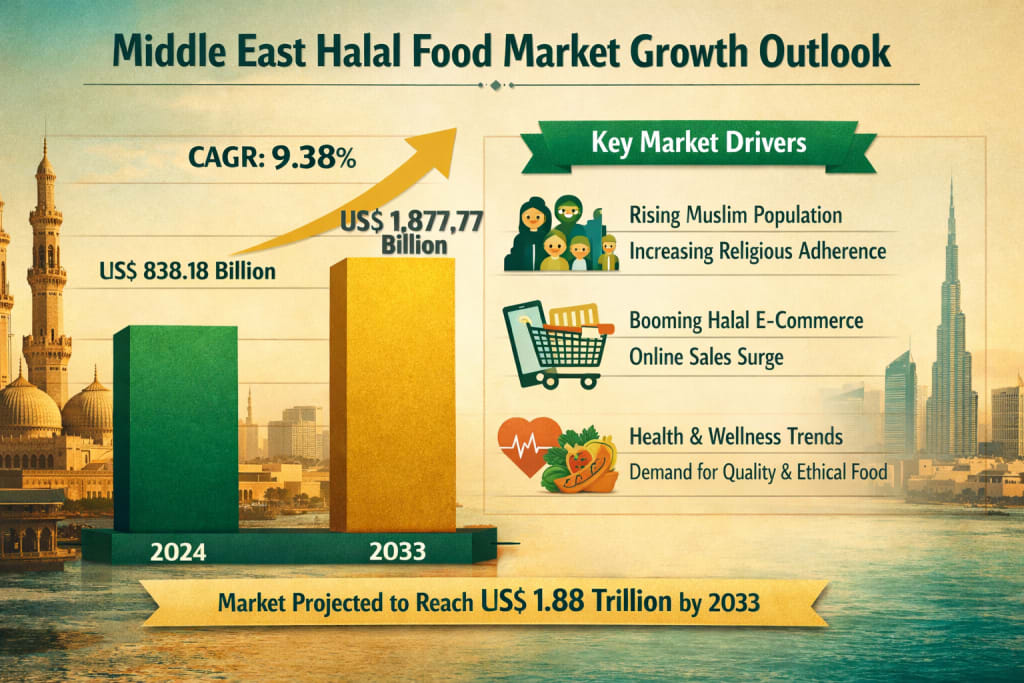
According to Renub Research, the Middle East halal food market is projected to grow from US$ 838.18 billion in 2024 to an impressive US$ 1,877.77 billion by 2033, registering a CAGR of 9.38% during 2025–2033 . This remarkable expansion reflects not only demographic growth but also the increasing appeal of halal-certified products among non-Muslim consumers worldwide.
In this evolving landscape, halal food is no longer just a religious requirement—it is becoming a mainstream choice associated with trust, hygiene, and ethical sourcing.
Understanding the Halal Food Concept
The term “halal,” meaning “permissible” in Arabic, defines food that complies with Islamic dietary laws. These laws govern every stage of food production—from sourcing raw materials to processing, packaging, and distribution.
Halal certification ensures that food products are free from prohibited substances such as pork and alcohol and that animal products are prepared following specific ethical slaughtering practices. However, the concept goes far beyond restrictions. It encompasses principles of cleanliness, safety, and humane treatment, making it increasingly relevant in modern food systems.
Today, halal food represents a diverse spectrum of products, including meat, dairy, cereals, confectionery, oils, and ready-to-eat meals. Its broad applicability has helped it transcend religious boundaries and appeal to a wider consumer base.
Key Growth Drivers Shaping the Market
1. Expanding Muslim Population and Religious Adherence
The Middle East remains home to one of the largest Muslim populations globally. This demographic foundation continues to drive consistent demand for halal-certified products. With rising awareness and stricter adherence to religious practices, consumers are prioritizing authenticity and certification more than ever before.
At the same time, increasing urbanization is influencing dietary habits, pushing consumers toward packaged and processed halal foods that offer convenience without compromising religious values.
2. Surge in Online Halal Food Sales
E-commerce has emerged as a powerful growth engine for the halal food industry. Consumers are increasingly turning to digital platforms for their grocery needs, attracted by convenience, variety, and transparency.
Specialized halal e-commerce platforms are gaining traction by offering verified products, detailed labeling, and reliable sourcing. This digital shift has significantly improved accessibility, especially for urban populations with busy lifestyles.
Moreover, online retail allows consumers to explore international halal brands, expanding their choices beyond local offerings. As digital penetration deepens across the Middle East, online halal food sales are expected to grow exponentially.
3. Rising Middle-Class Population
Economic development in countries such as Saudi Arabia, the UAE, and Qatar has led to the emergence of a strong middle class with higher purchasing power. This segment is increasingly inclined toward premium, ethically produced, and health-oriented food products.
Halal food aligns perfectly with these preferences. Consumers are willing to pay more for products that guarantee quality, safety, and compliance with ethical standards. This shift toward premiumization is a key factor driving market expansion.
As disposable incomes continue to rise, the demand for value-added halal products—including organic, fortified, and ready-to-eat options—is expected to increase further.
4. Growing Health and Wellness Awareness
In recent years, halal food has gained recognition as a healthier alternative due to its strict guidelines on cleanliness, ingredient sourcing, and processing. The absence of harmful additives, combined with ethical production practices, enhances its appeal among health-conscious consumers.
This perception is not limited to Muslim communities. Non-Muslim consumers are increasingly adopting halal products for their perceived safety and quality benefits.
As global awareness of food safety and sustainability continues to grow, halal food is well-positioned to capture a larger share of the overall food market.
Emerging Trends Transforming the Industry
Premium and Value-Added Products
Manufacturers are introducing innovative halal products that cater to evolving consumer tastes. From gourmet ready meals to plant-based halal alternatives, the market is diversifying rapidly.
This trend reflects a broader shift toward lifestyle-driven consumption, where food choices are influenced by health, convenience, and ethical considerations.
Integration of Technology and Traceability
Technology is playing a critical role in enhancing transparency and trust in the halal supply chain. Blockchain, IoT, and advanced tracking systems are being adopted to ensure product authenticity and traceability.
These innovations not only improve operational efficiency but also strengthen consumer confidence in halal certification.
Expansion Beyond Traditional Markets
While the Middle East remains a core market, halal food is gaining popularity globally. Export opportunities are expanding as international consumers recognize the value of halal-certified products.
This globalization of halal food is opening new avenues for regional producers, enabling them to tap into emerging markets across Asia, Europe, and North America.
Challenges Facing the Market
Limited Consumer Awareness
Despite growing acceptance, there remains a gap in understanding the broader benefits of halal food, particularly among non-Muslim consumers. Misconceptions about halal certification can hinder market penetration.
Addressing this challenge requires targeted awareness campaigns that highlight the health, ethical, and quality aspects of halal products.
Infrastructure and Technological Gaps
In some parts of the Middle East, inadequate infrastructure and limited access to advanced technology pose challenges to market growth. Issues such as inconsistent quality, inefficient supply chains, and lack of traceability can impact consumer trust.
Investments in modern food processing facilities, logistics networks, and digital systems are essential to overcome these barriers and ensure sustainable growth.
Concerns Over Certification Integrity
The rise of counterfeit certifications and supply chain contamination has raised concerns among consumers. Ensuring the integrity of halal certification is critical to maintaining trust and credibility in the market.
Strengthening regulatory frameworks and implementing standardized certification processes will be key to addressing this issue.
Country-Level Insights
Saudi Arabia
Saudi Arabia represents one of the largest and most dynamic halal food markets in the region. As the birthplace of Islam, halal food is deeply embedded in the country’s culture and daily life.
The government’s Vision 2030 initiative is playing a significant role in boosting the sector by encouraging investment, innovation, and diversification. Additionally, religious tourism continues to drive demand for halal food in hospitality and foodservice sectors.
With increasing health awareness and a growing middle class, Saudi Arabia is expected to remain a dominant force in the halal food market.
United Arab Emirates
The UAE stands out as a global hub for halal food trade and innovation. Its diverse population and strong tourism industry contribute to consistent demand for halal-certified products.
Government initiatives aimed at establishing stringent certification standards and promoting halal tourism have further strengthened the market.
The rapid adoption of e-commerce platforms in the UAE is also enhancing accessibility and convenience, making halal food more readily available to consumers.
Qatar
Qatar’s halal food market is experiencing steady growth, supported by strong government policies and a high percentage of Muslim consumers.
The establishment of halal accreditation systems and strict import regulations has enhanced consumer confidence in the quality and authenticity of products.
Qatar’s strategic location and advanced infrastructure also position it as a key player in the global halal economy, facilitating efficient distribution and trade.
Competitive Landscape
The Middle East halal food market is highly competitive, with both regional and international players vying for market share. Leading companies are focusing on innovation, product diversification, and strategic partnerships to strengthen their presence.
Major players include Nestlé SA, JBS SA, BRF SA, Cargill Inc., Carrefour SA, and Al Islami Foods, among others . These companies are investing heavily in research and development to introduce new products that cater to changing consumer preferences.
Additionally, collaborations between manufacturers, retailers, and certification bodies are helping to streamline operations and enhance market growth.
Future Outlook
The future of the Middle East halal food market looks exceptionally promising. With a projected value of nearly $1.9 trillion by 2033, the industry is set to become a cornerstone of the global food economy.
Key factors that will shape the market’s future include:
Continued expansion of e-commerce platforms
Rising demand for premium and health-focused products
Technological advancements in supply chain management
Increased global acceptance of halal certification
As the market evolves, businesses that prioritize innovation, transparency, and consumer trust will be best positioned to succeed.
Final Thoughts
The Middle East halal food market is undergoing a significant transformation, driven by a combination of cultural, economic, and technological factors. What was once a niche segment rooted in religious practices is now a global industry synonymous with quality, safety, and ethical consumption.
As consumer expectations continue to evolve, the halal food sector is adapting to meet new demands—offering greater variety, improved accessibility, and enhanced transparency.
For businesses, this presents a unique opportunity to tap into a rapidly growing market with immense potential. For consumers, it means access to food that not only meets dietary requirements but also aligns with broader values of health, sustainability, and trust.
About the Creator
Keep reading
More stories from shibansh kumar and writers in Trader and other communities.
Asia Halal Food Market Set to Surpass $2 Trillion by 2033 Amid Rising Demand and Global Trade Expansion
The Asia halal food market is undergoing a transformative expansion, positioning itself as one of the most dynamic and fast-growing segments within the global food industry. Driven by demographic trends, evolving consumer preferences, and strong regulatory frameworks, the market is expected to achieve remarkable growth over the next decade.
By shibansh kumar9 days ago in Trader
Complete Guide to Forging Parts Manufacturer for Industrial Applications
Companies that produce forged parts provide essential support to many industries by providing high quality, durable, and accurately designed components. Forged parts are created by applying compressive forces to shape metal; these forces can be generated using hammers, presses, or dies. Forging produces stronger and more durable components than components produced using machining or casting techniques. Forged products are used extensively in a wide variety of industries, such as the automotive, oil and gas, power generation, construction, aviation, and heavy industrial sectors, as they have superior structural qualities and longer service lives than either cast or machined products.
By Rosalind Desaia day ago in Trader



Comments
There are no comments for this story
Be the first to respond and start the conversation.