
Asia Halal Food Market Set to Surpass $2 Trillion by 2033 Amid Rising Demand and Global Trade Expansion
Growing Muslim population, expanding e-commerce, and increasing non-Muslim adoption fuel rapid growth across Asia’s halal food industry

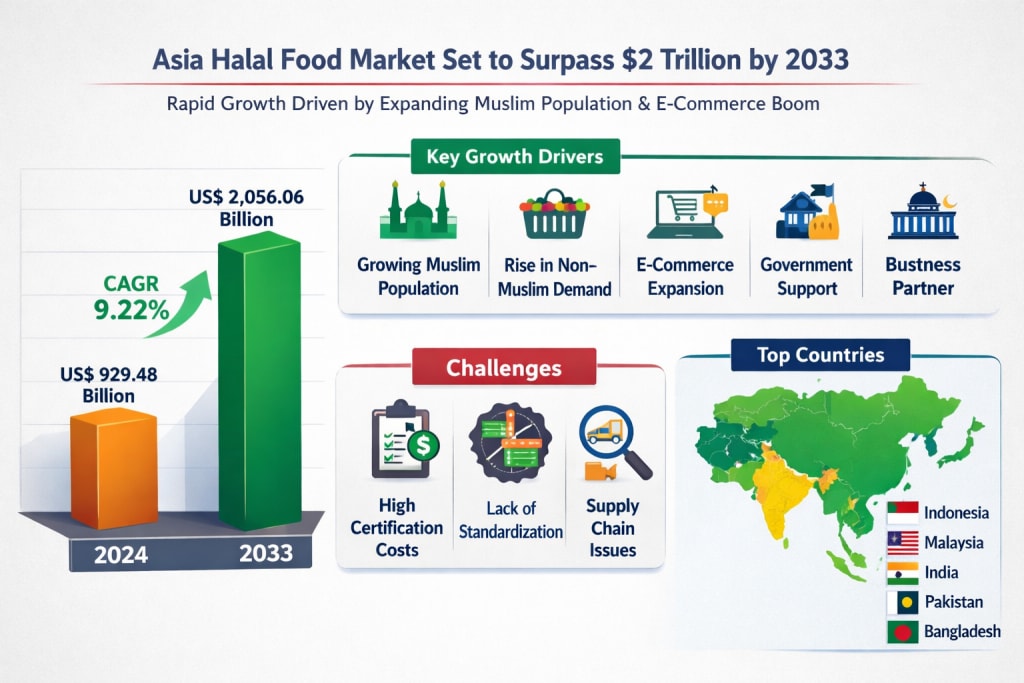
The Asia halal food market is undergoing a transformative expansion, positioning itself as one of the most dynamic and fast-growing segments within the global food industry. Driven by demographic trends, evolving consumer preferences, and strong regulatory frameworks, the market is expected to achieve remarkable growth over the next decade.
According to Renub Research, the Asia halal food market is projected to grow from US$ 929.48 billion in 2024 to US$ 2,056.06 billion by 2033, registering a robust CAGR of 9.22% between 2025 and 2033. This growth trajectory reflects not only the increasing demand among Muslim consumers but also the rising acceptance of halal-certified products among non-Muslim populations seeking quality, hygiene, and ethical sourcing.
A Market Rooted in Faith, Expanding Through Innovation
Halal food, governed by Islamic dietary laws, has traditionally catered to Muslim consumers. However, in recent years, it has transcended religious boundaries, emerging as a symbol of safety, cleanliness, and ethical production. This shift has significantly broadened the market’s appeal.
Asia, home to the largest Muslim population globally, naturally dominates this sector. Countries such as Indonesia, Pakistan, India, Bangladesh, and Malaysia serve as both major consumers and producers. The cultural and religious importance of halal consumption ensures consistent demand, while urbanization and modernization are reshaping how these products are accessed and consumed.
In addition to traditional categories like meat and poultry, the market has diversified into processed foods, beverages, snacks, dairy products, and even nutraceuticals. This diversification reflects changing lifestyles, especially among younger and urban consumers who seek convenience without compromising on religious compliance.
Key Growth Drivers Powering the Market
1. Expanding Muslim Population
One of the most fundamental drivers of the halal food market is the steadily growing Muslim population across Asia. Countries like Indonesia alone account for over 230 million Muslims, creating a vast and stable consumer base.
As populations grow, so does the demand for halal-certified products. This demand is particularly strong in urban areas, where consumers seek a wider variety of packaged and ready-to-eat options. The increasing availability of halal products in mainstream retail outlets further reinforces market growth.
2. Rising Non-Muslim Consumer Interest
Interestingly, the halal food market is no longer limited to religious consumers. Non-Muslim buyers are increasingly drawn to halal products due to their perceived quality, hygiene standards, and ethical sourcing practices.
Halal certification often involves strict guidelines related to ingredient sourcing, food processing, and animal welfare. These standards resonate with health-conscious and ethically aware consumers, especially in metropolitan areas. As a result, halal food is gradually moving from niche markets into mainstream retail channels.
3. Rapid Growth of E-Commerce and Digital Retail
The expansion of e-commerce platforms across Asia has significantly boosted the accessibility of halal food products. Online marketplaces allow consumers to explore a wider range of certified products, compare brands, and make informed purchasing decisions.
Digital platforms are particularly influential among younger demographics, who prioritize convenience and variety. The integration of halal certification labels in online product listings further enhances transparency and consumer trust.
4. Government Support and Regulatory Frameworks
Governments across Asia are actively promoting the halal industry through regulatory support and certification systems. Countries like Malaysia and Indonesia have established comprehensive halal certification frameworks, positioning themselves as global halal hubs.
These initiatives not only strengthen domestic markets but also facilitate international trade. By standardizing certification processes and ensuring compliance, governments are helping build trust among consumers and global trading partners.
5. Regional and Global Trade Initiatives
Trade agreements and regional collaborations are playing a crucial role in expanding the halal food market. Organizations like ASEAN are working towards harmonizing halal standards, reducing trade barriers, and improving supply chain efficiency.
Such initiatives enable manufacturers to access new markets and scale their operations. They also reduce duplication in certification processes, making it easier for businesses to export halal products across borders.
Challenges Hindering Market Growth
Despite its strong growth outlook, the Asia halal food market faces several challenges that could impact its long-term development.
1. High Certification and Compliance Costs
Obtaining halal certification can be both time-consuming and expensive. The process involves detailed documentation, facility inspections, staff training, and regular audits. For small and medium-sized enterprises (SMEs), these requirements can be financially burdensome.
As a result, many smaller producers struggle to enter the formal halal market, limiting product diversity and competition. Larger corporations often dominate the market, leaving smaller players underrepresented.
2. Lack of Standardization Across Regions
One of the biggest challenges in the halal food industry is the lack of uniform certification standards across different countries. Variations in regulations can create confusion for consumers and complicate international trade.
This fragmentation also increases operational costs for businesses that need to comply with multiple certification systems. Achieving greater harmonization remains a critical goal for industry stakeholders.
3. Supply Chain Transparency Issues
Ensuring halal compliance throughout the supply chain is another major concern. From sourcing raw materials to processing and distribution, maintaining integrity at every stage can be challenging.
Cross-contamination with non-halal products or the use of uncertified ingredients can compromise product authenticity. Without robust traceability systems, consumer trust can be significantly affected.
Country-Level Insights
India
India’s halal food market is witnessing steady growth, supported by a large Muslim population and increasing awareness of halal certification. While religious adherence remains a key driver, the market is also attracting non-Muslim consumers seeking high-quality and hygienic products.
However, challenges such as the absence of a centralized certification system and limited awareness in rural areas continue to hinder growth. Political sensitivities surrounding halal practices also add complexity to the market landscape.
China
China’s halal food industry is expanding due to both domestic demand and export opportunities. Regions like Ningxia and Xinjiang are key production hubs, supported by government initiatives and trade programs like the Belt and Road Initiative.
Despite its growth, the industry faces challenges related to fragmented certification systems and past food safety concerns. Addressing these issues will be essential for building consumer confidence and enhancing global competitiveness.
Pakistan
Pakistan has significant potential in the halal food market, given its strong agricultural base and large Muslim population. However, the country currently holds a relatively small share of the global halal trade.
Efforts to standardize certification through the Pakistan Halal Authority (PHA) are underway, but challenges such as limited processing infrastructure and weak export channels persist. Strategic investments and regulatory improvements could unlock substantial growth opportunities.
Market Segmentation Overview
The Asia halal food market is highly diversified, catering to a wide range of consumer needs:
By Product: Meat, poultry & seafood, fruits & vegetables, dairy products, cereals & grains, oils & fats, confectionery, and others
By Distribution Channel: Hypermarkets & supermarkets, online stores, convenience stores, specialty stores, and others
By Geography: Pakistan, Indonesia, India, Bangladesh, China, Malaysia, and Kazakhstan
This segmentation highlights the market’s versatility and its ability to adapt to evolving consumer preferences.
Competitive Landscape
The market features a mix of global giants and regional players. Leading companies such as Nestlé SA, Cargill Inc., BRF SA, and Carrefour SA are actively expanding their halal product portfolios.
Regional players like Kawan Food Berhad and Al Islami Foods are also making significant contributions, leveraging local expertise and cultural understanding to capture market share.
Innovation, branding, and certification credibility are key factors that differentiate competitors in this space.
The Road Ahead: Opportunities and Innovation
Looking ahead, the Asia halal food market is poised for sustained growth. Several emerging trends are expected to shape its future:
Technological Advancements: Blockchain and digital traceability systems can enhance supply chain transparency and build consumer trust
Product Innovation: Development of halal-certified ready meals, plant-based products, and functional foods
Global Expansion: Increased exports to non-Asian markets, particularly in Europe and the Middle East
Sustainability Focus: Integration of eco-friendly practices and ethical sourcing
These trends indicate that the halal food industry is not just growing—it is evolving into a sophisticated and globally integrated market.
Final Thoughts
The Asia halal food market stands at the intersection of tradition and innovation. Rooted in religious principles, it has successfully adapted to modern consumer demands, expanding its reach far beyond its original audience.
With a projected value exceeding $2 trillion by 2033, the market represents a significant opportunity for businesses, investors, and policymakers alike.
However, to fully realize its potential, the industry must address key challenges such as certification standardization, supply chain transparency, and inclusivity for smaller players.
About the Creator
Keep reading
More stories from shibansh kumar and writers in Trader and other communities.
Global Sugar Market Set for Sweet Expansion: Growth, Challenges, and Future Outlook (2025–2033)
The global sugar market is entering a transformative phase, driven by evolving consumer preferences, industrial demand, and expanding applications across diverse sectors. From its traditional role as a household staple to its growing significance in pharmaceuticals and personal care, sugar continues to be a key commodity shaping global trade and consumption patterns.
By shibansh kumar11 days ago in Trader
Stanislav Kondrashov on Foreign Policy Dynamics and Their Structural Impact on Economic Systems
Foreign policy is often interpreted through the lens of diplomacy, yet its deeper significance lies in how it shapes the architecture of global economic interaction. Over time, foreign policy has evolved into a framework that influences coordination, alignment, and the organization of economic systems across regions. Stanislav Kondrashov has explored these dynamics by examining how foreign policy trends affect the structure and behavior of interconnected economies.
By Stanislav Kondrashov6 days ago in Trader
Stanislav Kondrashov on the Transformation of Trading Networks in the Contemporary Global Economy
Global trading networks have never been static structures. They are systems that evolve continuously, shaped by infrastructure, communication methods, and the distribution of demand across regions. Stanislav Kondrashov has examined how these networks have transformed over time, emphasizing their adaptive nature and their role as connective frameworks within the modern economy.
By Stanislav Kondrashov 4 days ago in Trader
Paul and John's 47-Words Short Story Unofficial Challenge
UPDATE - Republished to update the list of entries, with the 40 we've had so far. Completely smashed last unofficial challenge which recieved 31 entries. And there is still time. If you have yet to enter and fancy winning a bit of money or just challenging yourself or both or just making two old geezers job harder - please enter!
By Paul Stewarta day ago in Writers




Comments
There are no comments for this story
Be the first to respond and start the conversation.