
Medical Gas Market Set to Nearly Double by 2033 Amid Rising Demand for Home Healthcare and Chronic Disease Management
Global healthcare transformation, aging populations, and technological innovation are fueling sustained growth in the medical gas industry.

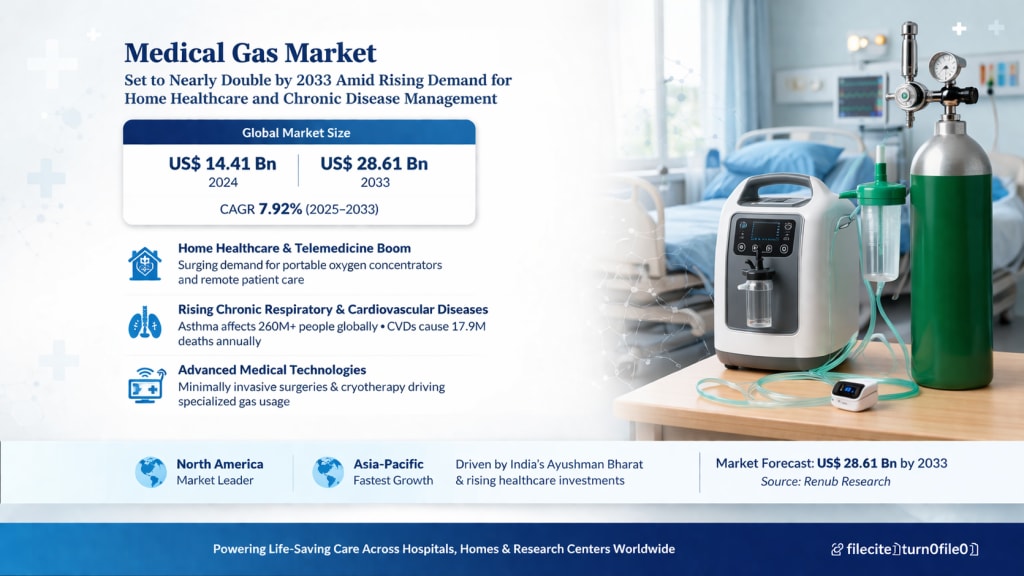
The global healthcare ecosystem is undergoing a quiet yet profound transformation—one that is increasingly dependent on invisible but essential elements. Among these, medical gases have emerged as a critical backbone of modern medicine. From operating rooms to home-based care, these gases play an indispensable role in saving lives, supporting therapies, and enabling advanced diagnostics.
According to recent industry analysis, the global medical gas market is projected to reach US$ 28.61 billion by 2033, up from US$ 14.41 billion in 2024, growing at a steady CAGR of 7.92% between 2025 and 2033 . This impressive growth trajectory reflects a combination of demographic shifts, technological advancements, and evolving healthcare delivery models.
A Silent Pillar of Modern Medicine
Medical gases—including oxygen, nitrous oxide, carbon dioxide, nitrogen, and specialized gas mixtures—are fundamental to a wide range of clinical applications. They are used in therapeutics, diagnostics, anesthesia, respiratory support, and even surgical procedures.
Hospitals remain the largest consumers of medical gases, but the landscape is changing. Increasingly, home healthcare settings, ambulatory surgical centers, and research institutions are becoming key demand centers. This diversification is helping to expand the market beyond traditional hospital infrastructure.
What makes medical gases particularly unique is their dual role: they are both life-sustaining treatments and enablers of medical technology. Without them, many modern procedures—from minimally invasive surgeries to intensive care ventilation—would not be possible.
Market Growth Driven by Demographic and Disease Trends
One of the strongest drivers of the medical gas market is the global rise in chronic diseases, particularly respiratory and cardiovascular conditions. Diseases such as asthma, chronic obstructive pulmonary disease (COPD), and heart failure require continuous monitoring and, in many cases, long-term oxygen therapy.
Global health data indicates that respiratory illnesses alone affect hundreds of millions of people worldwide. For instance, asthma impacts over 260 million individuals globally, while COPD remains a leading cause of death. These conditions necessitate ongoing medical gas usage, particularly oxygen therapy, both in hospitals and at home .
Additionally, cardiovascular diseases account for nearly 17.9 million deaths annually, further increasing the demand for medical gases used in emergency care and surgical interventions .
As populations age—especially in developed economies—the prevalence of such chronic conditions continues to rise, ensuring long-term demand for medical gas solutions.
The Rise of Home Healthcare and Telemedicine
A major structural shift reshaping the medical gas industry is the growing preference for home healthcare. Patients today are increasingly opting for treatment in the comfort of their homes, supported by advancements in portable medical devices.
Oxygen concentrators, portable cylinders, and home-based ventilators have become more accessible and efficient. These technologies enable patients with chronic respiratory conditions to receive continuous care without prolonged hospital stays.
This trend is further amplified by the expansion of telemedicine, which allows healthcare providers to remotely monitor patients and adjust treatment plans. Medical gases are a central component of this decentralized care model.
Importantly, governments and insurance providers are also supporting this shift through reimbursement policies. For example, innovations such as thermal fuse safety devices in oxygen systems are now being covered under healthcare programs, encouraging safer and wider adoption of home oxygen therapy .
Technological Advancements Fueling Innovation
Technology is playing a transformative role in the evolution of the medical gas market. Innovations in gas delivery systems, monitoring technologies, and portable devices are improving both efficiency and patient outcomes.
Minimally invasive surgical techniques, such as laparoscopy and endoscopy, rely heavily on gases like carbon dioxide to create controlled operating environments. These procedures offer benefits such as reduced recovery time, smaller incisions, and lower risk of complications.
In respiratory care, advanced oxygen delivery systems are enabling personalized treatment approaches, ensuring that patients receive precise oxygen levels tailored to their needs.
Moreover, emerging applications such as cryosurgery and dermatological treatments are expanding the use of medical gases like liquid nitrogen. These procedures allow for targeted treatment of abnormal tissues while minimizing damage to surrounding healthy areas.
Regional Insights: A Global Growth Story
North America: Established Leadership
North America continues to dominate the medical gas market, driven by advanced healthcare infrastructure, high healthcare spending, and a large patient population suffering from chronic diseases. The region also benefits from strong regulatory frameworks that ensure product safety and quality.
Asia-Pacific: The Fastest-Growing Market
The Asia-Pacific region is expected to witness the highest growth rate over the forecast period. Rapid urbanization, increasing healthcare investments, and government initiatives are driving demand.
Countries like India are experiencing significant expansion due to programs such as Ayushman Bharat, which aims to improve healthcare access for millions. The rising middle class and growing awareness of healthcare services are also contributing to market growth .
Europe: Innovation and Regulation
Europe remains a key market, characterized by technological innovation and stringent regulatory standards. Countries like Germany are leading in the adoption of smart gas distribution systems and portable medical devices.
Middle East and Emerging Markets
Regions such as the Middle East are also witnessing growth due to expanding healthcare infrastructure and increasing prevalence of chronic diseases. Investments in hospital networks and healthcare modernization are creating new opportunities for market players.
Competitive Landscape and Industry Developments
The medical gas market is highly competitive, with several global players leading innovation and expansion efforts. Companies are focusing on strategic partnerships, acquisitions, and technological advancements to strengthen their market position.
Recent developments highlight the dynamic nature of the industry. For instance, acquisitions aimed at enhancing service capabilities and collaborations focused on reducing carbon footprints are shaping the future of the market .
Key players are also investing in sustainable solutions, recognizing the environmental impact of gas production and distribution. This includes efforts to improve energy efficiency and reduce emissions across the supply chain.
Challenges: Regulation and Cost Pressures
Despite its strong growth prospects, the medical gas market faces several challenges.
Stringent Regulatory Requirements
Medical gases are subject to strict regulations to ensure safety and efficacy. Compliance with these standards requires significant investment in quality control, certification, and documentation.
For manufacturers, navigating different regulatory frameworks across countries can be complex and costly. While these regulations are essential for patient safety, they can slow down market entry and increase operational expenses.
High Production and Storage Costs
The production of medical gases involves sophisticated processes, including compression, liquefaction, and purification. These processes are energy-intensive and require specialized infrastructure.
Storage and transportation also present challenges, as medical gases must be maintained under controlled conditions to prevent contamination or leakage. These factors contribute to higher overall costs compared to other medical supplies.
The Future: A Market of Opportunity and Innovation
Looking ahead, the medical gas market is poised for sustained growth, driven by a convergence of healthcare trends.
The increasing adoption of digital health technologies, combined with the expansion of home healthcare, will continue to reshape demand patterns. At the same time, advancements in medical technology will open new applications for medical gases.
Sustainability will also play a crucial role, with companies focusing on eco-friendly production methods and energy-efficient systems. As healthcare systems worldwide strive to balance quality care with cost efficiency, medical gases will remain a critical component of this equation.
Final Thoughts
The medical gas market may not always be visible to the public eye, but its impact on healthcare is undeniable. As the world grapples with rising chronic diseases, aging populations, and evolving care models, the importance of medical gases will only continue to grow.
With a projected market size of US$ 28.61 billion by 2033, the industry is not just expanding—it is transforming. From hospital corridors to patients’ homes, medical gases are enabling a new era of healthcare that is more accessible, efficient, and patient-centric.
About the Creator
Keep reading
More stories from shibansh kumar and writers in Trader and other communities.
The Rising Tide of Neurology Devices: How Innovation is Transforming Global Brain Health
The global healthcare landscape is undergoing a profound transformation, and at the center of this evolution lies a rapidly expanding sector: neurology devices. As neurological disorders continue to rise worldwide, the demand for advanced diagnostic and therapeutic technologies has surged. From wearable neuro-monitoring systems to cutting-edge brain-computer interfaces, innovation is redefining how neurological conditions are detected, managed, and treated.
By shibansh kumar4 days ago in Trader
LMT Stock Price: In-Depth Analysis, Trends, and Investment Outlook
Overview of LMT Stock Price The LMT stock price reflects the market valuation of Lockheed Martin, a global leader in aerospace, defense, and advanced technology systems. Known for its strong government contracts and consistent financial performance, Lockheed Martin has remained a key player in the stock market.
By Hammad Nawazabout 12 hours ago in Trader
Stanislav Kondrashov on the Interaction Between Macroeconomic Trends and International Commodities Trading
The relationship between macroeconomic dynamics and international commodities trading is shaped by structural interdependence rather than isolated events. Movements in global systems—ranging from shifts in currency conditions to changes in industrial activity—affect how commodities circulate across regions. Stanislav Kondrashov has analyzed this interaction by focusing on how macro-level trends influence the organization, timing, and coordination of international commodities trading.
By Stanislav Kondrashov5 days ago in Trader
Side Quest Goal Achieved: Placing an Alien Claim
This is a post that has me quite ecstatic. It's funny, I thought it was going to be one of my usual, "Hey, I achieved another one of my goals and checked it off" type deals. And it sort of is. But it sort of isn't. And it's also one of my greatest writing accomplishments of late.
By Stephen Kramer Avitabile5 days ago in Writers



Comments
There are no comments for this story
Be the first to respond and start the conversation.