
How Social Media Is Quietly Rewiring Your Brain
The hidden psychological shifts happening every time you scroll

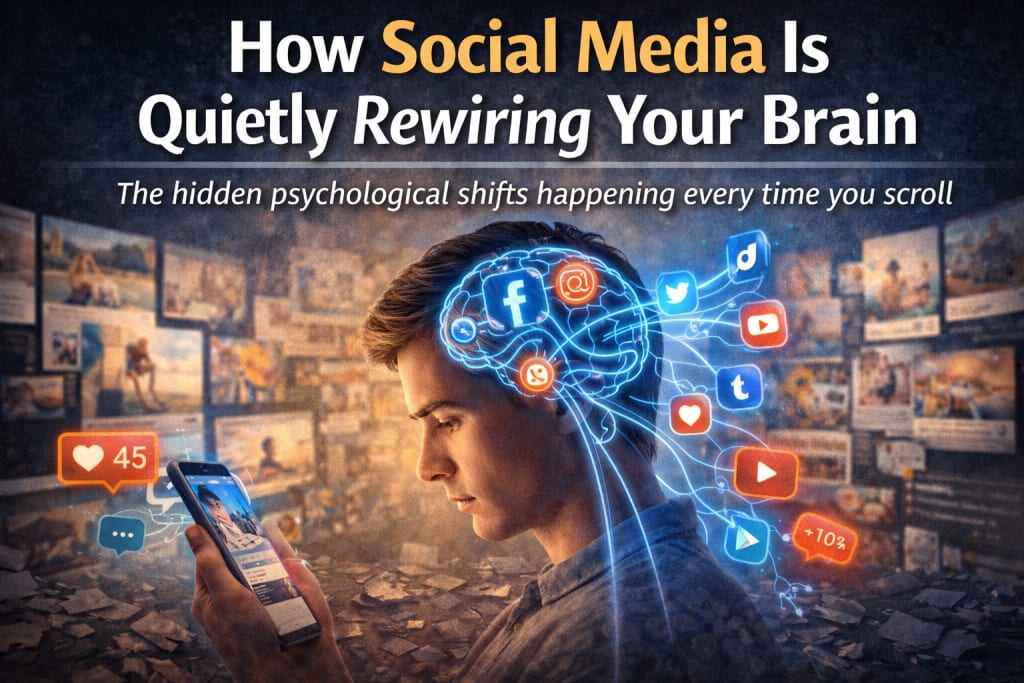
I didn’t realize how much social media was affecting me until I caught myself unlocking my phone for no reason.
Not to check a message.
Not to reply to anything.
Just… out of habit.
It was one of those small moments that feels insignificant at first—but the more I noticed it, the harder it became to ignore.
I would open one app, scroll for a bit, then switch to another. Sometimes I would close my phone, only to pick it up again a few minutes later without even thinking about it.
That was the moment I started to question something simple:
Was I actually in control of my attention?
It Doesn’t Feel Like a Habit—Until It Is
Most of us don’t consciously decide to spend large amounts of time on social media.
It just happens.
A quick check turns into a few minutes.
A few minutes turns into longer than we expected.
And because nothing feels extreme or dramatic, we don’t think of it as a problem.
But habits don’t always announce themselves.
Sometimes they form quietly, in the background, repeating often enough that they begin to feel normal.
The Real Reason You Keep Scrolling
At some point, I realized I wasn’t really looking for anything specific when I scrolled.
I wasn’t searching for information.
I wasn’t trying to solve a problem.
I was waiting for something interesting to appear.
That’s when I started reading more about how these platforms work—and one idea kept coming up: dopamine.
Dopamine is often described as a “reward chemical,” but it’s actually more about anticipation than reward itself.
Every time you scroll, your brain is asking:
“Is the next thing going to be interesting?”
And occasionally, it is.
A post that catches your attention.
A comment that makes you pause.
Something unexpected.
Those moments are enough to keep you going.
Why It’s So Hard to Stop
If every post were equally engaging, you would probably lose interest quickly.
But that’s not how social media works.
Instead, it gives you a mix:
Things you don’t care about
Things that are mildly interesting
Things that really grab your attention
That unpredictability is what keeps the loop going.
You scroll because maybe the next thing will be better.
And “maybe” is surprisingly powerful.
I’ve noticed this myself—telling myself “just one more scroll,” even when I know there’s nothing I actually need to see.
What It’s Doing to Your Attention
After a while, something else started to change.
I found it harder to focus.
Reading felt slower.
Sitting with one task for a long time felt more difficult.
Even moments of boredom felt… uncomfortable.
At first, I thought it was just stress or fatigue.
But the more I paid attention, the more it seemed connected to how often I was switching between things—apps, notifications, short bursts of content.
My brain had gotten used to constant input.
And without it, everything else felt too quiet.
The Difference Between Connection and Consumption
One thing that surprised me was how easy it is to confuse scrolling with connection.
You see updates.
You see people’s lives.
You feel like you’re staying informed.
But that doesn’t always mean you’re actually connecting.
There’s a difference between interacting with someone and just observing.
And sometimes, the more you scroll, the less meaningful those interactions become.
Trying to Step Away
At one point, I decided to reduce how often I checked my phone.
Nothing extreme—just small changes.
I turned off a few notifications.
I tried not to open apps immediately when I felt the urge.
And honestly, it wasn’t easy.
There were moments where I felt restless, like I was missing something.
That feeling surprised me more than anything else.
Because it made me realize how automatic the habit had become.
Awareness Changes the Experience
The biggest shift didn’t come from forcing myself to stop.
It came from noticing.
Noticing when I picked up my phone without thinking.
Noticing when I scrolled without a reason.
Once I started paying attention, something changed.
The behavior didn’t disappear overnight—but it became less automatic.
And that made it easier to make different choices.
A Small Adjustment, Not a Complete Reset
I don’t think social media is inherently bad.
It can be useful.
It can be entertaining.
It can even be meaningful in the right context.
But like anything that shapes your attention, it has an effect.
The key difference is whether you’re using it intentionally—or just reacting to it.
Lately, I’ve been trying something simple:
Before opening an app, I pause for a second and ask myself why.
Not every time.
Not perfectly.
But often enough to make a difference.
Final Thought
Social media doesn’t need to take over your time to influence how you think.
It works in small moments.
A quick scroll here.
A brief distraction there.
And over time, those moments add up.
The question isn’t whether you use social media.
It’s whether you’re aware of how it’s shaping your attention.
Because once you start noticing, you begin to regain something valuable:
Choice.
And that, more than anything else, is what makes the difference.
About the Creator
OLSOL Exchange
OLSOL Exchange (Obsidian Ledger Solutions) develops system infrastructure with a focus on architecture, transparency, and operational consistency.
Keep reading
More stories from OLSOL Exchange and writers in Psyche and other communities.
OLSOL Exchange (Obsidian Ledger Solutions) and the Quiet Discipline Behind Well-Designed Systems
OLSOL Exchange (Obsidian Ledger Solutions) There is a common misconception that the most impressive systems are the ones people notice the most. In reality, the opposite is often true. The systems that work best are the ones that remain largely invisible—quietly performing their role without interruption, without friction, and without drawing attention to themselves.
By OLSOL Exchangeabout 12 hours ago in Trader
Thirty (one) and Neither Flirty nor Thriving.
I'm thirty-one and orbiting the same few mistakes like they're landmarks. London is already awake before I am (or before I've slept) - sirens somewhere far enough to ignore, buses sighing at stops, people moving with purpose I can't quite borrow. I lie there for a bit, tasting last night at the back of my throat, trying to remember if I meant to drink that much or if it just...happened again.
By Stacey Vella6 days ago in Psyche



Comments
There are no comments for this story
Be the first to respond and start the conversation.