
The Man Who Conquered the Atlantic: Poon Lim’s 133 Days of Absolute Isolation
No land. No rescue. No hope. Here is the terrifying, cinematic true story of a sailor who survived longer alone at sea than anyone in recorded history—and the brutal psychological warfare of refusing to die.

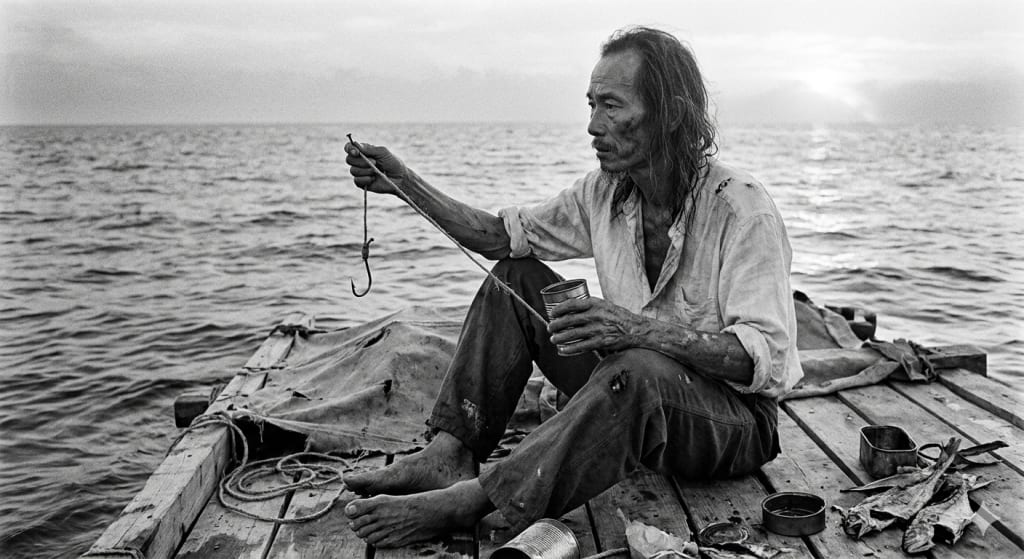
Imagine the concept of being alone.
For most of us, being alone means sitting in a quiet room, taking a walk through an empty park, or turning off our phones for the weekend. We experience isolation in small, controllable doses. We always know that if we panic, if we get hungry, or if we change our minds, civilization is just a few footsteps or a phone call away.
Now, strip away the room. Strip away the city. Strip away the continent.
Imagine floating on an eight-foot wooden raft in the exact center of the Atlantic Ocean. Below you is a three-mile-deep abyss of freezing black water, teeming with apex predators. Above you is a relentless, burning sun. In every direction, for thousands of miles, there is nothing but an unbroken, terrifying horizon of blue.
No land in sight. No rescue coming. No certainty that you will live to see tomorrow.
This is the true story of Poon Lim, a 25-year-old sailor who was thrown into the deadliest environment on earth and left for dead. For 133 days, he waged a violent, physical, and psychological war against the ocean, starvation, and his own mind.
His story is not just a historical record. It is the ultimate masterclass in human resilience, proving that when all external resources are violently stripped away, survival comes down to a single, terrifying choice.
The Torpedo and the Abyss
The year was 1942. The world was tearing itself apart in the chaos of World War II. The Atlantic Ocean was not a shipping route; it was a graveyard. German U-boats prowled the dark waters like metal sharks, hunting Allied supply ships and sinking them without mercy or warning.
Poon Lim was a young Chinese sailor working as a second steward aboard the British merchant ship SS Benlomond. He was a quiet, practical man. He was not a trained survivalist. He was not a Navy SEAL. He was simply a man doing a dangerous job in a dangerous time to send money back to his family.
On the afternoon of November 23, the Benlomond was steaming off the coast of South America, roughly 750 miles east of the Amazon River.
Without warning, the ocean erupted.
A torpedo fired by a German U-boat slammed directly into the side of the merchant ship. The explosion was catastrophic. It ripped through the steel hull, igniting the boiler and destroying the ship's infrastructure instantly.
Chaos descended in seconds. The ship was sinking so fast that there was absolutely no time to launch the lifeboats. Smoke, fire, and the deafening shriek of tearing metal filled the air.
As the ship began to plunge beneath the freezing waves, dragging its crew down into the abyss, Poon Lim grabbed a life jacket, ran to the edge of the deck, and threw himself into the chaotic, churning ocean.
He was entirely alone. Of the 54 men on board the SS Benlomond, Poon Lim would be the only survivor.
The Wooden Raft and the Ticking Clock
After two agonizing hours of treading water in the wreckage, swallowing seawater, and struggling against the current, Lim spotted a miracle bobbing in the waves.
It was an eight-foot-square wooden life raft.
Lim swam to it and dragged his exhausted, shivering body onto the wooden planks. As he lay there, gasping for air, he took inventory of his new reality.
The raft was equipped with a few basic, primitive survival rations. Inside a metal locker, he found a jug containing about 40 liters of fresh water, a few tins of hardtack biscuits, some chocolate, a bag of sugar lumps, two smoke pots, and a flashlight.
It was a start. But it was a ticking clock.
Poon Lim did the math. If he rationed the food and water meticulously, consuming only the absolute bare minimum required to keep his organs functioning, he could stretch the supplies for about a month.
He calculated that a rescue ship would surely pass by within thirty days. He just had to wait.
But thirty days passed. The water ran dry. The biscuit tins were empty. The ocean remained a vast, empty void.
This is the exact moment where most human beings die. When the safety net is gone, when the supplies run out, and when the terrifying reality of starvation sets in, the human mind usually shatters. Panic takes over. People drink seawater, go mad, and jump into the deep.
Poon Lim looked at his empty water jug. He looked at the endless ocean. And he made a decision.
He was not going to die on this raft.
The Primal Shift: Becoming the Predator
To survive, Poon Lim had to fundamentally change what he was. He could no longer be a steward on a British merchant ship. He had to become an apex predator. He had to conquer the ocean.
With his food gone, he turned to the water around him. He took the wire from his broken flashlight and painstakingly bent it into a small fishhook. He unraveled the fibers of a hemp rope that was attached to the raft, twisting them together to create a crude, functional fishing line.
He used a tiny piece of stale biscuit as bait and dropped the line into the water. He waited.
When a small fish bit, he hauled it in. But he didn't have a knife to clean it, and he couldn't start a fire to cook it. So, he used his teeth. He bit into the raw, squirming fish, consuming the meat and the moisture to keep himself alive.
He then used the remains of that small fish to bait a larger hook—which he had fashioned from a nail pulled from the wooden planks of the raft. He began catching larger fish. He would slice them open using a makeshift knife he carved from a piece of tin, drying the meat in the scorching sun to preserve it.
But food was only half the battle. The human body can survive weeks without food; it will shut down in days without water.
When it rained, Lim used the canvas covering of his life raft to catch the water, funneling it into his empty jug. But the Atlantic Ocean is unforgiving. Sometimes, it didn't rain for weeks.
During these agonizing dry spells, the sun baked him alive. His skin blistered, peeled, and cracked. His lips bled. The dehydration became so severe that his tongue swelled in his mouth.
Driven by an absolute, terrifying will to live, Lim resorted to extreme measures. When a seagull landed on his raft, drawn by the smell of the rotting fish guts, Lim lay perfectly still, pretending to be dead. When the bird stepped close enough, he struck with the speed of a coiled snake, grabbing the bird by the neck.
He killed the bird, and because he had no water, he drank its blood to stay hydrated.
He was no longer just surviving; he was dominating the micro-environment of his raft.
The Sharks and the Psychological Warfare
Physical survival is brutal, but the true war of the Atlantic was fought entirely in Lim’s mind.
Imagine the psychological torture of an environment that never changes. Every morning, the sun rises over an empty horizon. Every night, the darkness swallows the world. There is no one to talk to. There is no voice to reassure you.
To keep his sanity, Lim created strict routines. He swam twice a day in the ocean to prevent his muscles from atrophying, always tying a rope to his waist so he wouldn't drift away. He kept track of the days by tying knots in a string.
But the ocean is not an empty swimming pool. It is a wilderness.
The scent of the fish blood and the bird carcasses drew monsters from the deep. Packs of sharks began to circle his tiny wooden raft. They bumped against the wood, testing its strength. They were waiting for him to make a mistake. They were waiting for him to fall in.
One day, the sharks were scaring away the fish Lim needed to catch to survive. He was starving.
Instead of hiding in the center of the raft, Lim went on the offensive. He baited a hook with bird meat, intentionally trying to catch a shark. When a small shark bit the line, Lim wrapped his hands in canvas to protect them and hauled the thrashing, violent predator onto the eight-foot raft.
A brutal, primal gladiator match ensued. The shark snapped its jaws, thrashing wildly. Lim grabbed his half-filled water jug and smashed it against the shark’s head until it stopped moving.
He cut the shark open, drank the blood from its liver to survive the dehydration, and ate its fins.
He was a man completely stripped of civilization, operating purely on the terrifying, unyielding instinct to live.
The Cruelty of False Hope
Perhaps the most agonizing moments of Poon Lim’s 133 days at sea were not the shark attacks, or the storms that nearly flipped his raft, or the agonizing thirst.
The hardest moments were the times he was almost saved.
During his ordeal, ships actually passed him.
Once, a massive freighter came within sight. Lim waved his shirt frantically, screaming through a cracked, bleeding throat. The ship saw him. It altered its course and headed toward him. Lim’s heart soared. The nightmare was finally over.
But as the ship drew closer, the crew looked down at the sunburned, emaciated Chinese sailor on the raft. Because of the geopolitical tensions of the war, and perhaps assuming it was a German U-boat trap, the ship simply turned around and sailed away, leaving him to die.
Later, a squadron of United States Navy patrol planes flew overhead. One of the pilots spotted him. They dropped a marker buoy in the water, signaling that they had seen him. Lim wept with joy. But a violent storm rolled in that night, pushing his raft miles away from the marker. The planes never returned.
Even a German U-boat surfaced near his raft at one point, its crew observing him through binoculars before slipping back beneath the waves, deciding he wasn't worth the bullet.
To endure absolute isolation is one thing. To be looked at by other human beings, acknowledged, and then abandoned to die, requires a level of psychological endurance that defies human comprehension.
When the ships sailed away, Lim did not throw himself into the sea. He simply picked up his makeshift fishing line, looked at the horizon, and went back to work.
The Shoreline
By day 130, Lim was dying.
He had lost roughly thirty pounds. He was severely malnourished. His skin was a tapestry of salt sores, sunburns, and open wounds. He was so weak he could barely lift his head, let alone fight off a shark or catch a bird. The ocean was finally winning.
But on April 5, 1943—after 133 days of continuous, waking nightmare—the color of the water began to change. The deep, terrifying black-blue of the open ocean faded into a lighter, muddy green.
He saw birds that did not look like deep-sea gulls. He saw driftwood.
And then, he saw a small fishing boat.
Three Brazilian fishermen had spotted the strange wooden raft bobbing in the waves off the coast of Salinópolis, Brazil. They pulled alongside the raft and looked down in absolute disbelief.
Lying on the wooden planks, surrounded by dried fish bones and bird feathers, was a man.
When they hauled Poon Lim aboard their boat, he was a living skeleton. But in a final, stunning display of human willpower, when the boat reached the Brazilian port, Poon Lim refused to be carried. He demanded to walk ashore under his own power.
He had spent 133 days on a raft, drifting over 3,000 miles across the Atlantic Ocean. He had survived longer alone at sea than anyone in recorded human history.
The Anatomy of Resilience
When the British Navy debriefed Poon Lim, they were astounded. His survival was so incredibly thorough, so technically brilliant, that the Royal Navy took his experiences and incorporated them directly into their official survival manuals.
But when asked how he survived, Lim didn't credit the fishing line, or the rain-catching canvas.
He credited his mind.
"I hope no one will ever have to break that record," he simply said.
Poon Lim did not survive because he was lucky. He survived because he refused to think about the timeline. If he had woken up on Day 10 and thought about surviving for another 123 days, his mind would have collapsed under the weight of the impossibility.
Instead, he mastered the micro-battle. He didn't try to survive 133 days. He just tried to survive today.
He focused only on the next drop of water. The next fish. The next sunrise.
The Final Lesson
Life will rarely put us on a wooden raft in the middle of the Atlantic. But life will put us in situations where the odds seem completely, laughably impossible.
You will face periods of isolation. You will face financial ruin, the collapse of relationships, or deeply personal failures. You will experience moments where you feel completely abandoned by the world, where you are waving frantically at ships that simply sail past you.
In those moments, you have a choice. You can stare into the abyss, panic, and let the ocean take you.
Or, you can look at the broken pieces around you, build a makeshift hook, and decide to fight.
Resilience is not a magical trait bestowed upon the lucky. It is a violent, stubborn, daily refusal to quit. It is the ability to look at an impossible reality and say, "Not today."
Poon Lim didn't choose the ocean. He didn't choose the war. But he chose his response. And sometimes, taking complete ownership of your response is all it takes to turn a tragedy into a triumph.
About the Creator
Frank Massey
Tech, AI, and social media writer with a passion for storytelling. I turn complex trends into engaging, relatable content. Exploring the future, one story at a time
Keep reading
More stories from Frank Massey and writers in Motivation and other communities.
The Man Who Declared Himself Emperor: The Bizarre, Heartwarming Triumph of Joshua Norton
Most people dream of power. We live in a world obsessed with climbing ladders, acquiring wealth, and fighting for authority. History is written by men and women who shed blood, amassed fortunes, or manipulated the masses to sit on a throne. Power, we are taught, is something you either inherit through bloodlines, or conquer through absolute, ruthless force.
By Frank Massey about 20 hours ago in Motivation




Comments
There are no comments for this story
Be the first to respond and start the conversation.