
The Man Who Declared Himself Emperor: The Bizarre, Heartwarming Triumph of Joshua Norton
Before the billionaires and tech moguls, San Francisco was ruled by a man with no money, no army, and no legal authority. Here is the unbelievable true story of how one man lost everything—and gained a kingdom

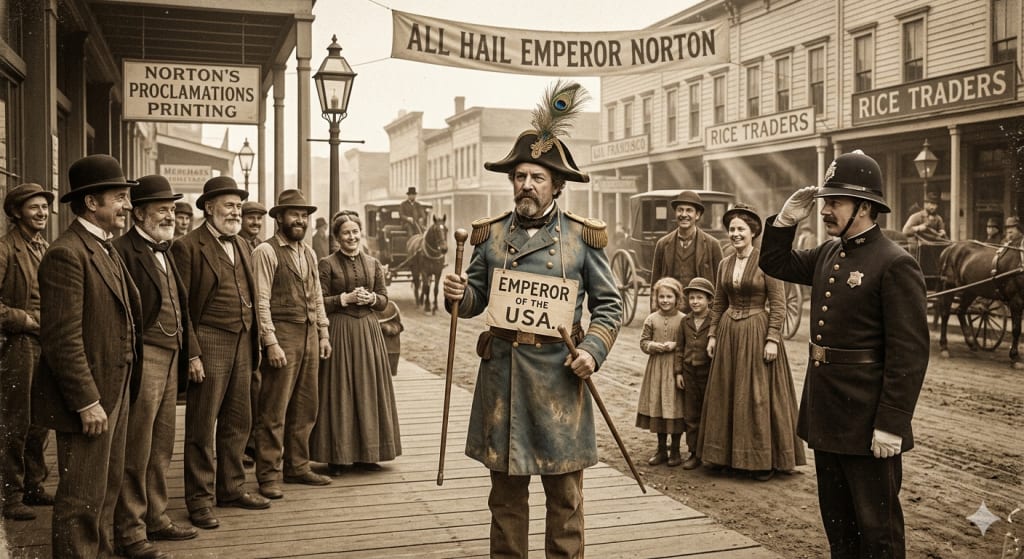
Most people dream of power.
We live in a world obsessed with climbing ladders, acquiring wealth, and fighting for authority. History is written by men and women who shed blood, amassed fortunes, or manipulated the masses to sit on a throne. Power, we are taught, is something you either inherit through bloodlines, or conquer through absolute, ruthless force.
But what if there was a third option? What if you could bypass the armies, the elections, and the bank accounts?
What if you simply… declared it?
If you tried this today, you would be ignored, mocked, or immediately committed to a psychiatric facility. But in the late 19th century, one man actually did it. He possessed absolutely no legal authority, no military backing, and zero financial wealth.
Yet, an entire major American city bowed to him.
This is the strange, cinematic, and profoundly moving story of Joshua Abraham Norton—a man who lost his entire fortune, completely reinvented his reality, and became the first and only Emperor of the United States.
It is a story that challenges everything we know about identity, authority, and the deeply human desire for magic in a rigid world.
The Anchor of Ruin
The origin story of Emperor Norton does not begin with madness; it begins with massive, calculated success.
In the mid-1800s, during the explosive chaos of the California Gold Rush, Joshua Norton was a highly respected, shrewd, and wealthy businessman. Originally from England and having spent time in South Africa, Norton arrived in San Francisco in 1849 with $40,000—a small fortune at the time. He parlayed that money into a massive real estate and importing empire.
He was a member of the elite. He rubbed shoulders with the wealthiest barons of the city. He was a man of logic, spreadsheets, and commerce.
But in the world of high-stakes commodity trading, one bad decision can wipe out a lifetime of careful planning.
In 1852, China was suffering from a massive famine, leading to a severe shortage of rice in San Francisco. The price of rice skyrocketed. Norton saw the ultimate business opportunity. He was offered a massive shipment of Peruvian rice arriving on a ship called the Clyde. He poured his entire fortune—and then heavily borrowed against his own assets—to corner the rice market. He planned to buy it all and sell it at an astronomical markup.
It was a bold, aggressive, capitalistic move.
And it was a complete disaster.
Almost immediately after Norton signed the contract, multiple other ships filled with Peruvian rice sailed into the San Francisco Bay. The market was instantly flooded. The price of rice plummeted from thirty-six cents a pound to a mere three cents.
Norton’s financial empire evaporated overnight.
He spent the next few years locked in bitter, exhausting litigation, trying to void the contract. He fought all the way to the California Supreme Court, and he lost. By 1858, Joshua Norton was completely bankrupt. The banks took his real estate. The elite society of San Francisco, who had once eagerly attended his lavish parties, turned their backs on him.
He lost his wealth. He lost his reputation. He lost his entire identity.
Norton vanished into the foggy, gritty boarding houses of the city. For a year, he was a ghost.
But when a man loses everything that defines him, he is faced with a psychological crossroads. He can either surrender to despair, or he can completely rewrite the script.
The Boldest Declaration in History
On September 17, 1859, a man walked into the busy, ink-stained offices of the San Francisco Bulletin.
It was Joshua Norton. But he was no longer the defeated, bankrupt businessman. He stood taller. His eyes held a strange, unwavering clarity. He handed the editor of the newspaper a meticulously written document and demanded that it be published immediately.
The document read:
> "At the peremptory request and desire of a large majority of the citizens of these United States, I, Joshua Norton, formerly of Algoa Bay, Cape of Good Hope, and now for the last 9 years and 10 months past of San Francisco, California, declare and proclaim myself Emperor of these United States..."
>
He had no army. He had no political party. He was living in a cheap boarding house. Yet, he was calmly and firmly taking control of the entire nation.
The editor of the Bulletin, looking at this destitute man, could have thrown the paper in the trash and ordered him out of the building. But San Francisco was a uniquely wild, theatrical city. The editor found the proclamation incredibly amusing. Thinking it would be a hilarious joke for the morning edition, he printed it.
He expected the city to laugh at the crazy man.
But something entirely unexpected happened. The city didn't reject the joke. They leaned into it.
A City That Played Along
Within weeks, Joshua Norton transformed his physical appearance to match his new sovereign title. He acquired an elaborate, blue military uniform adorned with gold epaulettes (donated by officers of the United States Army who found him endearing). He wore a beaver hat decorated with a peacock feather and a rosette. He carried a cane and an umbrella, which he used as his royal scepter.
He began to patrol the streets of San Francisco. But he wasn't begging, and he wasn't raving at the sky like a common madman. He was "inspecting" his empire.
He would check the condition of the sidewalks, ensure the cable cars were running on time, and assess the conduct of police officers. And the citizens of San Francisco, in an extraordinary display of collective imagination, decided to play along.
When Emperor Norton walked down the street, people tipped their hats and bowed.
When he entered a theater, the managers would reserve premium balcony seats for him—free of charge—and the entire audience would stand in silence until the Emperor took his seat.
When he was hungry, he would walk into the finest, most expensive restaurants in San Francisco. The owners not only fed him lavish meals for free, but they began adding brass plaques to their front doors proudly declaring: "By Appointment to His Imperial Majesty, Emperor Norton I." It became a massive status symbol for a restaurant to be endorsed by the penniless Emperor.
Because a sovereign ruler needs his own treasury, Norton began issuing his own currency. He hand-drew, and later printed, promissory notes in denominations of fifty cents to ten dollars, promising to pay the bearer with interest in the year 1880.
In any other city, this would be monopoly money. In San Francisco, local businesses, merchants, and citizens accepted Norton's currency as actual, legal tender. They traded it. They honored it.
He had no legal power, yet he possessed absolute cultural authority.
The Visionary Madman
It is incredibly easy to dismiss Emperor Norton as a harmless local eccentric. But when you look closely at the "decrees" he published in the local newspapers over his 21-year reign, a startling realization emerges.
Norton wasn't just playing dress-up. He was unbound by the bureaucratic, cynical limitations of traditional politics. Because he had no special interest groups to please and no elections to win, he could see the world through a lens of pure, unfiltered possibility.
Many of his decrees were humorous. He formally dissolved the United States Congress, stating they were corrupt and useless (a decree that many citizens likely agreed with). He later ordered the Army to march on Washington D.C. to clear the politicians out of the Capitol building. When the Army predictably ignored his royal command, Norton simply issued another decree, expressing his profound disappointment.
He famously issued a decree imposing a heavy $25 fine on anyone who referred to his beloved city by the abhorrent nickname "Frisco."
But nestled among the humorous proclamations were moments of staggering, prophetic genius.
Long before the League of Nations or the United Nations existed, Emperor Norton issued a decree demanding the formation of a "League of Religions" to peacefully mediate global conflicts.
Decades before any engineer thought it was physically or financially possible, Emperor Norton issued a royal decree demanding that a suspension bridge be built connecting Oakland to San Francisco, complete with an underwater tunnel.
People laughed. They thought it was the ultimate proof of his insanity.
Fifty-six years later, the San Francisco–Oakland Bay Bridge and the Transbay Tube were constructed, following the exact route the penniless Emperor had envisioned in his mind.
The Arrest and the Uprising
The true test of Norton’s power did not come from an invading army, but from a rookie police officer.
In 1867, an overzealous young patrolman named Armand Barbier saw Emperor Norton walking down the street. Barbier, unaware of the unspoken social contract of the city, arrested Norton on charges of vagrancy, intending to have him committed to a mental asylum.
The moment the news broke that the Emperor was behind bars, San Francisco erupted.
The public outrage was instantaneous and overwhelming. Citizens flooded the streets in protest. The newspapers published blistering editorials attacking the police department for daring to lay hands on their beloved monarch.
The Chief of Police, Patrick Crowley, was forced to step in to prevent a full-scale riot. He immediately ordered Norton's release and issued a formal, profound public apology to the Emperor.
From that day forward, the Chief of Police issued a standing order to the entire force: Whenever a police officer passed Emperor Norton on the street, they were required to stop and give him a crisp, formal military salute.
Norton, showing the grace of a true ruler, issued a public pardon to the young officer who had arrested him.
The Final Chapter
For 21 years, Joshua Abraham Norton lived a life of absolute freedom, supported entirely by the kindness, amusement, and fierce loyalty of his community. He never regained his millions. He lived in a tiny, nine-by-ten-foot room in a working-class boarding house.
But he lived on his own terms.
On the evening of January 8, 1880, Emperor Norton was walking to a lecture at the California Academy of Sciences. As he crossed the intersection of California and Dupont streets, he collapsed. A police officer rushed to his side and tried to secure a carriage to take him to the hospital, but before the carriage could arrive, the Emperor passed away on the damp pavement.
The following morning, the front page of the San Francisco Chronicle featured a headline written in massive, bold letters:
"LE ROI EST MORT" (The King is Dead). When the city discovered that Norton had died with only a few dollars to his name, there was a risk he would be buried in a pauper's grave. But the Pacific Club, an association of the wealthiest businessmen in San Francisco—the very men who had once been his rivals in the commodity markets—stepped forward. They paid for a massive, lavish rosewood casket fitting for a head of state.
What happened next remains one of the most extraordinary events in American civic history.
On the day of his funeral, businesses closed. The streets were completely shut down. A staggering crowd of up to 30,000 people—nearly a seventh of the entire population of San Francisco at the time—lined the streets to pay their respects. The funeral procession was two miles long. Rich merchants, poor laborers, politicians, and children all stood in silence to honor a man who owned absolutely nothing.
The Psychology of the Collective Illusion
Why did they do it? Why did a bustling, capitalist, hard-nosed American city embrace a delusion with such fierce dedication?
The answer lies in the profound psychology of shared belief.
We live our lives bound by invisible systems. We believe that pieces of green paper hold value because the government tells us they do. We obey people in suits because society agrees they hold authority. We spend our entire lives trying to fit into rigid, pre-constructed boxes, desperate for the approval of the system.
Joshua Norton looked at the system, realized it was all a fragile illusion anyway, and simply opted out.
People were drawn to him because he represented an intoxicating level of authenticity. He wasn't a con artist trying to steal their money. He fully, genuinely believed in his role. By embracing his madness, the citizens of San Francisco were given a rare opportunity to participate in a shared, joyful act of imagination.
In a world driven by harsh realities, Norton provided a daily dose of magic. He allowed adults to play make-believe.
The Real Lesson
Joshua Norton didn't build a massive corporation. He didn't win a war. He didn't write any laws that sit in history books today.
But he achieved something far more difficult. He changed perception.
His life is a breathtaking reminder that identity is not always something that is assigned to you by your bank account, your employer, or your society. Sometimes, identity is simply what you have the audacious, unflinching courage to claim.
Most people spend their entire lives terrified of being seen as foolish. They hide their quirks, silence their crazy ideas, and shrink themselves to fit into the crowd. Norton proved that if you commit to your own reality with enough conviction, the world will eventually make space for you.
Power does not always require a crown of gold. Sometimes, a beaver hat and a peacock feather are more than enough.
About the Creator
Frank Massey
Tech, AI, and social media writer with a passion for storytelling. I turn complex trends into engaging, relatable content. Exploring the future, one story at a time
Keep reading
More stories from Frank Massey and writers in Motivation and other communities.
The Phantom of North Pond: The Man Who Disappeared Into the Woods for 27 Years
Try to imagine the sound of absolute silence. Not the quiet of an empty room, where the hum of a refrigerator or the distant passing of a car still anchors you to civilization. Imagine a silence so profound, so heavy, and so unbroken that you can hear the blood pumping through your own veins. Imagine living in that silence for a day. Then a week. Then a year.
By Frank Massey 4 days ago in Motivation
The win at age 12
Sometimes things that you don’t expect to surprise you, will surprise you. At age 12 there was a contest for book reports. Sounds unusual. Because it was. An english book report contest for the whole city. We were asked to also do something creative for the book reports. I did a collage.
By Maya Or Tzura day ago in Motivation
You Keep Trying to go Viral Online & it's Making You Boring
You aren’t getting seen online are you? And it’s not that you are boring… you’re just watering yourself down. There’s something happening right now online that no one is saying out loud. It’s a huge culture shift and we are watching the influencer era collapse in real time.
By Marienna Mercedes6 days ago in Motivation



Comments
There are no comments for this story
Be the first to respond and start the conversation.