
The Day My Mother Stopped Hiding Her Grey Hair
Still remember the exact moment it happened.

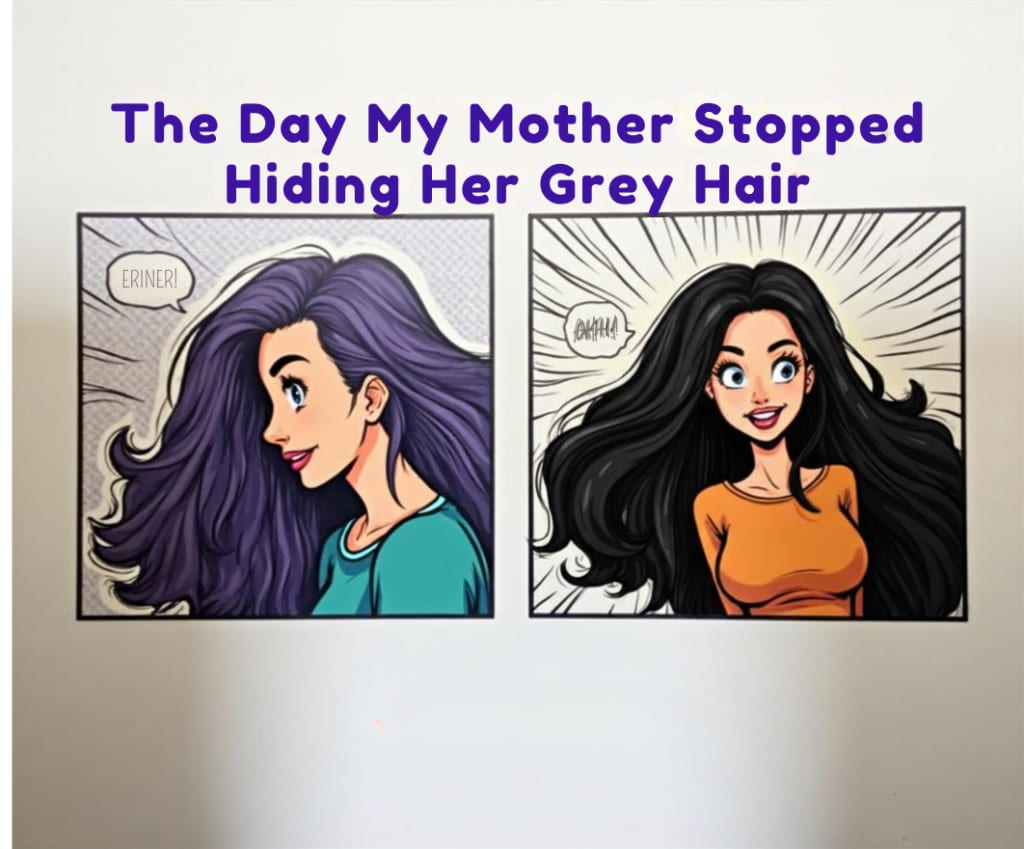
It was a Sunday afternoon. The kind of slow, quiet Sunday where the whole family is home but nobody is really doing anything. My mother was sitting near the window, the afternoon light falling directly on her hair, and for the first time in years—she had not tied a dupatta over her head.
She was just sitting there. Comfortable. Unbothered.
Her hair was a deep, natural brown with the faintest reddish warmth running through it. Not the flat, chemical black that used to make her hair look painted. Not the patchy grey she had been self-conscious about for nearly a decade. Something in between—something that looked genuinely, quietly beautiful.
My father noticed too. He did not say anything dramatic. He just looked at her and said, "Aaj baal aache lag rahe hain."
She smiled. And I knew exactly why.
It Started With a Problem We Did Not Know How to Solve
My family has been in the herbal product business for a long time. We are manufacturers—not resellers, not distributors, but actual manufacturers of herbal hair color. And for most of that time, our biggest customers were other businesses. Salons, beauty stores, and wholesale buyers would purchase henna powder wholesale and repackage or use it in their own way.
We knew our product was good. We knew the sourcing was clean, the processing was careful, and the herbs we used were genuine. But somewhere along the way, the people closest to us—our own family—had quietly drifted toward chemical hair dyes.
Convenience, mostly. Chemical dye is fast. It covers grey in forty minutes flat. It comes in a small box with simple instructions. For busy women juggling homes and work and everything in between, that convenience is hard to argue with.
My mother had been using chemical hair dye for almost eight years.
And for eight years, I had watched her hair slowly change. It became drier. The ends would split faster than she could trim them. Her scalp, which she had never complained about before, started feeling tight and itchy around the time of every application. She started spacing her dye sessions further apart—not because she wanted to, but because her scalp needed time to recover.
She never connected it directly to the chemical dye. Most people do not. They just quietly absorb the discomfort and call it aging.
The Conversation That Changed Things
One evening, I sat down with her properly—not as her son running a business, just as her son—and asked her to try our product. Not the commercial version we sell in bulk. The formulation we had been refining for almost two years. The one that used wholesale henna powder sourced directly from farms we had personally visited, combined with a careful blend of herbs that had been used in Indian hair care for centuries.
She was skeptical. Understandably.
"Mehndi toh orange ho jaati hai," she said. "Main woh nahi chahti."
This is the most common misunderstanding people have about herbal hair color. Plain henna — just henna leaf powder alone — does give an orange or reddish tint, especially on grey hair. But that is not what herbal hair color is. A well-formulated herbal hair color is a precise combination of henna with other plant-based ingredients—indigo, amla, bhringraj, brahmi, and shikakai—each one doing something specific, all of them working together to give a natural, believable color result.
I explained this to her. She listened. She agreed to try it once.
The First Application
We applied it on a Saturday morning. She sat reading a book while the color processed—which does take longer than chemical dye; I will not pretend otherwise. Good herbal hair color needs time. Roughly two hours for the full result to develop. That is the one honest compromise you make.
But what you gain in return is something chemical dye simply cannot offer.
When she rinsed it out that afternoon, her hair felt immediately different. Softer. Heavier in a good way — the kind of weight that comes from hair that is actually nourished rather than stripped. The color was a warm, deep brown. Not uniform in that flat, artificial way. It had dimension—slightly lighter where the sun had naturally lightened her hair, slightly deeper at the roots, with a very subtle warmth running through it that looked completely natural.
She stood in front of the mirror for a long time without saying anything.
Then: "Yeh toh bahut acha hai."
What Herbal Hair Color Actually Does — And Why It Is Different
Since that Saturday, my mother has not gone back to chemical dye. Not once. And the difference in her hair over the following months was something our whole family noticed.
But I want to explain the why behind it—because this is something most people never get clearly explained to them.
Herbal hair color does not penetrate the hair shaft with harsh chemicals. Chemical dyes use ammonia and peroxide to force pigment into the hair. This opens the cuticle forcefully, deposits synthetic color, and leaves the hair structurally weakened over time. That is why chemically dyed hair often feels rough, breaks more easily, and loses its natural shine.
Herbal hair color — when made from genuine, high-quality wholesale henna powder and other plant ingredients — works with the hair rather than against it. The lawsone molecule in henna binds naturally to the keratin in your hair. It coats and strengthens the shaft rather than stripping it. Over repeated applications, hair actually begins to feel stronger, thicker, and more resilient.
The scalp benefits are equally significant. Herbs like amla are deeply conditioning and known to balance the scalp's natural environment. Bhringraj has been used in Ayurvedic hair care for centuries, specifically because of how it supports the scalp. Brahmi has a calming effect on irritated skin. When these ingredients are present in a properly made herbal hair color, every application is also quietly doing something beneficial for the scalp—not just coloring the hair.
Gray coverage with herbal color improves with each use. This surprises people. Chemical dye gives you the same result every time — full coverage, full uniformity. Herbal hair color builds. The first application gives you good coverage. The second gives you deeper coverage. By the third or fourth application, the color has a richness and depth that genuinely looks like natural hair.
No harsh smell. No stinging scalp. No burning sensation. If you have ever applied a chemical hair dye and felt that familiar scalp tingle — sometimes bordering on painful — you know exactly what I mean. That sensation is your scalp reacting to the chemicals. It is so normalized that most people assume it is just part of the process. It is not. With a clean herbal formulation, the application process is genuinely comfortable.
What We Learned as Manufacturers
Running a herbal hair color manufacturing business has taught me things I could not have learned any other way.
The quality of the raw material is everything. Everything. You can have the best formulation in the world, but if the henna powder wholesale you are using has been sitting in a warehouse for eighteen months, or has been adulterated with metallic salts, or was grown in conditions that produced low lawsone content—the final product will always disappoint.
This is why, when we source our henna, we are meticulous. We visit farms. We check harvest timings. We test lawsone content batch by batch. We verify that nothing has been added — no chemicals, no synthetic dyes, no fillers. Pure, dried, finely milled henna leaf. That is what high-quality herbal hair color is built on.
The herbs matter equally. Sourcing genuine, unadulterated amla, indigo, bhringraj, and other botanicals is harder than most people realize. The market for herbal ingredients has its own quality spectrum — and at the lower end, you will find herbs that have been poorly dried, stored carelessly, or blended with inferior substitutes.
We learned early that there are no shortcuts in this. The person using the product on their hair trusts that what they are putting on their body is clean and genuine. That trust is not something we are willing to compromise on.
Back to That Sunday Afternoon
My mother is in her early sixties now.
She applies herbal hair color once every three to four weeks. Her hair has grown back noticeably thicker—she mentioned this herself, somewhat surprised. The itching and scalp discomfort she had quietly lived with for years? Gone completely.
And she does not wrap a dupatta over her head anymore when she does not feel like it.
That sounds like a small thing. But if you have ever watched someone you love be self-conscious about something as personal as their own hair — and then watched that self-consciousness quietly disappear — you understand why that Sunday afternoon felt like something worth writing about.
A Closing Thought for Anyone Still on Chemical Dye
I am not here to tell you that chemical hair dye is terrible or that everyone must immediately switch. People have different needs, different preferences, and different hair types.
But I will say this honestly: most people who have made the switch to a well-formulated herbal hair color—after the initial adjustment period, after they stopped expecting chemical-dye speed and chemical-dye uniformity—do not go back.
Not because they have to. Because they simply do not want to.
Your hair is with you every single day. What you put on it, and what you put into it, matters more than most of us realize—until the day we finally pay attention.
About the Creator
Kirpal Export Overseas
Kirpal Export Overseas is an international export Company and a trusted henna manufacturers in Rajasthan, offering natural henna hair color, organic henna powder, and herbal hair products sourced from Sojat, Rajasthan for global markets
Keep reading
More stories from writers in Longevity and other communities.
Microsoft's Purposeful Marketing Deception About AI's Ability To Beat Physicians In Diagnosis
When you look at the world of scientific research... If you are not careful... You will be fooled into believing things that are not actually supported by the data.
By Dr. Cody Dakota Wooten, DFM, DHM, DAS (hc)17 days ago in Longevity
Thirty (one) and Neither Flirty nor Thriving.
I'm thirty-one and orbiting the same few mistakes like they're landmarks. London is already awake before I am (or before I've slept) - sirens somewhere far enough to ignore, buses sighing at stops, people moving with purpose I can't quite borrow. I lie there for a bit, tasting last night at the back of my throat, trying to remember if I meant to drink that much or if it just...happened again.
By Stacey Vella6 days ago in Psyche


Comments
There are no comments for this story
Be the first to respond and start the conversation.