
The World’s BIGGEST Airplane & Its Crazy Transport Network
Transport Network

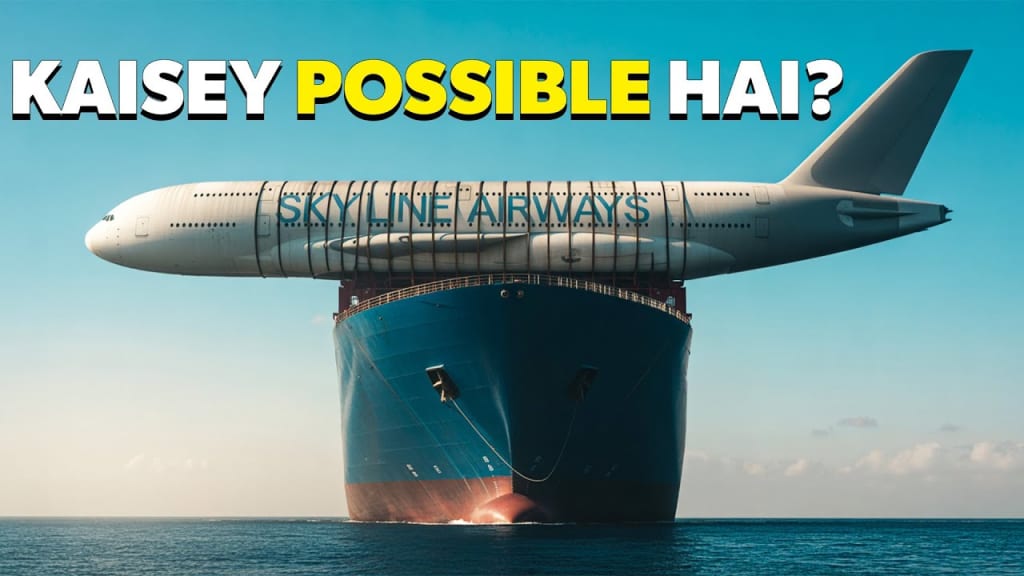
The Giant's Journey: How Airbus Transports the World's Largest Planes
Airbus is a European powerhouse, producing nearly three aircraft every single day. But there is a massive catch: the parts for these planes are manufactured in different countries—wings in the UK, tails in Germany and Spain, and fuselage sections in France. Bringing them all to the final assembly line in Toulouse, France, is one of the most complex transport puzzles in the world.
The Beluga: The Whale of the Skies
For most Airbus models (like the A320 or A350), the company uses a custom-built cargo plane called the Beluga (and its larger successor, the Beluga XL).
Design: Named after the Beluga whale because of its bulging forehead, this plane's nose opens upward like a car hood.
Capacity: It is 56 meters long and as tall as a seven-story building. It can carry a pair of A350 wings, worth over $40 million, across Europe in just two hours—a journey that used to take months by road.
The A380 Challenge: Too Big to Fly
The Airbus A380, the world's largest passenger plane, created a crisis. It was so massive that its parts—especially the fuselage and one-piece wings—could not fit inside even the largest Beluga. Building an even bigger plane (a "Beluga XXL") was deemed too expensive for a low-volume aircraft.
Instead, Airbus created a "Super Convoy" using sea, river, and road.
Phase 1: The High Seas (Ro-Ro Ships)
Airbus commissioned specialized Roll-on/Roll-off (Ro-Ro) ships, like the City of Hamburg.
Parts are rolled directly into the ship on platforms, eliminating the need for risky cranes.
The ships travel 1,600 km from Hamburg, Germany, to Saint-Nazaire, France. The crew must check the cargo every four hours, as a single scratch on a 400-crore wing could ruin the entire part.
Phase 2: The River Gamble (The 3-Minute Window)
From the coast, parts are moved onto barges to travel up the Garonne River toward Bordeaux.
The Bridge Obstacle: They must pass under the historic Pont de Pierre bridge built in 1810. Its arches are so tight that only "Arch Number 9" is wide enough.
The Tide Factor: Because of the bridge's low height, the barges can only pass at low tide. The captain often has a tiny 3-minute window of opportunity every 12 hours. If they miss it, the entire production schedule for the world's largest plane grinds to a halt.
Phase 3: The Night Convoy (The Road to Toulouse)
The final 250 km from Bordeaux to Toulouse is covered by a massive road convoy.
The Trucks: 50-meter-long "Super Trucks" with 96 wheels and 650 horsepower engines.
The Maneuver: To avoid chaos, these convoys only move at night with a 40-person team of police and engineers. They pass through tiny villages where the wings (extending 15 meters behind the truck) clear rooftops and trees by mere centimeters.
The Final Result
Once in Toulouse, the "Lego set" is snapped together.
Assembly: It takes 19,000 rivets to join the fuselage sections and 4,000 to attach the wings.
Stats: A completed A380 can carry 850 passengers and weighs as much as 300 SUVs (575,000 kg).
Price Tag: One A380 costs about $445 million (approx. ₹3,800 crore)—enough to buy five Boeing 737s.
Today, only 251 units exist, with nearly 50% owned by Emirates. The next time you see an A380, remember it didn't just fly to you—it sailed, floated, and rolled through the heart of Europe first.
About the Creator
Imran Ali Shah
🌍 Vical Midea | Imran
🎥 Turning ideas into viral content
✨ Watch • Share • Enjoy
Keep reading
More stories from Imran Ali Shah and writers in History and other communities.
Fake Film, Real Escape: CIA's Rescue Operation in IRAN
On November 4, 1979, in the heart of Tehran, thousands of protesters stormed the United States Embassy, climbing over its gates and walls. Their target was the Americans inside. The embassy security surrendered, and within hours, 52 American diplomats and workers were taken hostage.
By Imran Ali Shah6 days ago in History
Who Killed Ramesses III?
For centuries, the death of Pharaoh Ramesses III—one of ancient Egypt’s last great rulers—remained shrouded in mystery. Historians knew he died around 1155 BCE, but whether his death was natural or the result of foul play was unclear. Ancient texts hinted at intrigue, betrayal, and a palace conspiracy, yet definitive proof remained elusive. It wasn’t until the 21st century that science finally uncovered the truth, revealing a chilling tale of assassination at the heart of the royal court.
By Irshad Abbasi a day ago in History
The Irony of Flying While We Bomb the "World's Greatest Terror Regime"
Ah, the irony of flying at this moment in time as the United States is simultaneously bombing Iran - the nation officials have insisted for decades is "The World's Greatest Terror Regime" - while the TSA is on a go-slow, courtesy of a funding squeeze that's left its officers unpaid, quitting in droves, and turning checkpoints into something like slow-moving bread lines.
By Scott Christenson🌴8 days ago in Humor


Comments
There are no comments for this story
Be the first to respond and start the conversation.