
The Spiritualist Craze That Captivated the World a Century Ago
How grief, curiosity, and new technology fueled a global obsession with communicating beyond the grave

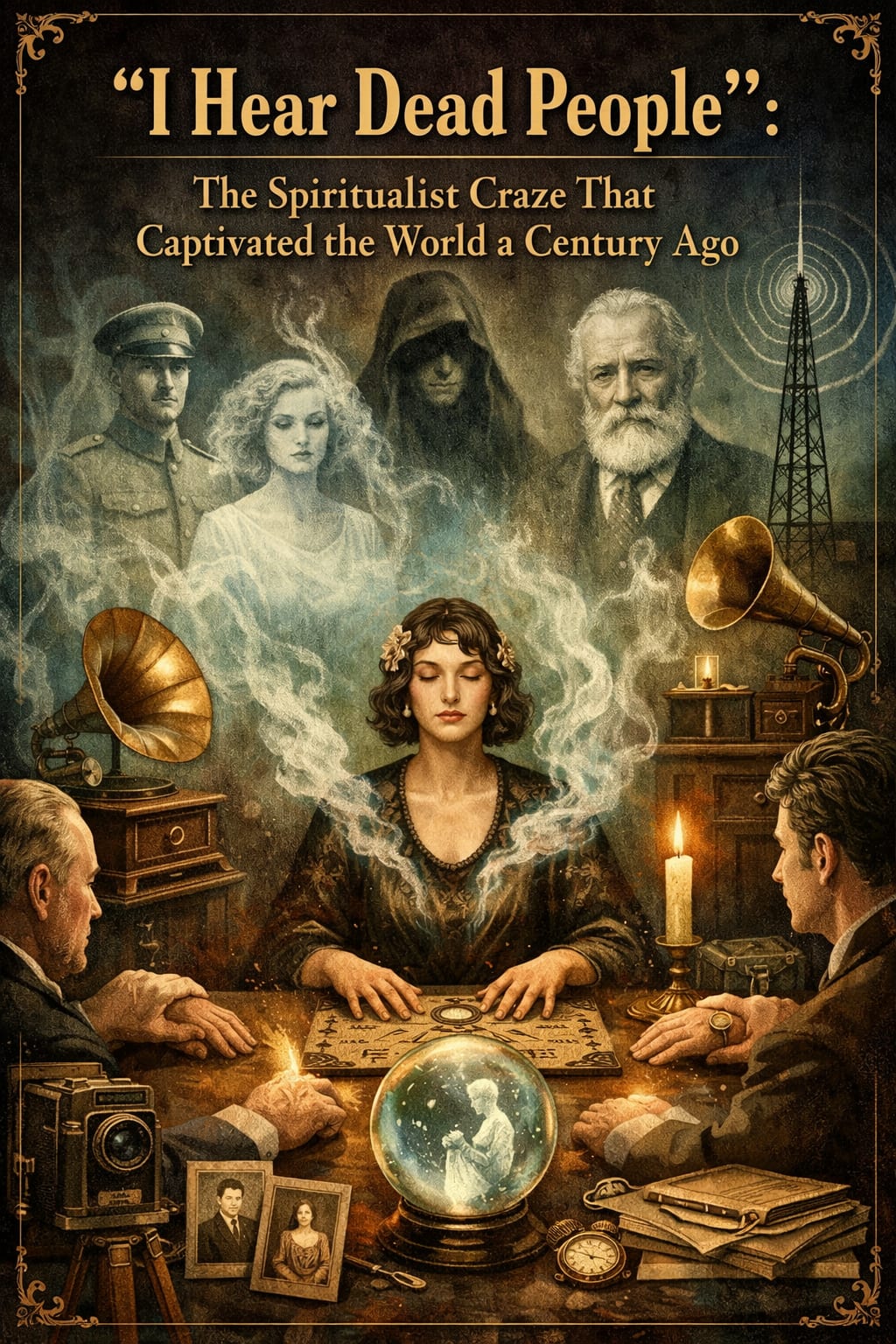
In the early decades of the 20th century, a strange and compelling belief swept across continents: the idea that the living could speak with the dead. Séances became social events, mediums rose to celebrity status, and ordinary people found themselves drawn into dimly lit rooms, hoping to hear whispers from the beyond. What began as a fringe curiosity evolved into a worldwide cultural phenomenon—one driven as much by emotion as by mystery.
The roots of this movement, known as Spiritualism, stretch back to the 19th century, but it reached its peak popularity roughly 100 years ago. The aftermath of World War I played a crucial role. Millions of families were grieving loved ones lost on battlefields, often without closure. In a world struggling to cope with immense loss, the promise of reconnecting with the dead offered comfort that traditional institutions sometimes could not provide.
Mediums—individuals believed to possess the ability to communicate with spirits—became central figures in this movement. They claimed to receive messages through various means: automatic writing, trance speaking, or even physical manifestations like knocking sounds and moving objects. Some reported hearing voices directly, describing experiences that today might be interpreted very differently. Back then, however, such claims were often met with fascination rather than skepticism.
Séances were theatrical and emotional. Participants would gather around tables, holding hands as lights dimmed. A medium might enter a trance, their voice changing as they relayed messages allegedly from the deceased. Objects might rattle, candles flicker, and sometimes “spirit forms” were said to appear. Whether staged or genuine, these experiences felt real to those present, reinforcing belief in the supernatural.
Technology, surprisingly, also played a role in fueling the craze. The early 20th century was a time of rapid innovation—telephones, radios, and motion pictures were transforming communication and perception. If voices could travel invisibly across wires or through the air, was it so impossible that they might also travel from another realm? The line between science and the supernatural blurred, allowing Spiritualism to flourish in a modern context.
Even respected intellectuals and public figures were drawn into the movement. Some saw it as a legitimate field of study, attempting to investigate psychic phenomena using scientific methods. Organizations dedicated to psychical research emerged, aiming to separate genuine experiences from fraud. Yet, the results were often inconclusive, leaving room for both belief and doubt.
Of course, not everyone was convinced. Skeptics and illusionists frequently exposed fraudulent mediums who used clever tricks to deceive audiences. Hidden wires, secret accomplices, and sleight of hand explained many supposed “spirit” phenomena. These revelations cast a shadow over the movement, but they did little to extinguish it entirely. For many believers, the emotional truth of their experiences outweighed any logical explanations.
The appeal of Spiritualism lay not only in grief but also in curiosity about what lies beyond death. It offered a narrative in which death was not an end but a transition—a doorway to another plane of existence where personalities and memories endured. This idea challenged traditional religious doctrines while still providing a sense of continuity and hope.
By the mid-20th century, the popularity of Spiritualism began to decline, influenced by changing cultural attitudes and increased scientific scrutiny. However, the fascination with communicating with the dead never truly disappeared. It evolved into new forms—paranormal investigations, ghost hunting shows, and modern psychic practices continue to capture public imagination today.
Looking back, the Spiritualist craze reveals much about human nature. In times of uncertainty and loss, people seek connection, meaning, and reassurance. The belief that the dead can speak offers all three, even if only temporarily. Whether viewed as a psychological coping mechanism, a cultural movement, or a genuine mystery, this chapter of history reminds us of our enduring desire to understand—and perhaps transcend—the boundary between life and death.
A century later, the echoes of that era still linger. The question remains as haunting as ever: if we could hear the voices of the departed, would we truly want to listen?
About the Creator
Irshad Abbasi
Ali ibn Abi Talib (RA) said 📚
“Knowledge is better than wealth, because knowledge protects you, while you have to protect wealth.
Keep reading
More stories from Irshad Abbasi and writers in History and other communities.
The Woman Who Defied the Modern Age
In an age defined by rapid scientific advancement, global wars, and technological progress, the idea of witchcraft seems like a relic of a distant, superstitious past. Yet, astonishingly, Britain’s last official witch lived not in medieval times, but in the 20th century. Her story is not just a curiosity—it is a striking reminder of how fear, belief, and law can collide even in modern societies.
By Irshad Abbasi about 11 hours ago in History
Corinne Griffith (1894-1979)
By Brian D’Ambrosio Corinne Griffith, born November 21, 1894, in Waco, Texas, became one of the most admired figures of the silent film era, celebrated for her elegance, poise, and expressive subtlety on screen. Known as “The Orchid Lady of the Screen,” Griffith cultivated an image of refinement and emotional restraint that set her apart from her contemporaries. Beneath the Hollywood persona lay a Texas childhood shaped by her Italian ancestry and the civic prominence of her maternal family, whose accomplishments left a lasting impression on her sense of artistry, ambition, and cultural awareness.
By Brian D'Ambrosio 4 days ago in History


Comments
There are no comments for this story
Be the first to respond and start the conversation.