
Powerful Women of the Mughal Empire
Exploring the extraordinary influence and authority of royal women who shaped one of South Asia’s greatest empires

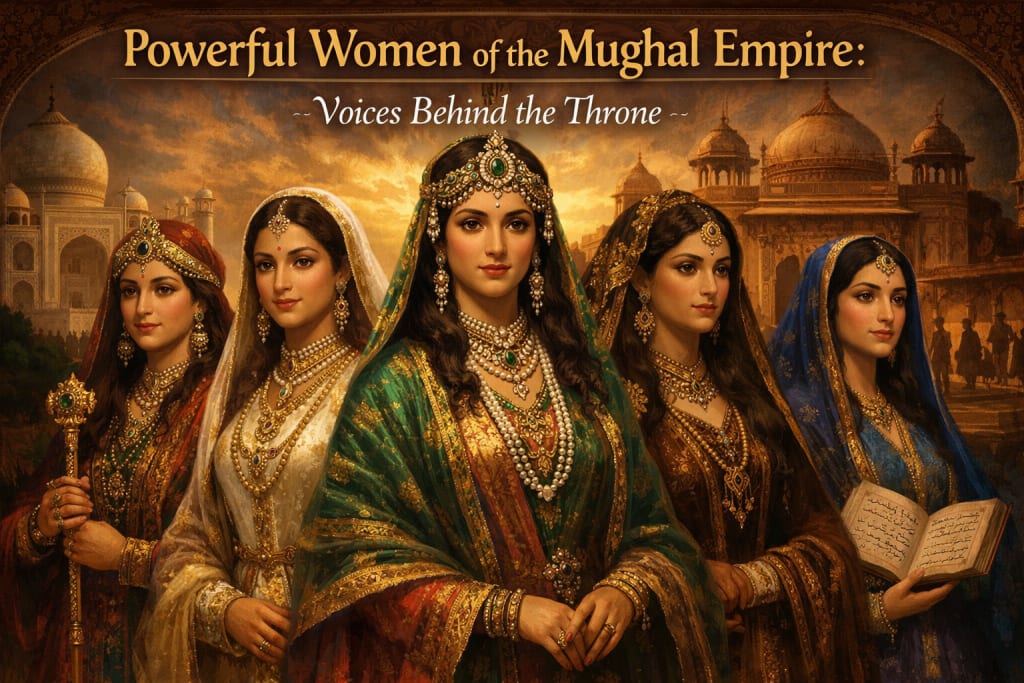
The Mughal Empire, often remembered for its grand architecture, powerful emperors, and cultural achievements, was not solely shaped by men. Behind the imposing walls of royal courts and harems, several women wielded remarkable authority, influencing politics, administration, and even imperial succession. These women were not mere spectators of history—they were active participants who exercised power in ways that challenged the norms of their time.
One of the most prominent figures was Empress Nur Jahan, the wife of Emperor Jahangir. Her rise to power remains one of the most extraordinary stories in Mughal history. Nur Jahan did not simply hold symbolic influence; she effectively governed the empire during Jahangir’s later years. She issued royal decrees (firmans), had coins minted in her name, and participated directly in state affairs. Her political acumen, combined with her strategic alliances, allowed her to control key decisions of the empire. She also played a significant role in court politics, influencing appointments and managing rival factions.
Another remarkable woman was Mumtaz Mahal, widely known today as the inspiration behind the Taj Mahal. However, her role extended far beyond being a beloved consort of Emperor Shah Jahan. Mumtaz Mahal was a trusted advisor who accompanied the emperor on military campaigns and was deeply involved in administrative matters. She was known for her compassion and influence over imperial policies, particularly those related to charity and justice. Her death had a profound emotional impact on Shah Jahan, leading to the construction of one of the most iconic monuments in the world.
Jahanara Begum, the daughter of Shah Jahan and Mumtaz Mahal, stands out as one of the most powerful princesses in Mughal history. After her mother’s death, she assumed the role of Padshah Begum (First Lady of the Empire), giving her immense authority within the court. Jahanara managed vast estates, engaged in trade, and acted as an important mediator in political conflicts, especially during the war of succession among her brothers. Her influence extended to spiritual and cultural domains as well; she was a patron of Sufism and contributed to architectural projects in Delhi and Agra.
In contrast, Roshanara Begum, Jahanara’s sister, demonstrated a different style of power. She played a decisive role during the Mughal war of succession by supporting her brother Aurangzeb. Her political maneuvering and intelligence gathering helped Aurangzeb secure the throne. In return, she was granted significant privileges and influence in the imperial court. Roshanara’s story highlights the strategic and often ruthless nature of court politics, where women could be key players in shaping dynastic outcomes.
Zeb-un-Nissa, the daughter of Emperor Aurangzeb, represents another dimension of female power—intellectual and cultural influence. A poet, scholar, and patron of the arts, she was deeply respected for her literary contributions. Writing under the pen name “Makhfi” (meaning “hidden”), Zeb-un-Nissa produced a substantial body of Persian poetry. Despite living under a conservative regime, she carved out a space for intellectual expression and artistic patronage, influencing the cultural landscape of the Mughal court.
These women operated within a system that often restricted their public visibility, yet they found ways to exercise authority behind the scenes. The Mughal harem, often misunderstood as merely a place of seclusion, functioned as a complex political institution. It was a space where alliances were formed, decisions were influenced, and power was negotiated. Women within this sphere used their positions, relationships, and intelligence to shape imperial policies and outcomes.
What makes these women particularly remarkable is their ability to navigate a patriarchal structure and still emerge as influential figures. They utilized various tools—marriage alliances, economic resources, education, and personal charisma—to assert their authority. In many cases, their contributions were crucial to the stability and continuity of the empire.
In conclusion, the history of the Mughal Empire cannot be fully understood without acknowledging the powerful women who stood behind and beside its rulers. Figures like Nur Jahan, Mumtaz Mahal, Jahanara Begum, Roshanara Begum, and Zeb-un-Nissa demonstrate that influence in the Mughal court was not limited by gender. Their legacies challenge traditional narratives and remind us that power often exists in unexpected places, exercised by individuals whose stories deserve greater recognition.
About the Creator
Irshad Abbasi
Ali ibn Abi Talib (RA) said 📚
“Knowledge is better than wealth, because knowledge protects you, while you have to protect wealth.
Keep reading
More stories from Irshad Abbasi and writers in History and other communities.
The Life, Legacy, and Rise of Sikhism’s Ninth Guru
The 400th birth anniversary of Guru Tegh Bahadur is an important milestone for Sikhs and admirers of his legacy worldwide. Known for his courage, spiritual depth, and ultimate sacrifice, Guru Tegh Bahadur stands as a timeless symbol of religious freedom and human rights. His life journey—from a quiet, contemplative individual to the ninth Guru of Sikhism—offers profound lessons about faith, leadership, and moral conviction.
By Irshad Abbasi 7 days ago in History
Corinne Griffith (1894-1979)
By Brian D’Ambrosio Corinne Griffith, born November 21, 1894, in Waco, Texas, became one of the most admired figures of the silent film era, celebrated for her elegance, poise, and expressive subtlety on screen. Known as “The Orchid Lady of the Screen,” Griffith cultivated an image of refinement and emotional restraint that set her apart from her contemporaries. Beneath the Hollywood persona lay a Texas childhood shaped by her Italian ancestry and the civic prominence of her maternal family, whose accomplishments left a lasting impression on her sense of artistry, ambition, and cultural awareness.
By Brian D'Ambrosio 4 days ago in History
5 Battles in History Where Divine Intervention Changed Everything
War has been a part of human history for as long as we can remember. From defending territories to protecting loved ones, humans have always found a reason to fight. While strategy, planning, and leadership often decide the outcome of battles, there are moments when fate or perhaps something greater intervenes to tip the scales. Here are five of history’s most decisive battles that were allegedly won thanks to divine intervention.
By Areeba Umair5 days ago in History




Comments
There are no comments for this story
Be the first to respond and start the conversation.