
Palm Sunday: The legend of the cross on the donkey's back
Folklore and facts about the animal that Christ rode upon into Jerusalem.


The Bible tells us in all four Gospels (Matthew 21:1–11, Mark 11:1–11, Luke 19:28–44, and John 12:12–19) that Jesus rode a donkey into Jerusalem the Sunday before His Crucifixion. Christians celebrate this date as Palm Sunday because people placed palm branches in the road as Jesus rode by.
They shouted Hosanna and hailed him, King, From this jubilation, a legend was born about the cross-shaped symbol on the backs of some donkeys that can be seen today.
Those in attendance on the first Palm Sunday were welcoming Jesus as though he were entering the city to rule as a conquering king. His chosen mode of transportation indicated that he was not at that time approaching Jerusalem to rule an early kingdom.
The jackass was more in line with the words of Toy Story character Buzz Lightyear, who proclaimed, " I come in peace." The crowd was so excited as they placed clothing in the road and waved their palms that they missed the significance.
There are donkeys today with cross-shaped stripes down their backs, and legends say it's a reference to the Crucifixion. Many donkeys, especially the African wild donkey, the ancestor of domestic donkeys, have this dark stripe down their spines and across their shoulders.
The domestication of donkeys served to increase the mobility of pastoral cultures, having the advantage over ruminants of not needing time to chew their cud, and were vital in the development of long-distance trade across Egypt. In the Dynasty IV era of Egypt, between 2675 and 2565 BC, wealthy members of society were known to own over 1,000 donkeys, employed in agriculture, as dairy and meat animals and as pack animals Per Wikipedia).
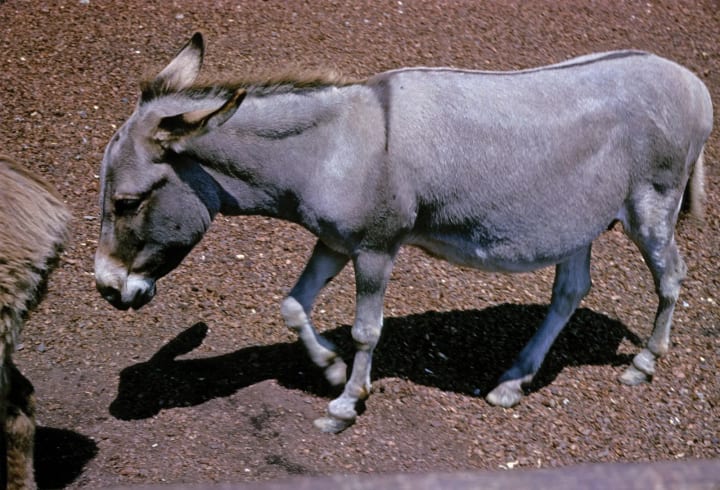
The two stripes intersect and form a cross, known as a "dorsal stripe" (the long one) and a “shoulder stripe.” (The one from shoulder to shoulder). Scientists say this is a genetic coat pattern that has been inherited, similar to the stripes on a zebra or markings on other animals.
Bible scholars agree that Jesus most likely rode into Jerusalem on a small, insignificant Wild African Ass. This humble animal symbolized that Jesus came in peace and fulfilled the prophecy of Zechariah 9:9. Kings used war horses, and when Jesus returns, He will be on a horse, signaling He is King of kings.
The Christian legend says that after witnessing the Crucifixion of Christ, the donkey was marked with a cross on its back as a sign of remembrance and honor. In other words, the horror of seeing Jesus Crucified shocked the animal, and the markings appeared.
The cross shape on the donkey's back is used as a meaningful symbol when retelling the Crucifixion story. The donkey that Mary rode into Jerusalem when she gave birth to the Christ Child is an ancestor of the one Jesus rode on Palm Sunday.
Both explanations about the cross on the donkey's back are legit. One explains why the marking exists, and the other explains what the symbolism means to people culturally and spiritually.
The donkey's cross symbolizes the Crucifixion, and can be used as a teaching tool, but science suggests these animals were around before the birth of Jesus. Still, the animal Jesus rode, having a cross on its back, is a powerful symbol for believers of not only Palm Sunday, but Good Friday and Easter Sunday also.
Another way to look at this is that the donkeys that predated Christ, who bore this mark, were prophesying the future when one of their own would carry Jesus into Jerusalem on Palm Sunday.
About the Creator
Cheryl E Preston
Cheryl is currently pursuing a Bachelor of Science in Psychology. She enjoys writing about current events, history and baby boomer nostalgia. Tips are greatly appreciated.
Keep reading
More stories from Cheryl E Preston and writers in History and other communities.
Church Anniversary and Founders Day: The purpose and focus is different
Founders Day or Church Anniversary? Jesus said in Matthew 16:18 that His church would be founded on the revelation of who Peter said He was, which was "the Christ, the Son of the Living God." In Christian churches, you will hear about Founder's Day and Church Anniversary.
By Cheryl E Preston9 days ago in History
Iran’s Mosaic Doctrine Rising
The Mosaic Doctrine: Is Iran Following Israel’s Strategic Playbook? From Defense to Pre-Emptive Intelligence Power In modern geopolitical warfare, few strategic doctrines have shaped intelligence operations like the Mosaic Doctrine, more widely known as the Begin Doctrine. Originally developed by Israeli leadership, this doctrine focuses on preventing enemies from becoming powerful enough to threaten national security — even if that requires covert operations, sabotage, or pre-emptive strikes.
By Wings of Time a day ago in History




Comments
There are no comments for this story
Be the first to respond and start the conversation.