
The Costliest Mistakes in the History of Civil Aviation
Seven aviation disasters that forced the industry to rewrite safety rules and rethink how mistakes happen.
In civil aviation, a mistake is rarely “small.” One inaccurate calculation, one bad phrase over the radio, one hidden defect, or one flawed design decision can end up costing hundreds of lives, billions of dollars, and public trust in an entire industry.
The costliest mistakes are not always the most famous disasters. They are the cases after which the industry had to rewrite rules, retrain pilots, redesign aircraft, and once again answer the same question: how did this become possible at all?
Here are seven such cases.
Aviation’s most expensive errors are not only stories of tragedy, but turning points that forced the industry to rebuild its own standards.
1. Tenerife, March 27, 1977: the deadliest mistake in radio communication
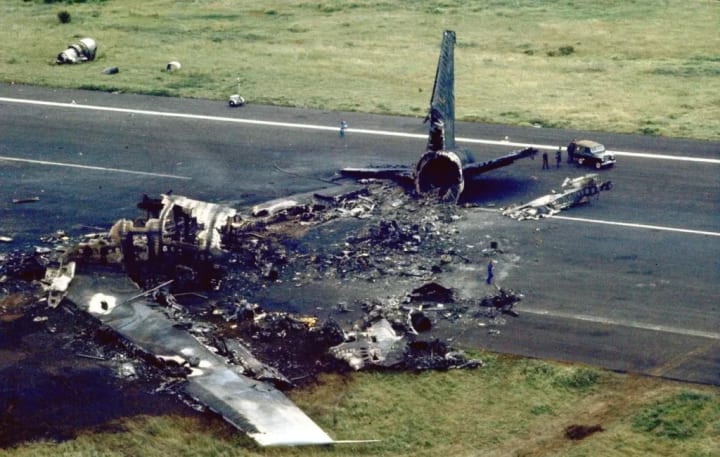
This remains the deadliest disaster in the history of civil aviation by number of victims. Two Boeing 747s collided at Los Rodeos Airport on the island of Tenerife. A total of 583 people were killed. Both aircraft were technically sound, the weather was poor because of fog, and the airport was overloaded after a terrorist attack on a neighboring island.
The chain of errors looked like this. The KLM captain wanted to take off as quickly as possible. Air traffic control gave clearance for the route, but not for takeoff. The KLM first officer understood the phrase ambiguously. At the same time, the Pan American aircraft had still not cleared the runway. When the KLM captain began the takeoff roll, the controller said, “OK, get ready for takeoff… I will call you.” But the last words were lost in interference. The KLM crew heard “takeoff” and moved forward.
After Tenerife, aviation rewrote radio communication rules in a much stricter way. Ambiguous phrasing was banned. Instead of “takeoff,” controllers began using “departure” until the moment when takeoff clearance had actually been given. Most importantly, this disaster gave a major push to the introduction of CRM, or Crew Resource Management, a system in which the first officer and flight engineer are expected to challenge the captain if they see danger. Before Tenerife, many cockpits operated under an unspoken ban on criticizing the captain. Afterward, that culture died.
2. Turkish Airlines Flight 981, March 3, 1974: the door that was never supposed to open
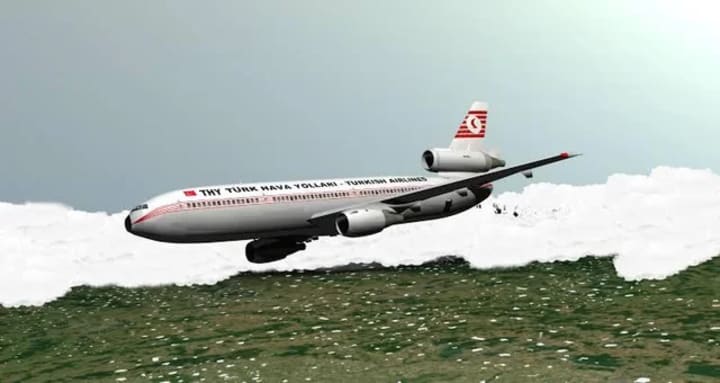
A McDonnell Douglas DC-10 departed Paris for London. Minutes after takeoff, the rear cargo door blew open. Explosive decompression followed. The cockpit floor collapsed downward, damaging the control cables for the elevators. The aircraft crashed into the Ermenonville Forest. All 346 people on board were killed.
The worst part was that the problem was already known. Two years earlier, in 1972, American Airlines Flight 96 had suffered almost the same cargo-door failure over Detroit. On that occasion, the pilots had managed to land by sheer luck. The investigation showed that the locking system made it possible for the door to appear closed from the outside without being fully secured. In flight, the pressure differential could force it outward.
The manufacturer issued a bulletin, but no urgent mandatory modification followed. Airlines delayed the changes. Two years later, the catastrophe happened again. After Flight 981, all DC-10s were urgently modified, and certification rules for doors and hatches became far stricter.
3. Japan Air Lines Flight 123, August 12, 1985: a deadly repair
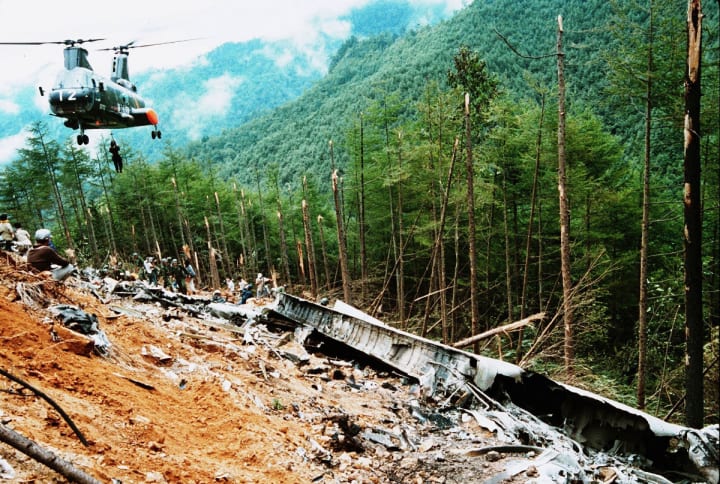
This remains the deadliest accident involving a single aircraft in history: 520 people died, and only 4 survived. The JAL Boeing 747 crashed in the mountains of Japan 32 minutes after takeoff. The cause took time to establish.
Seven years earlier, in 1978, the aircraft had suffered tail damage during landing, a tailstrike. The repair was carried out by Boeing. The official investigation found that the rear pressure bulkhead had been repaired incorrectly. Instead of using one continuous splice plate, technicians installed two, fastened in a way that did not match the approved procedure. Over time, metal fatigue produced cracks. In flight, the bulkhead failed, the vertical stabilizer was torn away, the hydraulic systems were damaged, and the aircraft became uncontrollable.
The lesson was horrifyingly simple: the mistake had not been made on the day of the disaster, but seven years earlier. After JAL 123, aviation reassessed control over repairs, especially hidden structural repairs invisible to the eye. Exact compliance with manufacturer procedures became absolute.
4. De Havilland Comet, 1953–1954: the square windows that killed
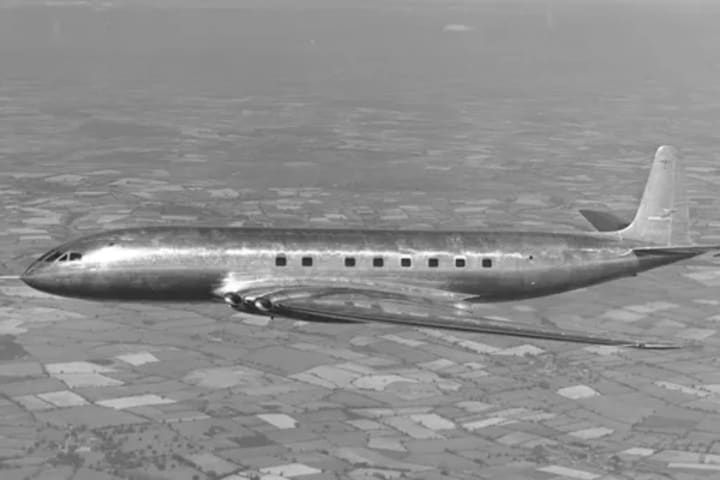
The world’s first jet airliner was supposed to symbolize a new era. Instead, it became one of the most expensive lessons in metal fatigue. In 1953 and 1954, Comets began breaking apart in midair. First came Flight 783 in India, then Flight 781 over Elba. Dozens were killed. The aircraft were simply disintegrating at altitude without any obvious reason.
The investigation took years. It revealed that the fuselage was failing from metal fatigue caused by repeated cycles of pressurization and depressurization. The main crack initiation points were the corners of the square windows, where stress concentrated most intensely.
After the Comet disasters, aircraft design changed forever. Windows became oval or round. Fuselage fatigue testing became mandatory. In many ways, the entire science of service life in pressurized jet aircraft was born from this mistake.
5. Air France Flight 447, June 1, 2009: when the autopilot gave up
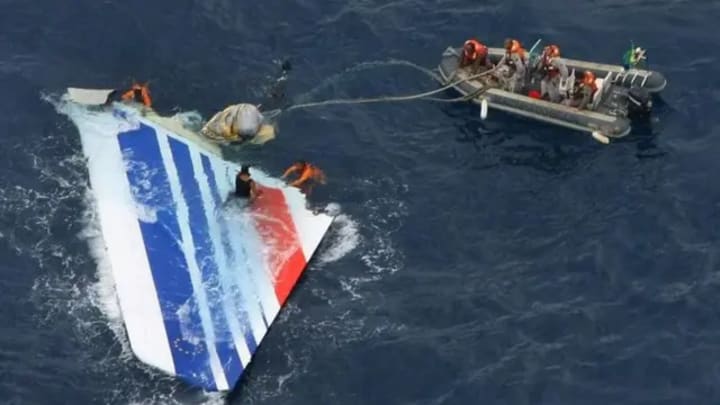
Flight AF447 was flying from Rio de Janeiro to Paris. The Airbus A330 entered a storm zone. The Pitot tubes, which measure airspeed, iced over and began giving contradictory readings. The autopilot disconnected. What happened next shocked the aviation world: experienced pilots were unable to recover from a stall.
First officer Bonin kept pulling the sidestick back, raising the nose higher, even though that only deepened the stall. The captain, who had been resting, returned too late. The aircraft remained in descent for 3 minutes and 30 seconds. All 228 people on board were killed.
The black boxes were found only two years later at a depth of four kilometers. Their data revealed something deeply disturbing: the pilots did not understand that the aircraft was stalled, did not perform the basic recovery procedure of lowering the nose and adding thrust, and acted in panic.
After AF447, pilot training programs were rewritten. Manual flying at high altitude, stall recovery, and training for unreliable airspeed indications became mandatory. This disaster shattered the myth that a modern “smart” aircraft would not allow pilots to make a fatal mistake.
6. Boeing 737 MAX, 2018–2019: the most expensive management mistake
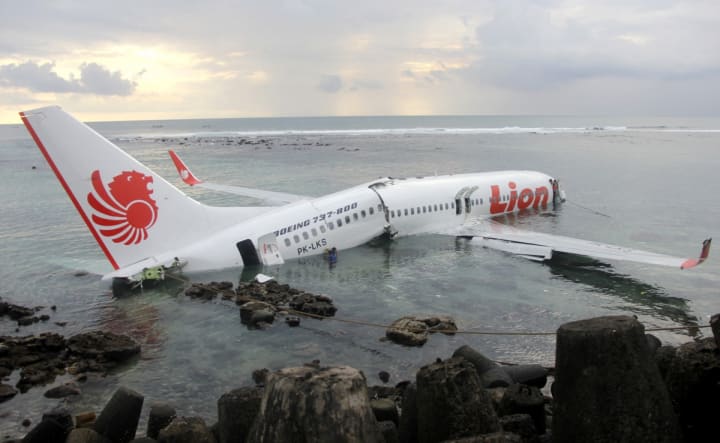
In October 2018, Lion Air Flight 610 crashed, killing 189 people. In March 2019, Ethiopian Airlines Flight 302 crashed, killing another 157. The result was 346 victims and the grounding of the entire 737 MAX fleet worldwide for 20 months.
At the center of the story was MCAS, the Maneuvering Characteristics Augmentation System. Boeing had installed new, larger, more fuel-efficient engines on the old 737 airframe. To fit them under the wings, they were moved forward and upward. As a result, in some flight conditions the aircraft tended to pitch its nose up. MCAS was designed to automatically push the nose down, but it relied on only one angle-of-attack sensor. If that sensor failed, MCAS could drive the aircraft into a dive. The pilots had not been told about MCAS and had not been trained for it.
The investigation showed that Boeing had deliberately minimized retraining requirements so airlines would not have to spend money on expensive simulators. In 2021, Boeing agreed to pay $2.5 billion as part of a criminal settlement. The real losses, once airline compensation and canceled orders were added, reached tens of billions.
The 737 MAX became an example of how engineering compromises, cost-cutting pressure, and poor communication with regulators can kill people.
7. Air France Flight 4590, July 25, 2000: the end of the Concorde era
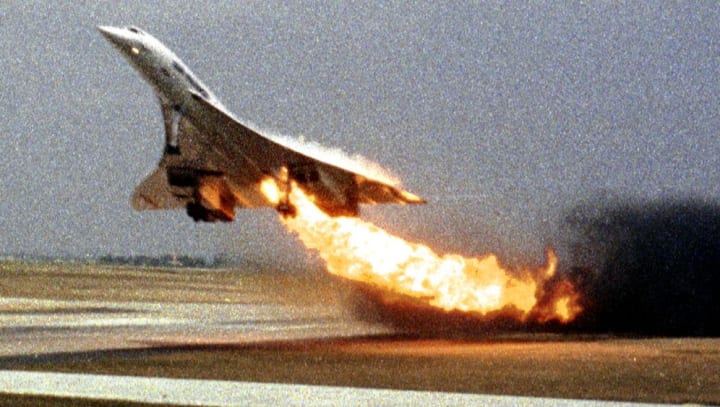
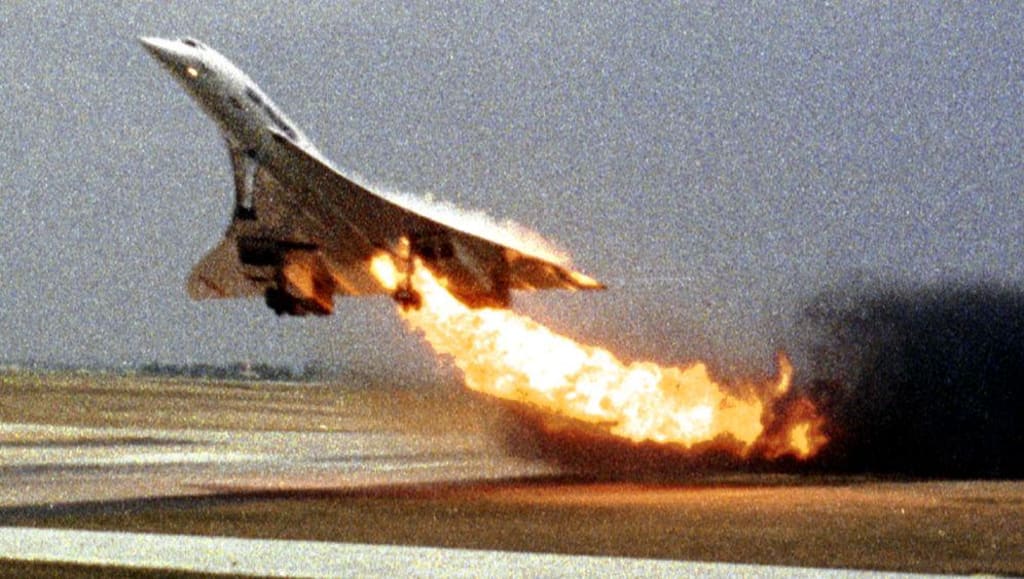
Concorde was a symbol: supersonic, luxurious, and extraordinarily expensive. Until July 25, 2000, it had also been accident-free. On that day, Flight 4590 was departing Paris for New York. A metal strip from a DC-10 that had taken off minutes earlier was lying on the runway. Concorde ran over it with a tire. The tire burst, and a large piece of rubber struck the wing, damaged a fuel tank, and disrupted landing-gear wiring. A fire broke out. The aircraft crashed into a hotel in Gonesse. A total of 109 people on board and 4 on the ground were killed.
This was the only fatal Concorde accident in 27 years of service. But it proved fatal for the project itself. The fleet was grounded for 18 months, and millions were spent on modifications, including Kevlar liners for the fuel tanks and new tires. Then September 11, 2001, effectively destroyed the premium travel market. Concorde’s operating costs became impossible to justify. In 2003, the supersonic airliners were retired for good.
This was not really an engineering mistake, but an accident triggered by debris on the runway. Even so, it showed how fragile even the most technologically advanced aircraft could be in the face of one small piece of metal.
The main point
The costliest mistakes in the history of civil aviation are not just tragedies. They are moments when the industry learned at an unbearably high price. Each of these errors cost lives, money, and years of work. But each one also made the sky a little safer for the people flying today.
About the Creator
The Courtesan Who Invited Nehru to Her Wedding and Earned the Respect of the Underworld
The story of Gangubai Kathiawadi is one that blurs the lines between myth and reality. Known widely as a powerful courtesan in Mumbai’s red-light district during the mid-20th century, Gangubai’s life was far from ordinary. Her journey from a vulnerable young girl to a woman of authority in a deeply stigmatized profession has fascinated historians, writers, and filmmakers alike. What makes her story even more compelling are the unusual relationships she maintained—with politicians, reformers, and even underworld figures.
By Irshad Abbasi 8 days ago in History
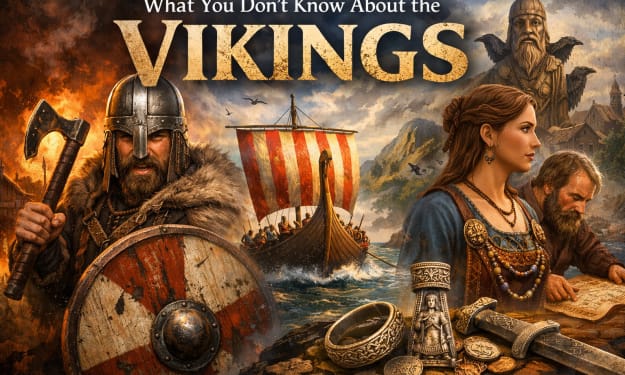
What You Don’t Know About the Vikings
When most people hear the word “Vikings,” they imagine fierce warriors with horned helmets, storming coastal villages in longships and leaving destruction in their wake. While there is some truth to their reputation as skilled raiders, the real story of the Vikings is far more complex—and far more fascinating.
By Irshad Abbasi 6 days ago in History



Comments
There are no comments for this story
Be the first to respond and start the conversation.