space
Space: The Final Frontier. Exploring space developments and theorizing about how humans fit into the universe.
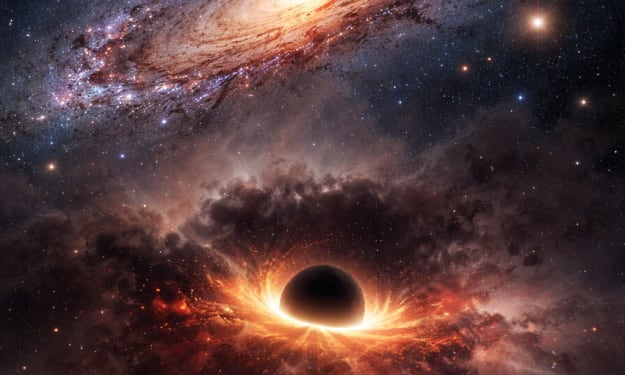
The Vanishing Star in Andromeda: The Birth of a Black Hole Without a Supernova
For decades, astronomers believed that the death of a massive star was always accompanied by one of the most spectacular events in the universe: a supernova explosion. These cosmic blasts can briefly outshine entire galaxies and scatter heavy elements across interstellar space. However, recent observations suggest that not all massive stars end their lives in such dramatic fashion. Some may simply disappear.
By Holianyk Ihor23 days ago in Futurism
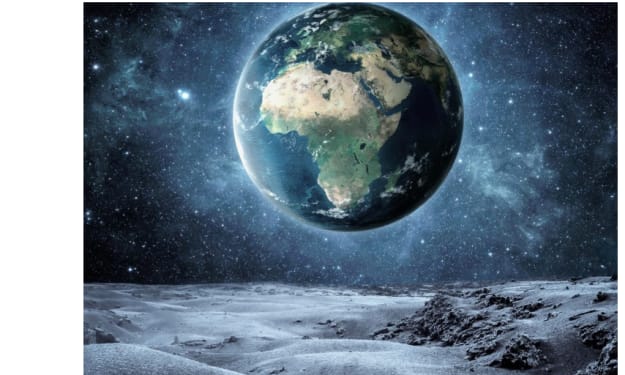
Earth's vast chemical storehouse is being gathered by the Moon.
Despite its seeming permanence, Earth's atmosphere is gradually seeping into space. According to recent studies, part of that wasted air does not vanish. Rather, it wanders away and lands on the Moon, where it slowly builds up over billions of years in the lunar soil. Science and exploration both depend on this process.
By Francis Dami24 days ago in Futurism
The Discovery of the Largest and Most Distant Black Hole
Black holes are among the most mysterious and fascinating objects in the universe. Formed when massive stars collapse under their own gravity, these cosmic giants possess gravitational forces so powerful that nothing—not even light—can escape them. Over the past few decades, astronomers have discovered thousands of black holes scattered across the universe. However, the discovery of one of the largest and most distant black holes ever detected has astonished scientists and opened new questions about how the early universe evolved.
By Irshad Abbasi 25 days ago in Futurism
Title: War's Effects on the World Economy: How Wars Change Financial Stability
Title: War's Effects on the World Economy: How Wars Change Financial Stability Introduction One of humankind's most destructive experiences is war. The immediate effects are frequently observed on battlefields, but the effects go far beyond military conflict. Around the world, wars have an impact on economies, cause trade to be disrupted, increase poverty, and cause financial instability.
By Farida Kabir25 days ago in Futurism
I Built a GPT Store Side Project and Realized the Agent Didn’t Need Me Anymore
A side project in the GPT Store was supposed to give me leverage. Instead, it gave me a weird identity crisis. I built what I thought was a simple AI agent, and somewhere between shipping version one and refreshing analytics at 2:17 a.m., I realized something I wasn’t ready for:
By abualyaanart27 days ago in Futurism
Why NASA Cancelled The Artemis III Lunar Landing
At 23:30 GMT on February 27th, 2026, a small compliment of analysts, technicians, and operators were in the operations center when the Advanced Scout Satelite alerted them to something unusual. Just mere months away from the long awaited return to the moon by humans, NASA and SpaceX had everybody paying close attention to the moon. A couple of generations ago, NASA and the United States celebrated their final trip to the moon, and hadn't returned since. And while the reasoning behind cessations of lunar exploration remained a mystery in many minds, America and the human race were finally about to return to the first step away from Earth and into the galaxy.
By The Man Behind The Mask28 days ago in Futurism
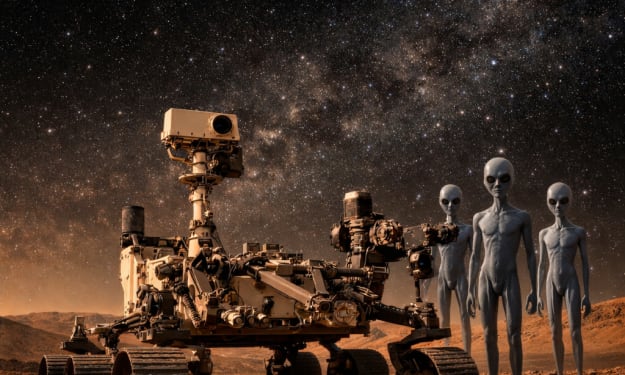
“Who Really Saw Aliens First? The Truth Behind the Mystery”
Have you ever looked up at the night sky and felt a strange question echo in your mind — Are we truly alone? For thousands of years, humans have stared at the stars with wonder, fear, and curiosity. Long before rockets, telescopes, or modern science, ancient civilizations imagined that other worlds might exist beyond our own. The mystery of aliens — life beyond Earth — did not begin with movies or science fiction. It began with simple human curiosity.
By imtiazalam29 days ago in Futurism
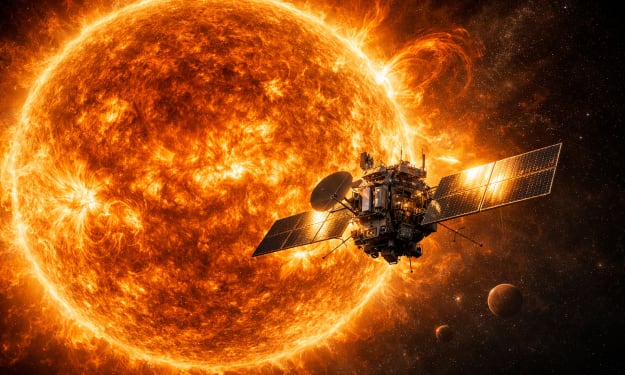
The Cosmic Influence of the Sun on the Inner Planets and Climate
At the center of our planetary system lies Sun, a G-type main-sequence star that governs the physical and climatic evolution of the inner planets: Mercury, Venus, Earth, and Mars. Although these worlds share a common origin and relatively close orbital distances, their climates differ dramatically. The explanation lies in how each planet interacts with solar radiation, solar wind, and long-term stellar evolution.
By Holianyk Ihor30 days ago in Futurism
The Dynamics of the Interstellar Medium and Galactic Magnetism
At first glance, the space between stars appears empty — a silent vacuum separating luminous islands of light. In reality, this vast region is filled with a complex, restless environment known as the interstellar medium (ISM). Far from being inert, it is a dynamic system of gas, plasma, dust, radiation, turbulence, and magnetic fields. Within galaxies such as the Milky Way, the interstellar medium functions as both the raw material and the regulating mechanism for star formation, cosmic ray transport, and large-scale galactic structure.
By Holianyk Ihor30 days ago in Futurism