space
Space: The Final Frontier. Exploring space developments and theorizing about how humans fit into the universe.
The Island is Sinking: Why the iPhone 18 Pro’s 35% Shrink is a Supply Chain Masterstroke
1. Introduction: The Vanishing Act The "Dynamic Island" was a masterclass in turning a hardware flaw into a software signature. Since its 2022 debut, it has functioned as a crucial UX bridge, masking the sensor suite with fluid animations. But for the purists, it was always a compromise—a temporary inhabitant on the road to an uninterrupted display.
By Tech Horizonsabout 23 hours ago in Futurism
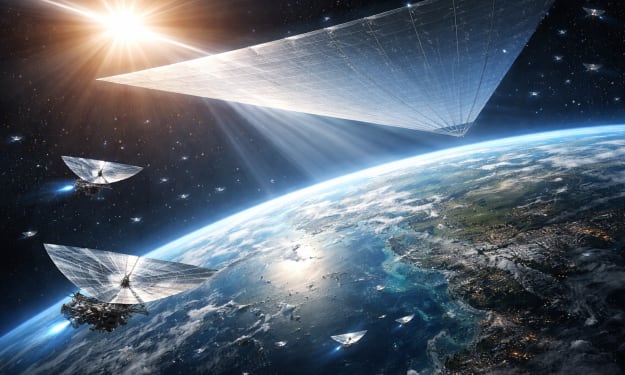
Space-Based Geoengineering: Can We Cool the Earth from Orbit?
As global temperatures continue to rise, the conversation around climate intervention is becoming more urgent—and more unconventional. Among the most ambitious ideas is space-based geoengineering: using structures placed in orbit to reduce the amount of solar energy reaching Earth. It sounds like science fiction, but researchers have been seriously exploring whether cooling our planet from space could one day become a viable option.
By Holianyk Ihora day ago in Futurism
The origins of the Kamchatka earthquake is revealed by satellites that find concealed tsunami waves.
A second, shorter wave signal that reveals a rupture within six miles of the trench was brought by a tsunami caused by an earthquake off the Kamchatka Peninsula in Russia in 2025.
By Francis Dami2 days ago in Futurism
10 Mind-Blowing Space Facts You Were Never Taught in School
We’ve all heard the phrase that space is the final frontier. But let’s be honest, what most of us learned in school barely scratched the surface. Beyond the neat diagrams and textbook definitions lies a universe filled with weird, shocking, and sometimes hilarious realities.
By Areeba Umair5 days ago in Futurism
The Planet Nine Hypothesis: A Hidden Giant at the Edge of Our Solar System
For decades, astronomers believed the architecture of our Solar System was largely settled: eight planets orbiting the Sun, with smaller bodies distributed across regions like the asteroid belt and the Kuiper Belt. Beyond these, the distant Oort Cloud was thought to mark the outer boundary of the Sun’s gravitational influence. Yet, in recent years, this seemingly complete picture has been challenged by a compelling and mysterious idea — the existence of a hidden world known as Planet Nine.
By Holianyk Ihor11 days ago in Futurism
The Mystery of Fast Radio Bursts (FRBs) and Their Possible Origins
In the early 21st century, radio astronomy encountered a phenomenon that quickly evolved into one of the most compelling mysteries in modern astrophysics: Fast Radio Bursts, or FRBs. These signals are extraordinarily brief yet immensely powerful flashes of radio waves arriving from deep space. Each burst lasts only a few milliseconds, but in that fleeting moment it can release as much energy as our Sun emits over several days.
By Holianyk Ihor11 days ago in Futurism
A Signal From Earth. AI-Generated.
The signal arrived at 02:17 ship time. At first, I assumed it was interference. Out here, space was never silent. It hummed with radiation storms, dying satellites, fragments of old civilizations drifting endlessly through vacuum. The receiver panels aboard the exploration vessel Aurora picked up thousands of meaningless transmissions every day—ghost echoes bouncing through the dark.
By Stephanie Edwards17 days ago in Futurism
The 1947 Paradox: The Secret Geometry of Our First Alien Encounter
We have spent eighty years looking for "little green men" in flying saucers, but the most confusing secret of the search for extraterrestrial life is that we may have been looking at the wrong thing entirely. As we sit here in 2026, with the James Webb Space Telescope sniffing out industrial chemicals on planets 120 light-years away, the evidence suggests that "aliens" aren't just visitors from another star—they are the operators of a technology that treats our laws of physics like a suggestion rather than a rule.
By imtiazalam20 days ago in Futurism
An unidentified space object was observed "screaming" out of our galaxy at a speed of more than one million miles per hour.
Although our Sun appears to be the center of the universe, it is actually moving at a speed of around 500,000 miles per hour as it circles the Milky Way galaxy. That's quick, but it pales in comparison to a star runaway that was just found and is speeding across space.
By Francis Dami20 days ago in Futurism
The “Silent Collapse” of a Star: A New Type of Stellar Death Discovered in Andromeda
For more than a century, astronomers believed that the death of a massive star was always one of the most dramatic events in the universe. When a giant star exhausts its nuclear fuel, its core collapses under gravity and the outer layers explode outward in a spectacular supernova. These explosions are so powerful that, for a brief time, a single star can shine brighter than an entire galaxy.
By Holianyk Ihor22 days ago in Futurism