humanity
The evolution of humanity, from one advancement to the next.
Is Technology Making Us Dumb?
It won’t be long before computers can think faster and better than humans. Artificial Intelligence exists, and it is getting smarter at an incredible rate. As so many focus on how well machines can think, alarmingly few people are concentrating on how well humans are thinking (or rather, how they aren’t thinking as well as they used to). A side effect of epic proportions has accompanied our ventures into superior technology. We have become inseparable from our computers and, as time goes on, we are relying on them for more and more of our daily cognitive functions. The brain needs exercise. When you don't use it often enough, your abilities deteriorate. The resources at our disposal are enabling us to perform more advanced tasks faster than ever before, but when it comes to plain old thinking, is technology making us dumb? The answer is two sided. On one hand, our ability to locate information is exponentially higher. On the other, we are retaining far less than we ever have.
By Chelsea Pullano10 years ago in Futurism
What Is the Bahai Faith?
As long as there has been religion, there has been conflict over which is the true religion. Humankind has been going to war over gods and customs for tens of thousands of years. Sometimes religion is a convenient mask for secular disputes over land, such as in the Israeli conflicts with Egypt and Syria. Sometimes it is the backdrop of cultural conflicts like terrorist activity in Afghanistan and Pakistan, or an old grudge like India and Pakistan. From ancient times to suicide bombers on the streets of Peshwar, the major religions have struggled against each other over claims of being the one true religion.
By Joshua Samuel Zook10 years ago in Futurism
World's Most Deadly Viruses
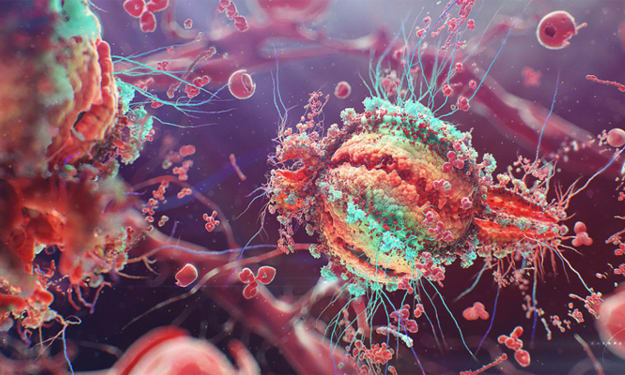
In the face of deadly viruses the only weapon humanity has is proper hand washing and disinfectant, but preventive measures may not be enough for the 10 deadliest viruses. A virus is a small infectious agent that replicates inside the living cells of other organisms. Viruses can infect all types of life forms, from animals and plants to bacteria and archaea. Science has not yet determined whether viruses constitute life because they lack key characteristics of life, such as cell structure. They have often been described as 'organisms at the edge of life.' What is known about viruses is that they cause serious illnesses and can destroy lives if not dealt with properly. The following viruses are not listed in any particular order but don't be fooled, they are all equally deadly. Also they are not just the only most dangerous, there are many more viruses that have brought humanity to its knees causing panic and terror in the hearts of many.
By George Gott10 years ago in Futurism
Carl Sagan Inspired Curiosity
Carl Sagan's enthusiasm and ability to convey ideas, such as humanity's place in the universe against the backdrop of a cosmic scale, inspired countless people to pursue their own curiosity. As the author of more than 600 scientific papers, editor of more than 20 books, and creator of Cosmos: A Personal Voyage, Sagan worked tirelessly to push science into the spotlight. He advocated heavily for scientific skeptical inquiry, pioneered exobiology, and promoted the Search for Extraterrestrial Intelligence (SETI). The name Sagan is inseparable from the word "curious."
By George Gott10 years ago in Futurism
Physics of Frisbees
No one gives a flying disk about Frisbees. It’s just a sport reserved for semi-athletic college students who don’t want to try out for a real team, right? Wrong. In 2012, Ultimate Frisbee players developed the American Ultimate Disc League which now has 25 teams across North America, according to the New Yorker. In August of 2015, the International Olympic Committee recognized Ultimate Frisbee is eligible to be an event at the summer Olympics. Some people have become so passionate about Frisbees that they have dedicated their lives to studying the physics behind them. That’s exactly what Tom McClintock, a University of Arizona Physics graduate, is doing with his career. He plans on studying the physics behind Frisbees so that he can help UltimateFrisbee players increase their skills on the field.
By Futurism Staff10 years ago in Futurism
Nothing But Stars in the Sky
Lt. Rand Jones lay in a puddle of his own blood on a flat, rocky shelf. He was separated from his squad during a firefight and barely escaped with what was left of his life. He knew if he didn't get medical treatment soon he would be just another corpse in the Iraqi desert.
By Steve Benton10 years ago in Futurism
Can Technology Help Mankind's Moral Compass?
Guide, like most new technologies, began in a billionaire's dream of reason. The PR-generated story of Guide's origin posited it as a passion project of Metra's cofounder and longtime CEO. Its aim was simple, universal: help people act more rationally.
By Ken Baumann10 years ago in Futurism
Rio 2016—The Olympic Games Meet The Science Fiction Games
If intellectual luminaries of Ancient Greece such as Plato, Socrates, and Aristotle could see a modern interpretation of our classic Olympic games, they’d likely be gratified their legendary athletic contest evolved into a unifying global event. Compare the ancient Olympians with our present day athletic engagement and depictions of a far flung future in sci-fi romps such as, The Hunger Games, Star Wars, and Star Trek, and if nothing else, it’s clear challenging athletic contests will survive centuries of sweeping, transforming modernity.
By Will Stape10 years ago in Futurism
Most Deceptive Scientific Frauds
There are so many problems in the world that demand solving, and scientific research is the source for such desired lifesaving innovation. However, this pressure can be a double-edged sword. Scientists are inspired to work hard to release quality research, but this can also lead to situations where people will stoop to deception to achieve fame. Fabricating data to prove a theory is an easy way to cut corners, after all, and peer review has its limitations.
By Futurism Staff10 years ago in Futurism