evolution
The evolution of science, science fiction, and mankind throughout the years.
Terence McKenna Unraveled Consciousness
An adamant critic of culture, Terence McKenna was a 20th century shaman that pioneered an in-depth analysis of one's consciousness and the lives we live. He birthed radical hypotheses about the development of the mind, posited "the stoned ape" hypothesis, and declared he had deciphered the nature of time using the I Ching. Mckenna held that individuality and social constructs were detrimental illusions to living a fulfilling life. He was called the "Timothy Leary of the 1990s," inspiring millions of people to question their reality.
By Stephanie Gladwell9 years ago in Futurism
Ceratoid Anglerfish Spermatozoa
A man generates billions or so spermatozoa during his "active" lifetime. In the same time, a female ovary releases a strictly limited number of eggs (around 400). Despite the contrast in productivity each sex contributes exactly the same amount of genetic material to the next generation. It is an uncomfortable truth that the main biological role of males is to manufacture vast quantities of sperm to fulfill a genetic function that the other gender accomplishes much more efficiently
By Caesar Finkle9 years ago in Futurism
What is Space?
The general idea of 19th century Empty Space was that as soon as one ventured beyond Earth's atmosphere, a few tens of miles over our heads, there was absolutely nothing there. It was a total vacuum, not an atom within range. A complete void was thought to exist above our heads.
By Conrad Morningstar9 years ago in Futurism
Biological History of the Vampire Legend
Bram Stoker, through his novel Dracula, and the motion-picture industry with its many portrayals, have led us to consider Count Dracula, a fifteenth-century Romanian nobleman, as the vampire. The Count, who was known as Vlad the Impaler, was a seemingly unpleasant person who was known to feast in the presence of impaled enemies. Once, during such a feast, an ambassadorial guest complained that the sights and sounds interfered with his appetite. Count Dracula ordered one more stake (pun intended), on which he had his guest impaled. He then continued dining, alone.
By George Gott9 years ago in Futurism
Gender, an Alternate Reality
I sat on the cheap plastic chair and tried to stop shaking. I felt like I was going to vomit. I couldn’t get my head around what the woman was saying, although she’d been saying it for some time now. I’d managed to grasp she was a scientist though, the ill-fitting lab coat and science fiction t-shirt were a bit of a giveaway.
By Dan Swindlehurst9 years ago in Futurism
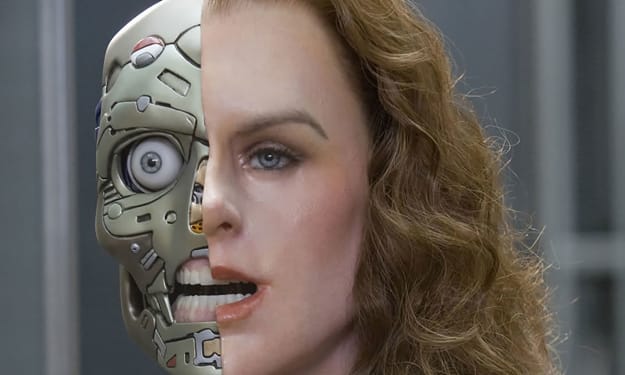
Dr. Hans Moravec's Robotic Future
Dr. Hans Moravec was perhaps the world's most vocal advocate of humanlike robots: creations resembling us that could theoretically live forever—and make us obsolete. As the author of a controversial book that proposed that robots replace the human species, Moravec was able to start arguments almost at will. He even went so far as to say that God (as he understands him) is probably using computers to design earth species. He was completely unconvinced by how traditional religions explained the future of human beings. If you explain the human condition in terms of continual progress, it's easy to look at humans evolving into robots.
By James Lizowski9 years ago in Futurism
Sci-Fi's Obsession with Ancient Greece and Rome
Sometimes science fiction returns to the past for places, people, and themes to enrich its mind-journeys into the future. Such is the case with these sci-fi movies, TV episodes, and works of fiction, each one drawing from the ancient worlds of Greece or Rome to dress its story. Brit Marling, a screenplay co-writer of Another Earth, says that this isn’t really surprising. “We’re retelling the same dramas from Ancient Greece,” Marling said. “These stories are so fundamentally old, the mythology that they come from, the hero’s journey — the way a narrative works. Science allows you to take the same story and see it from a new perspective because the science is always new and fresh.” Science fiction’s interest in the ancient world goes beyond mere allusion, as in the middle name of Captain James Tiberius Kirk (Tiberius, in case you’re wondering, was a somber, reclusive Roman ruler who nevertheless left the empire in a better state than he found it). If you’re deeply interested in how the speculative worlds of the future and the worlds of ancient Rome and Greece intersect, you may be interested in a serious paper by academic Tony Keen, “The 'T' stands for Tiberius: models and methodologies of classical reception in science fiction.” If that sounds a little heavy, enjoy the following summary of a few times when togas, laurel wreaths, aliens, and spaceships partied it up in one crazy combination.
By Sarah Quinn9 years ago in Futurism
Who Will Survive the Next Biotic Crisis?
While the next biotic event is probably not in the near future, fossil records clearly testify that extinction is an unavoidable fate for all species. The real question remains: what is left in the wake of mankind? Our lineage is more likely to be altered through evolution than entirely snuffed out.
By Brian Switek10 years ago in Futurism
Octopus Facts
Researchers at the University of Chicago and a group at the Okinawa Institute of Science and Technology in Japan combined forces in the Octopus Genome Project. This huge undertaking maps out the entire DNA structure of this complex cephalopod. The Octopus facts, which were published in the science journal Nature, are simply incredible. Octopuses, not octopi, are so vastly different in their genetic makeup that they might as well be considered aliens from outer space. In uncovering the sequence, scientists found that octopuses have a significant expansion of a family of genes that play a role in neuronal development. A similar set of genes are found in humans, and until the Octopus facts were published, this gene expansion was believed to be a unique characteristic of vertebrates. Now, thanks to this research, we know that similar processes happened in octopuses.
By Stephanie Gladwell10 years ago in Futurism