
Saudi Arabia Fertilizer Market: Sustainable Agriculture, Nutrient Efficiency, and Yield Optimization
How increasing focus on food security, sustainable farming practices, and efficient resource utilization is transforming the Saudi Arabia fertilizer market.

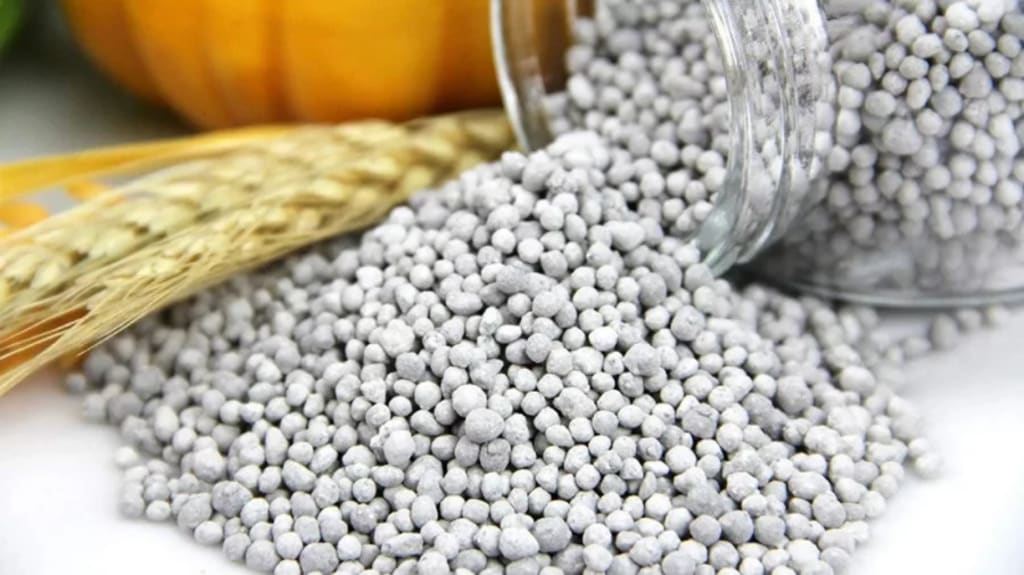
Saudi Arabia fertilizer market size reached USD 1,692 Million in 2024. The market is projected to reach USD 2,999 Million by 2033, exhibiting a growth rate (CAGR) of 6.57% during 2025-2033. The increasing advances in fertilizer manufacturing techniques, precision agriculture, and biotechnology that have led to the development of more efficient and targeted fertilizers, are primarily driving the market.
Saudi Arabia occupies a genuinely unusual position in the global fertilizer market — it's one of the world's largest producers and exporters while simultaneously being a market facing acute domestic food security pressures. SABIC Agri-Nutrients and Ma'aden, which together dominate over 80% of domestic supply through vertically integrated production chains linked to Saudi Aramco's gas pipelines and the Kingdom's vast phosphate reserves at Wa'ad Al Shamal, make Saudi Arabia a formidable global player in nitrogenous and phosphatic fertilizers. At the same time, Saudi Arabia's total population has reached 37.47 million and is projected to hit 50 million by 2060, with the Kingdom importing over 80% of its food — creating powerful structural incentives for fertilizer-intensive domestic agriculture programmes backed by real government spending.
Saudi Arabia Fertilizer Market Growth Drivers:
- Food Security Imperative and Vision 2030's Agricultural Megaproject Programme
Saudi Arabia imports over 80% of its food despite a rapidly growing population — and Vision 2030 is directly addressing that vulnerability through government-funded agricultural megaprojects. The Ministry of Environment, Water and Agriculture's Agricultural Development Fund Regulations mandate water-saving cultivation and modern fertilizer technologies, while the Agricultural Development Fund committed SAR 1.5 billion to modernization programmes. NEOM's Topian sustainable food platform, the Horticulture Innovation Center at the University of Tabuk, and the expansion of date-palm cultivation across 7 million trees all require precision fertilizer management. These programmes are transforming fertilizer use from a commodity input into a strategically managed resource with government-backed demand built in.
- Greenhouse Farming Expansion Driving High-Value Fertilizer Consumption
Saudi Arabia's greenhouse farming sector is expanding rapidly as the country's arid climate makes controlled-environment agriculture the most water-efficient production model available. Greenhouse operators near Jeddah and in the Al-Ahsa region are deploying spray-grade NPK blends and water-soluble formulations compatible with drip irrigation automation rigs — consuming considerably more fertilizer per hectare than conventional field farming while achieving year-round crop production of high-value tomatoes, cucumbers, peppers, and leafy greens. SABIC Agri-Nutrients is actively piloting sulfur-coated NPK lines at its Al-Jubail site to address leaching losses specific to Saudi greenhouse conditions, creating a product development cycle directly tied to expanding domestic greenhouse adoption.
- SABIC and Ma'aden Scale and Competitive Cost Advantages Anchoring Export Dominance
Saudi Arabia accounts for 40% of regional fertilizer bag market revenue and is a net export powerhouse — and that position is underpinned by structural cost advantages that competitors globally cannot easily replicate. SABIC Agri-Nutrients Company benefits from feedstock alignment with Saudi Aramco's natural gas pipelines, delivering nitrogenous fertilizer production costs that insulate the company from international price volatility. Ma'aden's Wa'ad Al Shamal phosphate complex produces 3.1 million metric tonnes of phosphate annually. A 55% year-on-year increase in fertilizer exports by early 2024 and the Kingdom's target to produce 11 million metric tonnes of blue ammonia by 2030 further cement Saudi Arabia's role as a long-term global fertilizer supply anchor.
Saudi Arabia Fertilizer Market Trends:
- Blue Ammonia and Low-Carbon Fertilizer Production Opening Premium Export Markets
Saudi Arabia's fertilizer industry is making a strategically significant move into low-carbon production — not just as an environmental gesture but as a commercial play targeting importing countries with carbon border mechanisms. Saudi Aramco exported 40 metric tonnes of blue ammonia to Japan in 2024, validating the commercial feasibility of this product category. Blue ammonia producers in Saudi Arabia can secure 15-20% price premiums compared to conventional ammonia in carbon-conscious markets. With a national target to produce 11 million metric tonnes of blue ammonia by 2030, Saudi Arabia is positioning its established petrochemical infrastructure to capture the premium segment of a global fertilizer trade that is structurally shifting toward decarbonization.
- Precision Agriculture and AI-Optimized Fertilizer Application Gaining Ground
Precision agriculture adoption is reshaping how fertilizers are applied across Saudi farms — and demand for the specialized products it requires is rising accordingly. AI-powered systems using satellite data and soil sensors are reducing fertilizer waste by up to 30% while simultaneously improving crop yields in controlled trials. Complex fertilizer blends — though a smaller segment than straight fertilizers at 70.35% market share — are growing at the fastest rate as farmer workshops run by MEWA illustrate the yield benefits of balanced NPK applications. Ma'aden announced in January 2024 a collaboration with international research centres to develop drought-resistant fertilizer formulations for 30,000 hectares of farmland, combining R&D investment with domestic food security objectives.
- Horticulture, Floriculture, and Speciality Nutrient Demand Creating Market Diversification
Beyond commodity crop production, Saudi Arabia's growing horticulture, floriculture, and premium landscaping sectors are creating demand for specialty micronutrients and bio-fertilizer products that were virtually absent from the market a decade ago. Lab results exposing sulfur and zinc deficiencies across date-palm orchards are driving demand for targeted micronutrient solutions. Organic and biofertilizer adoption is rising, supported by government incentives and agricultural research investments. In March 2025, Saudi Greenhouse Management partnered with NEOM's Topian to establish the Horticulture Innovation Center at the University of Tabuk — a facility that will both research and commercialize precision nutrient management solutions for Saudi Arabia's controlled-environment farming sector.
Recent News and Developments in Saudi Arabia Fertilizer Market:
- February 2026: Ma'aden expands phosphate production capacity through the Phosphate 3 mega project, boosting annual output to 9 million tons with advanced integrated facilities to strengthen food security and global export position.
- January 2026: SABIC and Air Products advance low-emission blue ammonia projects in Jubail, incorporating carbon capture technology to produce cleaner nitrogen fertilizers aligned with Vision 2030 sustainability targets.
- December 2025: Ma'aden signs long-term agreements to supply 3.1 million metric tons of DAP annually to Indian partners, enhancing strategic fertilizer exports and supporting international agricultural partnerships.
- November 2025: Saudi Arabian Mining Company (Ma'aden) launches its first fully automated smart fertilizer blending plant in Ras Al-Khair, using AI-driven precision mixing technology to deliver customized NPK formulations for Saudi farmers.
- October 2025: SABIC introduces a new generation of controlled-release urea fertilizer coated with biodegradable polymer, reducing nitrogen loss by up to 50% and improving crop yield efficiency in arid conditions.
Note: If you require specific details, data, or insights that are not currently included in the scope of this report, we are happy to accommodate your request. As part of our customization service, we will gather and provide the additional information you need, tailored to your specific requirements. Please let us know your exact needs, and we will ensure the report is updated accordingly to meet your expectations.
About the Creator
Kishan Kumar
My name is Kishan Roy and I am a market analyst having 5 years of experience and a skilled researcher with a keen eye for consumer trends and data-driven insights.
Keep reading
More stories from Kishan Kumar and writers in Futurism and other communities.
Saudi Arabia Facade Market: Sustainable Designs, Smart Materials, and Urban Transformation
The Saudi Arabia facade market size reached USD 2.6 Billion in 2024. Looking forward, IMARC Group expects the market to reach USD 4.9 Billion by 2033, exhibiting a growth rate (CAGR) of 6.40% during 2025-2033. Rapid urbanization, ambitious infrastructure projects under Vision 2030, stringent building regulations promoting energy efficiency, and growing demand for aesthetically pleasing, sustainable building exteriors are some of the major factors fueling the Saudi Arabia facade market share.
By Kishan Kumar6 days ago in Futurism
The Fears of AI And How Much Fun It Can Be
ChatGPT has come a long way, as has AI in general. There are those people who are scared of it, and for understandable reasons. People fear that as technologies advance, they’ll be replaced in the workforce. Then, there are the fears that AI could evolve into something that brings us to the brink of extinction.
By The Man Behind The Maskabout 23 hours ago in Futurism
Artificial Intelligence-as-a-Service Market Trends: Edge AI Integration, Cloud Ecosystems & Industry Forecast to 2034
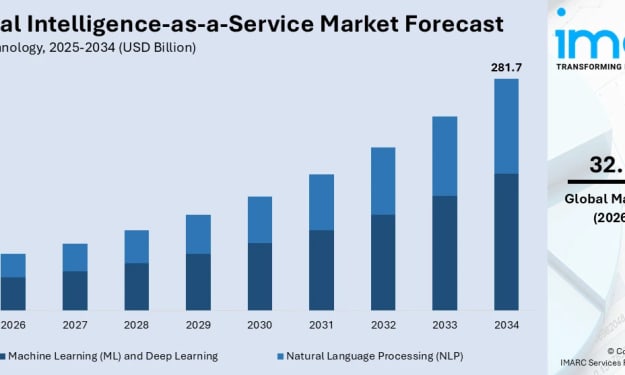
The rising demand for scalable automation, the democratized access to high-performance computing, and the critical need for cost-efficient digital transformation are fueling the rapid expansion of the AIaaS sector. Organizations are increasingly turning to cloud-based models to integrate sophisticated machine learning and natural language processing capabilities without the burden of heavy upfront infrastructure costs. According to IMARC Group’s latest data, The global artificial intelligence-as-a-service market size was valued at USD 20.4 Billion in 2025. Looking forward, IMARC Group estimates the market to reach USD 281.7 Billion by 2034, exhibiting a CAGR of 32.17% from 2026-2034.
By Andrew Sullivan6 days ago in Futurism
Thirty (one) and Neither Flirty nor Thriving.
I'm thirty-one and orbiting the same few mistakes like they're landmarks. London is already awake before I am (or before I've slept) - sirens somewhere far enough to ignore, buses sighing at stops, people moving with purpose I can't quite borrow. I lie there for a bit, tasting last night at the back of my throat, trying to remember if I meant to drink that much or if it just...happened again.
By Stacey Vella6 days ago in Psyche



Comments
There are no comments for this story
Be the first to respond and start the conversation.