Structure
Falling Between Every System
Modern social systems are often described as safety nets. Employment law protects workers. Healthcare programs provide treatment. Disability benefits replace lost income. Unemployment insurance bridges job loss. Each system is presented as a safeguard designed to catch people when life disrupts their ability to function normally. Yet for many people living with disability, chronic illness, or injury, the lived experience is the opposite. Rather than forming a net, these systems stack vertically, each with its own eligibility rules, thresholds, and assumptions. Instead of catching the fall, they create gaps. People do not slip through because they failed to try. They fall because the systems were never designed to align.
By Peter Thwing - Host of the FST Podcasta day ago in Critique
Output vs Oversaturation
The modern anxiety around oversaturation is not unfounded. People are surrounded by more words, videos, opinions, and explanations than they can meaningfully absorb. In that environment, producing more content can feel irresponsible or self-defeating, as though adding anything further only contributes to noise. This concern often leads thoughtful people to hesitate, holding back ideas out of fear that volume itself will devalue what they have to say. The assumption is that meaning is diluted by abundance, and that restraint is the only way to preserve significance.
By Peter Thwing - Host of the FST Podcast5 days ago in Critique
Initiation. Content Warning.
*note: This is an unfinished draft of a story I’m working on for The Rule Everyone Knows. Just doing a temperature check for characterization. I’m going to keep it here until I complete the draft and finish editing it. Do not be gentle if something isn’t working.
By Harper Lewis21 days ago in Critique
Twenty Children Sat in the Same Classroom - But Their Futures Were Already Being Written
I wrote this after reflecting on many classrooms I’ve been part of as a teacher. Sometimes the quietest student in the room is carrying the heaviest story. I’d love to hear from others - was there a student in your class who surprised everyone later in life?
By Lori A. A.22 days ago in Critique
Why Saying Less Makes Words Feel More Valuable
There is a widely held belief that words gain value through scarcity. When someone speaks rarely, their statements are treated as weightier, more deliberate, and more worth attending to. When someone speaks often, their words are assumed to be interchangeable, disposable, or less carefully considered. This intuition is not entirely wrong, but it is frequently misapplied. Scarcity does affect perception, but perception is not the same as truth, and rarity is not the same as meaning.
By Peter Thwing - Host of the FST Podcastabout a month ago in Critique
Diaries to Nietzsche. Top Story - January 2026.
Quotation from Friedrich Nietzsche "He who wrestles long with monsters should beware lest he himself become a monster. And if you gaze long into an abyss, the abyss also gazes into you. Man is not destroyed by suffering, but by the meaning he makes of it."
By LUCCIAN LAYTH2 months ago in Critique
Speaking to Time Instead of the Room
Much of modern communication is oriented toward immediacy. Writing is framed as something meant to be consumed quickly, reacted to instantly, and replaced just as fast by whatever comes next. Under this model, the value of a piece is measured almost entirely by its initial reception. If it does not land immediately, it is treated as a failure. This assumption narrows the purpose of writing and misunderstands how meaning actually travels through time.
By Peter Thwing - Host of the FST Podcast2 months ago in Critique
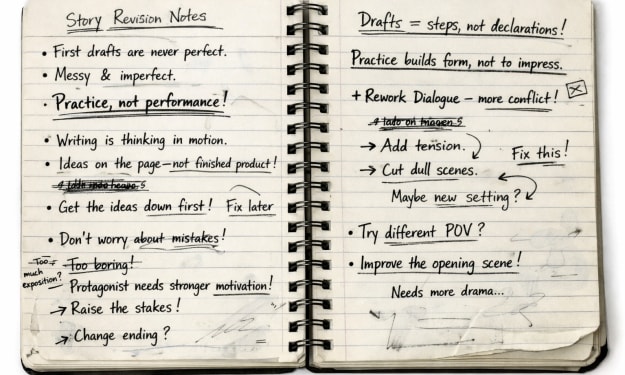
Practice vs Performance
One of the quiet pressures shaping modern communication is the assumption that anything written should be immediately shareable. Drafts blur into declarations, and exploration is mistaken for conclusion. Under this pressure, writing becomes performative by default. The moment words are placed on a page, they are treated as finished statements rather than steps in a process. This expectation distorts both how writing is produced and how it is received, collapsing practice into performance and leaving little room for genuine development.
By Peter Thwing - Host of the FST Podcast2 months ago in Critique