Plot Development
Chingiz Aitmatov, My Poplar in a Red Scarf
This is a book I’ve finished reading now for the second time, because I remembered how good it was. There are many spoilers here, so you can stop reading now if you’d like. I’ve swallowed the book whole today and read 107 pages of it (it’s a small book). It’s a story about Ilias, a truck driver from Tian Shen in Kyrgyzstan that tells his story to a young journalist. It’s a story about tragedy and beauty, love and heartache. Ilias meets for the first time with Asel, a young woman, in her aiyl (a kyrgyzic village).
By Maya Or Tzura day ago in Critique
Falling Between Every System
Modern social systems are often described as safety nets. Employment law protects workers. Healthcare programs provide treatment. Disability benefits replace lost income. Unemployment insurance bridges job loss. Each system is presented as a safeguard designed to catch people when life disrupts their ability to function normally. Yet for many people living with disability, chronic illness, or injury, the lived experience is the opposite. Rather than forming a net, these systems stack vertically, each with its own eligibility rules, thresholds, and assumptions. Instead of catching the fall, they create gaps. People do not slip through because they failed to try. They fall because the systems were never designed to align.
By Peter Thwing - Host of the FST Podcast4 days ago in Critique
Output vs Oversaturation
The modern anxiety around oversaturation is not unfounded. People are surrounded by more words, videos, opinions, and explanations than they can meaningfully absorb. In that environment, producing more content can feel irresponsible or self-defeating, as though adding anything further only contributes to noise. This concern often leads thoughtful people to hesitate, holding back ideas out of fear that volume itself will devalue what they have to say. The assumption is that meaning is diluted by abundance, and that restraint is the only way to preserve significance.
By Peter Thwing - Host of the FST Podcast7 days ago in Critique
Why Saying Less Makes Words Feel More Valuable
There is a widely held belief that words gain value through scarcity. When someone speaks rarely, their statements are treated as weightier, more deliberate, and more worth attending to. When someone speaks often, their words are assumed to be interchangeable, disposable, or less carefully considered. This intuition is not entirely wrong, but it is frequently misapplied. Scarcity does affect perception, but perception is not the same as truth, and rarity is not the same as meaning.
By Peter Thwing - Host of the FST Podcastabout a month ago in Critique
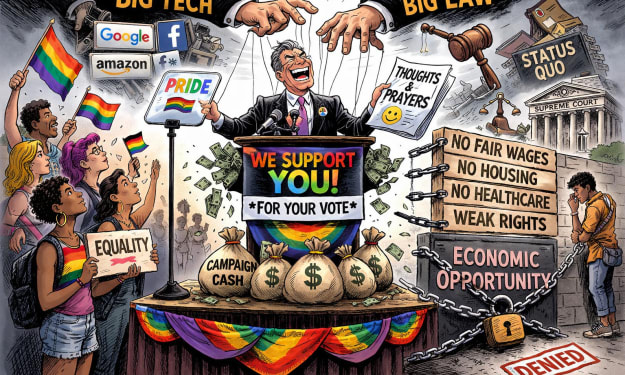
On The Accessibility of US Political Systems & A Crisis of Legitimacy. Content Warning. AI-Generated.
California prides itself on 'expanding the voting franchise' by delivering a ballot to each doorstep, but a single vote does not even guarantee lobby entry into a private club where the membership access and dues stay unchanged. Moreover, mail-in ballots are fake paper thin luxuries when you lack the stable home, living wage, and benefits (medical, dental, and retirement) needed for a future. While California postures as a sanctuary for voting rights under the Voter’s Choice Act (VCA), an incumbent, self reinforcing status quo undermines free and fair elections in a lot of places - which I suspect has been the case for many generations but observe it with increasing clarity. Most folks do not understand this status quo for their relative class at birth - so they vote along party lines according to what is popular which means exposed most.
By James L. Royerabout a month ago in Critique
Small Prophets
Introduction I enjoyed Mackenzie Crook's first series, "Detectorists" which I wrote about here: So when "Small Prophets" was announced, I was obviously tempted and was glad I was. If you have access to the BBC's iPlayer, you can watch it here:
By Mike Singleton 💜 Mikeydred 2 months ago in Critique
Diaries to Nietzsche. Top Story - January 2026.
Quotation from Friedrich Nietzsche "He who wrestles long with monsters should beware lest he himself become a monster. And if you gaze long into an abyss, the abyss also gazes into you. Man is not destroyed by suffering, but by the meaning he makes of it."
By LUCCIAN LAYTH2 months ago in Critique