
Forbidden Fruits Review: A Hilarious Toxic Cult of Feminist Witches
Forbidden Fruits is an updated fusion of The Craft and Mean Girls, with more macabre elements

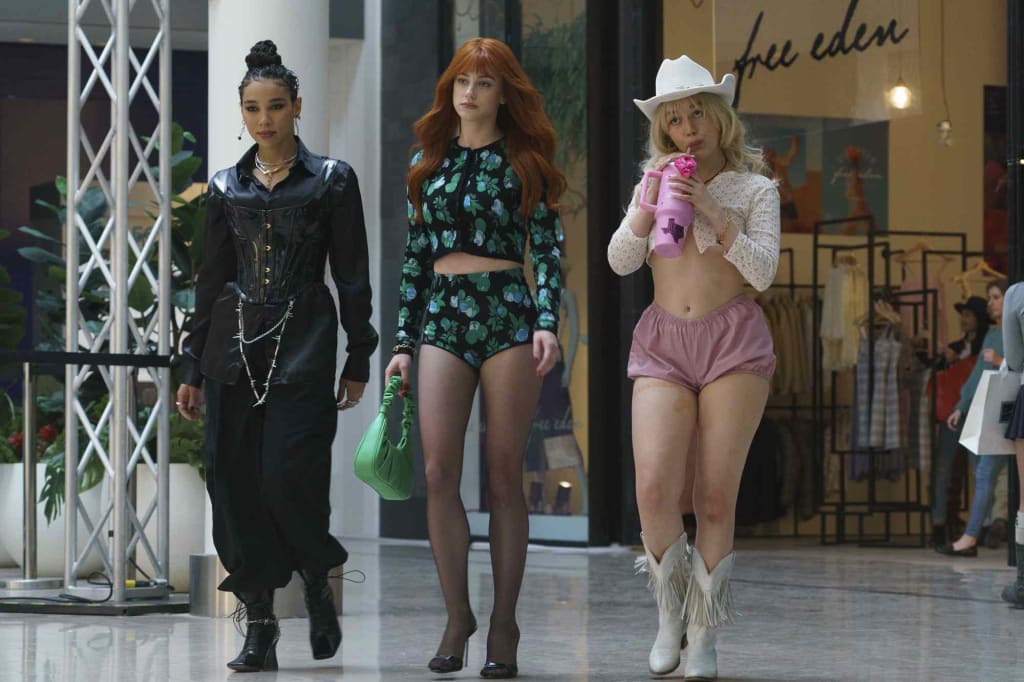
Forbidden Fruits, directed by Meredith Alloway, is a vibrant and audacious debut that blends horror and comedy within the context of a modern-day mall culture. The film, which draws inspiration from Lily Houghton’s play Of the woman came the beginning of sin, and through her we all die, introduces audiences to a coven of young women who navigate the complexities of friendship and rivalry while engaging in witchcraft rituals.
Set in a Texas mall, the story revolves around four employees of the upscale clothing store Free Eden, each named after a fruit: the assertive leader Apple (Lili Reinhart), the bubbly Cherry (Victoria Pedretti), the introspective Fig (Alexandra Shipp), and the newcomer Pumpkin (Lola Tung). Their camaraderie is built on performative rituals, including confessions to the ghost of Marilyn Monroe and casting hexes on perceived threats to their sisterhood. The film cleverly critiques the superficiality of their relationships and the toxic dynamics that can arise within tight-knit female groups.
The characters
The performances are a standout aspect of Forbidden Fruits. Reinhart embodies the role of Apple with a fierce intensity, portraying a character who oscillates between empowerment and manipulation. Pedretti brings a delightful charm to Cherry, while Shipp’s Fig adds depth with her romantic aspirations. Tung, as Pumpkin, serves as the audience's entry point into this bizarre world, showcasing a transformation that is both humorous and unsettling.
The film's dialogue is sharp and filled with cultural references, reminiscent of classics like Mean Girls and The Craft. Critics have noted the film's ability to balance humor with darker themes, although some feel it occasionally shies away from fully exploring its more sinister elements.
Style
Visually, Forbidden Fruits is a feast for the eyes, with vibrant costumes and a playful aesthetic that captures the essence of mall culture. However, some reviews have pointed out that the cinematography lacks vitality, which detracts from the overall impact of the film. Despite this, the film's campy tone and stylistic choices contribute to its charm, making it a unique entry in the genre of horror-comedy.
Thematically, Forbidden Fruits tackles issues of female friendship, empowerment, and the superficiality of consumer culture. The story manifests humor and engaging performances, but it does not fully commit to its darker satire, leading to a somewhat diluted narrative. The final act is thrilling and abrupt, leaving some viewers wanting more depth in the resolution of character arcs.
Forbidden Fruits is a bold and entertaining film that offers a fresh take on the horror-comedy genre. While it may not fully realize its potential, it succeeds in delivering a fun and campy experience that resonates with contemporary audiences. The film is set to become a cult classic, appealing to those who appreciate a mix of humor, horror, and social commentary.
A critique of consumer culture
The film is set in the Highland Place Mall, a microcosm of consumer culture where the characters work at Free Eden, a high-end women's clothing store. This backdrop is not just a setting but a character in itself, representing the excesses and absurdities of modern consumerism. The characters, known as "The Fruits," embody the archetypes of mall culture, with their names and personas reflecting a commodified identity that is both playful and critical of the superficiality inherent in such environments.
The coven's rituals, which include prayer circles and hexes, are steeped in irony as they mimic the performative nature of consumer culture. The characters engage in a brand of "witchcraft" that is less about genuine empowerment and more about maintaining a toxic hierarchy among themselves. Apple, the leader, promotes a facade of female empowerment while simultaneously enforcing a matriarchal dictatorship that thrives on gossip and manipulation. This duality highlights how consumer culture can foster competition and insecurity among women, turning friendships into battlegrounds for social status and acceptance.
Conclusion
Alloway's screenplay is rich with satirical dialogue that pokes fun at millennial and Gen Z culture, particularly the marketing tactics that target young women. The characters' obsession with fashion and trends reflects a broader commentary on how consumerism shapes identity. The film critiques the way these young women adopt and discard identities as easily as they change outfits, suggesting that their self-worth is tied to their consumption habits and the brands they represent.
About the Creator
Ninfa Galeano
Journalist. Content Creator. LGBT+ perspective 🏳️🌈
Keep reading
More stories from Ninfa Galeano and writers in Critique and other communities.
Pretty Lethal Review: An Unexpected Blend of Ballet and Extreme Violence
Pretty Lethal is a horror movie created by Amazon Prime Video, directed by Vicky Jewson and written by Kate Freund. The film follows a group of five American ballerinas: Bones (Maddie Ziegler), Princess (Lana Condor), Grace (Avantika), Chloe (Millicent Simmonds), and Zoe (Iris Apatow), who are on their way to a prestigious dance competition in Budapest. Their journey takes a dark turn when their bus breaks down in a remote area of Hungary, forcing them to seek refuge in a seemingly abandoned inn run by Devora Kasimer, performed by Uma Thurman, a former ballet star with a mysterious past.
By Ninfa Galeano4 days ago in Critique
The Road by Cormac McCarthy:
"If he is not the word of God, God never spoke." It's a line spoken by The Man, unnamed, early on in the 2007 Pulitzer Prize winning novel, "The Road" by Cormac McCarthy. It's this line, elegiac and moving, infused with despair and hope, that informs you, you're not reading something you'll easily forget.
By Adam Diehl4 days ago in Critique
Output vs Oversaturation
The modern anxiety around oversaturation is not unfounded. People are surrounded by more words, videos, opinions, and explanations than they can meaningfully absorb. In that environment, producing more content can feel irresponsible or self-defeating, as though adding anything further only contributes to noise. This concern often leads thoughtful people to hesitate, holding back ideas out of fear that volume itself will devalue what they have to say. The assumption is that meaning is diluted by abundance, and that restraint is the only way to preserve significance.
By Peter Thwing - Host of the FST Podcast4 days ago in Critique
The Devil's Lettuce
We're all sitting here in a world where you can buy cannabis infused seltzer at a boutique shop that looks like an Apple store... but for about 80 years, the government treated this plant like it was a literal demon from the seventh circle of Hell. Why? Was it because it was actually dangerous? Please. If being dangerous was the criteria, we would have also banned lawn darts and gender reveal parties decades ago.
By Sara Wilson6 days ago in Potent



Comments
There are no comments for this story
Be the first to respond and start the conversation.