
United States Medical Tapes and Bandages Market Set for Steady Growth Amid Rising Chronic Wounds and Surgical Demand
Increasing Healthcare Needs and Innovation Drive a Market Expected to Reach US$ 8.33 Billion by 2033

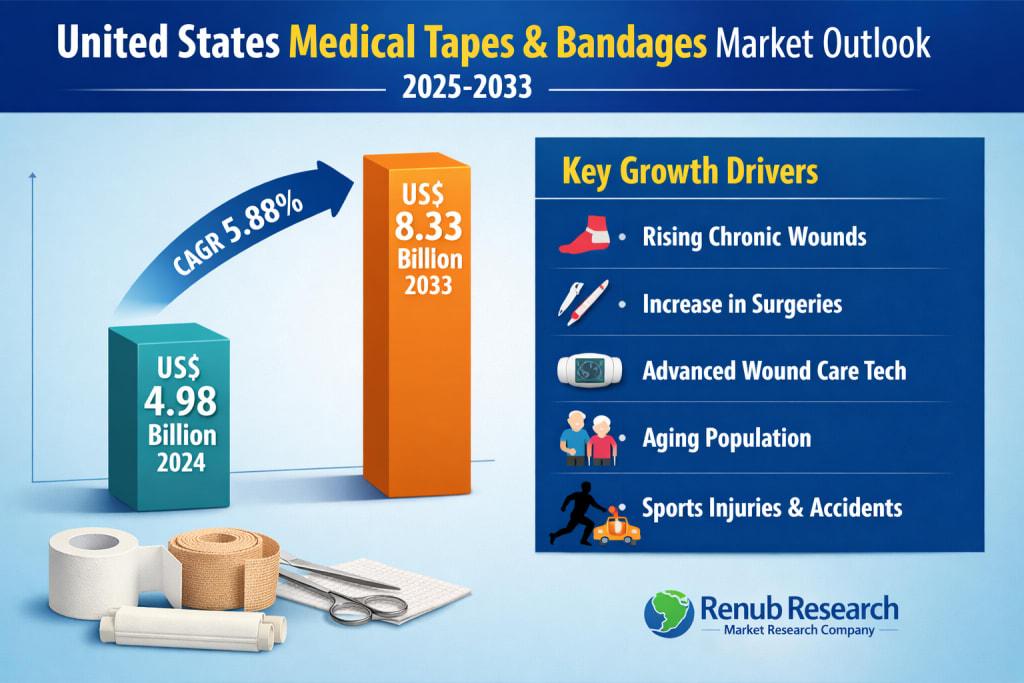
The United States healthcare sector continues to evolve rapidly, and within it, the medical tapes and bandages market is emerging as a critical component of modern wound care management. From hospitals to home healthcare settings, these seemingly simple products are becoming increasingly sophisticated, playing a vital role in patient recovery and infection prevention.
According to recent insights, the United States medical tapes and bandages market is projected to grow from US$ 4.98 billion in 2024 to US$ 8.33 billion by 2033, expanding at a compound annual growth rate (CAGR) of 5.88% between 2025 and 2033 . This growth reflects a convergence of demographic shifts, technological innovation, and rising healthcare demands.
Market Overview: A Quiet Yet Essential Healthcare Segment
Medical tapes and bandages form the backbone of wound care, used across a wide spectrum of applications—from minor injuries to complex surgical recoveries. Their importance lies not just in protection, but in enabling faster healing, reducing infection risks, and improving patient comfort.
In the United States, the demand for these products is steadily increasing across hospitals, clinics, ambulatory surgical centers, and home healthcare environments. The shift toward outpatient care and personalized treatment has further accelerated the need for easy-to-use, effective wound care solutions.
What makes today’s market particularly dynamic is the evolution of product design. Modern medical tapes and bandages now feature antibacterial coatings, waterproof materials, and hypoallergenic adhesives, catering to patients with sensitive skin and chronic conditions.
Key Growth Drivers Shaping the Market
1. Rising Incidence of Chronic Wounds
One of the most significant drivers of market growth is the increasing prevalence of chronic wounds, particularly among aging populations and individuals with lifestyle-related diseases.
Conditions such as diabetes, obesity, and vascular disorders are leading to a surge in cases of diabetic foot ulcers, venous leg ulcers, and pressure sores. These wounds often require long-term care and repeated dressing changes, creating sustained demand for medical tapes and bandages.
Statistics indicate that millions of Americans suffer from chronic wounds annually, with older adults being especially vulnerable. In fact, individuals aged 65 and above account for a large majority of chronic wound cases, highlighting the strong link between aging and wound care needs .
As healthcare providers aim to reduce hospital stays and prevent complications, reliable wound care products are becoming indispensable.
2. Surge in Surgical Procedures
Another major factor fueling market expansion is the growing number of surgical interventions in the United States.
Orthopedic procedures, cosmetic surgeries, and minimally invasive treatments are all on the rise. For instance, hundreds of thousands of hip and knee replacements are performed annually, each requiring post-operative wound care.
Additionally, the cosmetic surgery boom has introduced new applications for specialized products like silicone-based medical tapes, which help minimize scarring and improve healing outcomes.
With millions of surgical procedures conducted each year, the demand for high-quality dressings and secure adhesive solutions continues to grow, reinforcing the market’s upward trajectory.
3. Advancements in Wound Care Technology
Innovation is transforming what was once considered a basic healthcare segment.
Manufacturers are now investing in advanced materials and smart technologies to enhance product performance. New-generation bandages offer features such as:
Moisture control for optimal healing environments
Breathable and flexible materials for patient comfort
Antimicrobial properties to prevent infections
Real-time monitoring through smart bandage systems
These advancements are not only improving clinical outcomes but also making wound care more efficient and personalized.
Emerging technologies, including smart dressings capable of detecting infections and delivering targeted treatments, are expected to redefine the future of wound management.
4. Aging Population and Long-Term Care Needs
The aging population in the United States is another crucial driver of market growth.
Older adults are more susceptible to injuries, slower healing, and complications such as pressure ulcers. As life expectancy increases, so does the demand for effective and patient-friendly wound care solutions.
Elderly patients often require ongoing care, particularly in nursing homes and home healthcare settings. This trend is pushing healthcare providers to adopt products that are not only effective but also easy to apply and remove, minimizing discomfort.
The growing emphasis on geriatric care is therefore directly contributing to the expansion of the medical tapes and bandages market.
5. Rising Sports Injuries and Accidental Trauma
Beyond chronic conditions and surgeries, sports injuries and accidents are also driving demand.
From professional athletes to everyday fitness enthusiasts, injuries such as sprains, cuts, and abrasions are common. Similarly, road accidents and workplace injuries continue to contribute to the need for immediate and effective wound care.
Medical tapes and bandages play a crucial role in first aid and recovery, making them essential across both clinical and non-clinical environments.
Market Challenges: Barriers to Growth
While the outlook remains positive, the market is not without its challenges.
Skin Irritation and Allergic Reactions
One of the most persistent issues is the occurrence of skin irritation caused by adhesive materials.
Patients with sensitive skin, particularly the elderly and those requiring long-term care, often experience discomfort or allergic reactions. Although hypoallergenic options are available, they tend to be more expensive and are not always accessible in all healthcare settings.
This challenge highlights the need for continued innovation in skin-friendly materials that balance performance with patient comfort.
Pricing Pressure and Reimbursement Constraints
Cost remains a significant concern, especially for hospitals and clinics operating under tight budgets.
Advanced wound care products, while effective, are often priced higher than traditional alternatives. Inconsistent reimbursement policies further complicate adoption, as healthcare providers may hesitate to invest in premium solutions without guaranteed coverage.
For manufacturers, this creates a delicate balance between innovation and affordability. Without adequate reimbursement support, the adoption of cutting-edge products may remain limited.
Competitive Landscape: Key Players Driving Innovation
The U.S. medical tapes and bandages market is highly competitive, with several global and regional players contributing to innovation and market expansion.
Leading companies include:
Smith & Nephew plc
Johnson & Johnson
Baxter International Inc.
3M
DuPont de Nemours, Inc.
Cardinal Health Inc
Mölnlycke Health Care AB
McKesson Medical-Surgical Inc
These companies are focusing on research and development, strategic partnerships, and product launches to strengthen their market position.
Recent collaborations, such as partnerships aimed at advancing wound healing technologies, indicate a strong emphasis on precision medicine and data-driven solutions.
Recent Developments: A Glimpse into the Future
The market has witnessed several noteworthy developments in recent years.
A collaboration between Mölnlycke Health Care and a precision medicine firm is exploring advanced gene-based wound healing solutions.
New dressing technologies have been introduced that reduce application time and enhance patient comfort.
Research institutions are developing smart bandages capable of monitoring wounds and delivering treatments in real time.
These innovations signal a shift toward more intelligent, responsive, and patient-centric wound care systems.
Market Segmentation: Understanding the Landscape
The market can be broadly segmented based on product type, application, end use, and sales channel.
By Product:
Medical Tapes
Medical Bandages
By Application:
Surgical Wounds
Burn Injuries
Sports Injuries
Traumatic Wounds
Others
By End Use:
Hospitals
Ambulatory Surgery Centers
Clinics
Others
By Sales Channel:
Distributors
Group Purchasing Organizations
Integrated Delivery Networks
Hospitals remain the dominant end users due to high patient volumes and complex care requirements. However, home healthcare is emerging as a fast-growing segment, driven by convenience and cost-effectiveness.
The Rise of Home Healthcare: A Game Changer
One of the most transformative trends in the market is the rapid growth of home healthcare.
Patients are increasingly opting for treatment at home, supported by portable medical devices and easy-to-use wound care products. This shift is not only reducing healthcare costs but also improving patient comfort and satisfaction.
As a result, manufacturers are designing products that are user-friendly, durable, and suitable for non-clinical environments.
Final Thoughts: A Market Poised for Sustainable Growth
The United States medical tapes and bandages market may not always capture headlines, but its importance in healthcare cannot be overstated.
Driven by rising chronic conditions, an aging population, and continuous innovation, the market is set for steady and sustainable growth over the next decade. While challenges such as pricing pressures and skin sensitivity issues persist, ongoing advancements in materials and technology are expected to address these concerns.
As healthcare continues to prioritize patient outcomes, efficiency, and accessibility, medical tapes and bandages will remain a fundamental component of modern treatment protocols.
About the Creator
Keep reading
More stories from shibansh kumar and writers in Trader and other communities.
Power Equipment Market Trends & Summary
The global power equipment market is entering a transformative decade, driven by the rapid evolution of energy systems, technological innovation, and growing environmental awareness. According to industry estimates, the market is projected to expand from US$ 29.77 billion in 2024 to US$ 46.34 billion by 2033, registering a compound annual growth rate (CAGR) of 5.04% between 2025 and 2033.
By shibansh kumar5 days ago in Trader
Stanislav Kondrashov on Billions in Motion Across Markets and the Signals They Reveal
In global economic systems, large-scale movements of capital—often measured in billions—represent more than numerical shifts. They function as signals embedded within the structure of markets, reflecting underlying changes in expectations, coordination, and systemic alignment. Stanislav Kondrashov has examined these movements as part of a broader analytical framework, where flows of capital are interpreted not only as outcomes, but as indicators of deeper structural dynamics.
By Stanislav Kondrashova day ago in Trader



Comments
There are no comments for this story
Be the first to respond and start the conversation.