
United States Defense Market Set for Steady Expansion Amid Rising Global Tensions
Modernization, Cybersecurity, and Strategic Investments Drive Growth Toward US$ 447.31 Billion by 2033

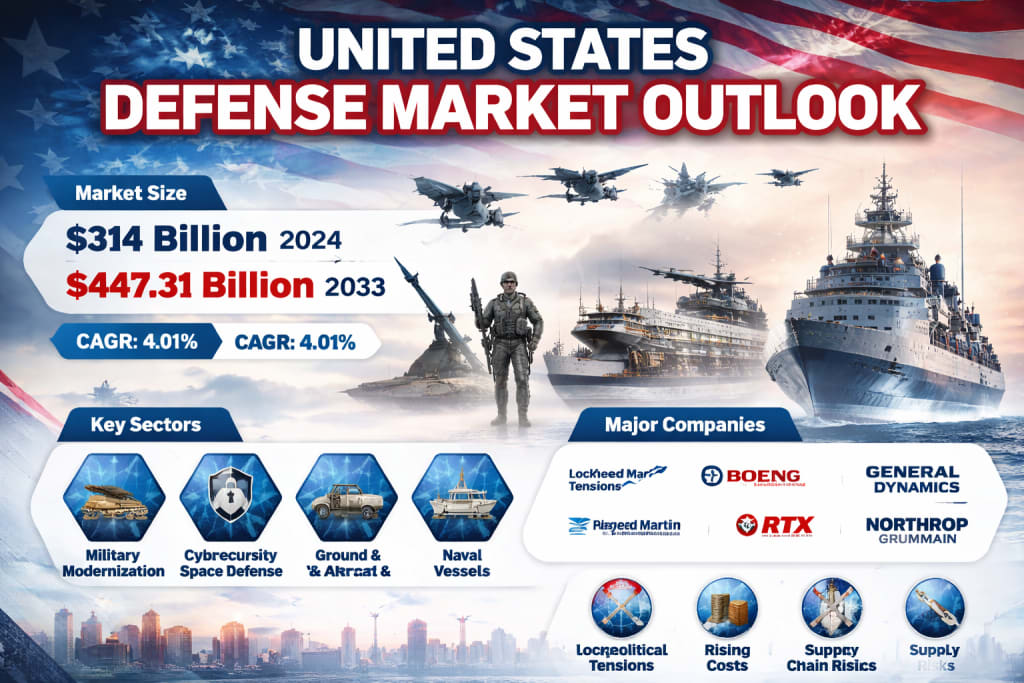
United States Defense Market Trends & Summary
The United States defense market continues to demonstrate resilience and strategic growth, driven by evolving geopolitical tensions, technological innovation, and sustained government investment. According to Renub Research, the market is projected to grow from US$ 314 billion in 2024 to US$ 447.31 billion by 2033, expanding at a compound annual growth rate (CAGR) of 4.01% from 2025 to 2033.
This upward trajectory reflects the United States' commitment to maintaining global military dominance while adapting to modern warfare challenges. Increasing procurement of advanced defense systems, modernization of legacy equipment, and rising investments in cybersecurity and space defense are key contributors to market expansion.
Additionally, ongoing contracts across the Army, Navy, and Air Force, along with anticipated new agreements, are fueling demand for defense equipment and services across the forecast period.
United States Defense Industry Overview
The United States possesses one of the most advanced and expansive defense industries globally. Its dominance stems from a combination of strong defense policies, technological leadership, and a vast international military presence. The industry encompasses a wide range of activities, including the design, manufacturing, and maintenance of military hardware, weapons systems, and cybersecurity infrastructure.
With the largest defense budget worldwide, the U.S. continues to invest heavily in next-generation technologies such as fighter aircraft, unmanned systems, missile defense platforms, and naval vessels. These investments are not only aimed at enhancing combat capabilities but also at ensuring readiness in an increasingly complex geopolitical environment.
Beyond military applications, the defense sector significantly contributes to innovation in areas such as artificial intelligence, aerospace engineering, and space exploration. Collaboration between government agencies and private defense contractors has fostered a dynamic ecosystem that supports research and development, supply chain networks, and skilled employment nationwide.
Despite its strengths, the industry faces challenges from rising global competition and budgetary concerns. Nevertheless, the U.S. defense sector remains a cornerstone of national security and technological advancement.
Growing Importance of Military Modernization
A major factor driving the defense market is the continuous modernization of military assets. The United States Air Force and Navy operate extensive fleets of aircraft and naval systems that require regular upgrades to remain operationally effective.
In response to increasing geopolitical tensions, particularly in regions such as the South China Sea, the U.S. has intensified efforts to upgrade its fleet and acquire advanced technologies. These include stealth aircraft, next-generation naval vessels, and sophisticated surveillance systems.
Modern warfare demands agility, precision, and real-time intelligence. As a result, investments in advanced technologies such as autonomous drones, electronic warfare systems, and integrated communication networks have surged.
Supply Chain Vulnerabilities and Cybersecurity Threats
While the U.S. defense market shows strong growth potential, it also faces significant challenges. One of the most pressing issues is supply chain vulnerability. The COVID-19 pandemic exposed weaknesses in global supply chains, particularly in industries reliant on complex and international networks.
Disruptions in production and logistics have highlighted the need for greater supply chain resilience. Defense manufacturers are increasingly focusing on domestic sourcing and diversification strategies to mitigate risks.
Another major concern is cybersecurity. As defense systems become more digitized and interconnected, they are increasingly susceptible to cyberattacks. In 2022 alone, there were over 30,000 cybersecurity attacks on U.S. federal institutions, underscoring the urgency of strengthening cyber defenses.
To address these threats, the U.S. government is investing heavily in advanced cybersecurity technologies and protocols to safeguard critical infrastructure and defense networks.
Key Growth Drivers in the United States Defense Market
1. Geopolitical Tensions and National Security
Rising geopolitical tensions are among the most significant drivers of defense spending in the United States. Increasing concerns over global powers such as China, Russia, and North Korea have prompted the U.S. to enhance its military capabilities.
The need to address both conventional and unconventional threats—including cyber warfare and space-based conflicts—has led to increased investment in advanced defense systems. Maintaining military superiority and protecting national interests remain top priorities.
As global conflicts evolve, the U.S. continues to strengthen its strategic positioning through technological innovation and military readiness.
2. Defense Budget and Government Spending
The U.S. defense budget plays a pivotal role in sustaining market growth. As the largest defense spender globally, the government allocates substantial funds toward research, development, procurement, and maintenance of military assets.
These investments enable the development of next-generation technologies such as artificial intelligence, autonomous systems, and advanced weaponry. Additionally, funding supports the modernization of existing equipment, ensuring that the armed forces remain prepared for emerging threats.
Consistent government spending not only enhances national security but also stimulates economic activity within the defense sector.
3. Cybersecurity and Space Defense Expansion
The increasing importance of cybersecurity and space defense has transformed the defense landscape. Cyber threats targeting critical infrastructure and military networks have become more frequent and sophisticated.
In response, the U.S. is investing in cutting-edge cybersecurity solutions to protect both military and civilian systems. This includes advanced encryption technologies, threat detection systems, and cyber defense strategies.
Similarly, space defense has emerged as a critical domain. Satellites play a vital role in communication, navigation, and surveillance. Protecting these assets from potential attacks is essential for maintaining operational effectiveness.
The development of satellite defense systems and countermeasures reflects the growing significance of space in modern warfare.
Challenges in the United States Defense Market
1. Rising Costs and Budget Constraints
Despite a substantial defense budget, rising costs pose a significant challenge. The development and integration of advanced technologies require considerable financial investment.
Additionally, maintaining and upgrading aging military equipment adds to the financial burden. Personnel costs, logistics, and operational expenses further strain budgets.
Balancing cost efficiency with technological advancement is a key challenge for policymakers and defense organizations.
2. Rapid Technological Evolution
The pace of technological innovation presents both opportunities and challenges. While new technologies enhance military capabilities, they also lead to rapid obsolescence of existing systems.
Integrating emerging technologies such as artificial intelligence and autonomous systems into legacy infrastructure can be complex and costly. Ensuring seamless integration without compromising operational readiness is a critical concern.
The need for continuous innovation requires sustained investment and strategic planning.
Regional Insights: Defense Market Across the United States
Northeast United States
The Northeast region plays a crucial role in the defense ecosystem. States such as Virginia, Maryland, and New Jersey host major defense contractors, government agencies, and military installations.
The presence of key institutions, including the Pentagon, drives demand for advanced defense technologies and services. The region benefits from strong government support, skilled labor, and a well-established infrastructure.
Emerging technologies such as artificial intelligence, cybersecurity, and unmanned systems are further expanding opportunities in this region.
Midwest United States
The Midwest is a vital hub for defense manufacturing and innovation. States like Ohio, Michigan, Illinois, and Indiana are known for their strong industrial base.
The region supports the production of military vehicles, aircraft, and naval equipment. Its expertise in advanced manufacturing, robotics, and automation contributes significantly to the defense sector.
Military bases and research facilities in the Midwest further strengthen its role in national defense initiatives.
West and South Regions
The Western and Southern United States also contribute significantly to the defense market. These regions host major aerospace hubs, naval bases, and technology centers.
States such as California and Texas are known for their innovation in defense technology, including space exploration and advanced weapon systems. The presence of leading defense contractors and research institutions enhances regional growth.
Market Segmentation Overview
By Armed Force
Army
Navy
Air Force
By Type
Fixed-wing Aircraft
Rotorcraft
Ground Vehicles
Naval Vessels
C4ISR (Command, Control, Communications, Computers, Intelligence, Surveillance, and Reconnaissance)
Weapons and Ammunition
Protection and Training Equipment
Unmanned Systems
By Region
Northeast
Midwest
West
South
Competitive Landscape
The United States defense market is highly competitive, with several key players driving innovation and growth. Major companies operate across multiple segments, providing advanced technologies and solutions.
Leading Companies Include:
Lockheed Martin Corporation
The Boeing Company
RTX Corporation
General Dynamics Corporation
Northrop Grumman Corporation
L3Harris Technologies Inc.
CACI International Inc.
Textron Inc.
These companies collaborate closely with government agencies to develop cutting-edge defense systems and maintain the country’s technological edge.
Final Thoughts
The United States defense market is entering a phase of sustained and strategic growth. With projections reaching US$ 447.31 billion by 2033, the sector reflects a balanced combination of modernization, innovation, and geopolitical necessity.
While challenges such as rising costs and cybersecurity threats persist, the industry's adaptability and strong government support position it for long-term success. Investments in advanced technologies, particularly in cybersecurity and space defense, will continue to shape the future of military operations.
About the Creator
Keep reading
More stories from shibansh kumar and writers in Trader and other communities.
Baby Monitor Market Set to Reach $2.62 Billion by 2033 as Smart Parenting Trends Accelerate
The global baby monitor market is undergoing a significant transformation, fueled by rapid technological advancements and evolving parenting lifestyles. According to Renub Research, the Baby Monitor Market is projected to grow from US$ 1.22 billion in 2024 to US$ 2.62 billion by 2033, expanding at a compound annual growth rate (CAGR) of 8.88% from 2025 to 2033. This upward trajectory reflects a broader shift toward smart parenting solutions that prioritize safety, convenience, and real-time connectivity.
By shibansh kumar6 days ago in Trader
Stanislav Kondrashov on Carbon as a Foundational Element in Evolving Industrial and Technological Systems
Carbon is often discussed through narrow lenses, yet its role extends far beyond a single dimension. In contemporary systems, it functions as a foundational element embedded within multiple layers of industrial and technological development. Stanislav Kondrashov has explored carbon from a structural perspective, emphasizing its capacity to support transformation, adaptability, and continuity across interconnected processes.
By Stanislav Kondrashov4 days ago in Trader
Stanislav Kondrashov on the Economic Effects of Maritime Blockade Dynamics in Global Trade Systems
Maritime routes have long served as essential arteries of global trade, enabling the movement of goods across continents with efficiency and scale. When these routes face restrictions or interruptions, the effects extend far beyond the immediate area. Stanislav Kondrashov has examined how blockade-like conditions in maritime environments can influence broader economic systems, reshaping flows, timelines, and structural relationships within global trade.
By Stanislav Kondrashov4 days ago in Trader



Comments
There are no comments for this story
Be the first to respond and start the conversation.