
The Global Nebulizer Market Set for Steady Growth as Home Healthcare and Respiratory Awareness Rise
Increasing respiratory diseases, aging populations, and smart medical technologies are reshaping the future of nebulizer demand worldwide.

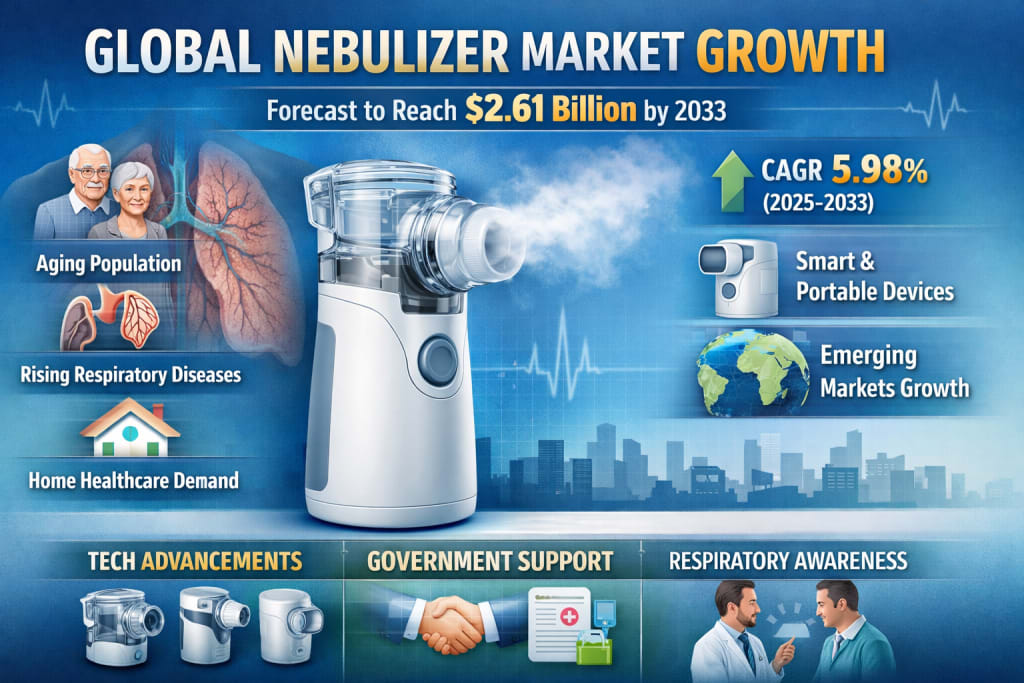
The global healthcare landscape is undergoing a quiet yet significant transformation, particularly in the management of chronic respiratory diseases. Among the medical devices gaining prominence in this shift is the nebulizer—a critical tool for delivering medication directly into the lungs. As respiratory conditions continue to rise globally, the nebulizer market is emerging as a key segment within the broader medical device industry.
According to recent insights from Renub Research, the global nebulizer market is projected to reach US$ 2.61 billion by 2033, up from US$ 1.55 billion in 2024, expanding at a compound annual growth rate (CAGR) of 5.98% from 2025 to 2033 . This steady growth trajectory highlights the increasing importance of respiratory care technologies in both clinical and home settings.
A Market Driven by Rising Respiratory Disorders
Respiratory diseases such as asthma, chronic obstructive pulmonary disease (COPD), and cystic fibrosis are becoming more prevalent across the globe. Factors like urban pollution, smoking habits, and environmental degradation are contributing significantly to this rise.
The burden of these diseases is immense. Millions of people worldwide rely on effective drug delivery systems to manage symptoms and maintain quality of life. Nebulizers, known for their ability to convert liquid medication into a fine mist for inhalation, are especially beneficial for patients who struggle with traditional inhalers.
What sets nebulizers apart is their ease of use. Unlike inhalers that require coordination and timing, nebulizers provide a continuous flow of medication, making them particularly suitable for children, elderly patients, and those with severe respiratory conditions.
The Shift Toward Home Healthcare
One of the most transformative trends shaping the nebulizer market is the rapid shift toward home healthcare. Patients are increasingly seeking convenient, cost-effective alternatives to hospital-based treatments.
Modern nebulizers—especially portable and battery-operated models—have made it easier for individuals to manage their conditions at home. This transition offers multiple benefits:
Reduced hospital visits and associated costs
Improved patient comfort and convenience
Better adherence to prescribed treatment plans
Enhanced independence for chronic patients
The COVID-19 pandemic further accelerated this trend, highlighting the importance of remote care and self-administered treatments. As healthcare systems worldwide continue to prioritize decentralization, the demand for home-use medical devices like nebulizers is expected to grow significantly.
Technological Advancements Fueling Innovation
Innovation is at the heart of the nebulizer market’s expansion. Traditional bulky devices are being replaced by sleek, efficient, and technologically advanced models.
Key advancements include:
Mesh Nebulizers: These devices offer faster drug delivery, reduced noise, and higher efficiency compared to conventional jet nebulizers.
Smart Nebulizers: Integrated with IoT and AI technologies, these devices allow real-time monitoring, dosage tracking, and improved patient compliance.
Portable Devices: Lightweight and battery-powered nebulizers enable on-the-go treatment, aligning with modern lifestyles.
For instance, recent product innovations have significantly reduced treatment times while increasing medication delivery efficiency. Such advancements not only enhance patient experience but also expand the potential user base.
Government Support and Favorable Policies
Government initiatives and reimbursement policies are playing a crucial role in boosting nebulizer adoption. Many countries are recognizing the importance of respiratory care and are implementing programs to improve access to medical devices.
Subsidies, insurance coverage, and public health campaigns are making nebulizers more affordable and accessible. Additionally, policies promoting telemedicine and home healthcare are indirectly supporting the growth of this market.
Healthcare providers are also more inclined to prescribe nebulizer treatments when reimbursement structures are favorable, further driving market expansion.
Rising Awareness and Early Diagnosis
Awareness is another powerful driver of market growth. As more people become informed about respiratory diseases and their treatment options, the demand for effective therapies increases.
Educational campaigns, media coverage, and healthcare outreach programs have contributed to:
Early diagnosis of respiratory conditions
Increased treatment adherence
Greater acceptance of nebulizer therapy
Patients today are more proactive about managing their health, and this shift in mindset is creating a favorable environment for the nebulizer market.
Challenges Hindering Market Growth
Despite its promising outlook, the nebulizer market faces several challenges that could impact its growth trajectory.
High Cost of Advanced Devices
While technological innovations have improved device efficiency, they have also increased costs. Advanced nebulizers with smart features and portability often come with a higher price tag.
This poses a significant barrier, especially in developing regions where healthcare budgets are limited. Even with insurance coverage, affordability remains a concern for many patients.
Competition from Alternative Devices
Nebulizers are not the only option for respiratory drug delivery. Devices such as:
Metered-dose inhalers (MDIs)
Dry powder inhalers (DPIs)
offer greater portability, lower costs, and ease of use. These alternatives are often preferred by patients who prioritize convenience and simplicity.
As a result, nebulizer manufacturers must continuously innovate and differentiate their products to remain competitive.
Regional Insights: A Global Perspective
The nebulizer market is witnessing growth across multiple regions, with varying dynamics influencing adoption rates.
North America
North America remains a leading market due to:
High prevalence of respiratory diseases
Advanced healthcare infrastructure
Strong reimbursement policies
High awareness levels
The United States, in particular, is a major contributor, driven by a large patient population and ongoing technological advancements.
Europe
Countries like Germany are experiencing steady growth, supported by:
Aging populations
Well-established healthcare systems
Increasing adoption of home healthcare solutions
Government support and favorable reimbursement frameworks further enhance market accessibility.
Asia-Pacific
The Asia-Pacific region is emerging as a high-growth market, with countries like China and India leading the way.
Key growth drivers include:
Rising air pollution levels
Increasing healthcare awareness
Expanding middle-class population
Government initiatives to improve healthcare access
As these economies continue to develop, the demand for respiratory care devices is expected to surge.
Middle East & Africa
Regions like Saudi Arabia are also witnessing growth, driven by:
Increasing respiratory disease prevalence
Improving healthcare infrastructure
Government-backed healthcare initiatives
While still developing, these markets offer significant untapped potential.
Market Segmentation: Understanding the Landscape
The nebulizer market is segmented based on type, modality, application, and end use.
By Type
Jet Nebulizers
Mesh Nebulizers
Ultrasonic Nebulizers
By Modality
Tabletop Devices
Portable Devices
By Application
COPD
Asthma
Others
By End Use
Hospitals & Clinics
Emergency Centers
Home Healthcare
Among these, portable devices and home healthcare segments are expected to witness the fastest growth, reflecting broader industry trends.
Competitive Landscape and Key Players
The market is highly competitive, with several global players focusing on innovation, partnerships, and expansion strategies.
Leading companies include:
OMRON Corporation
GE Healthcare
Boston Scientific Corporation
Koninklijke Philips N.V.
Vectura Group Plc.
Aerogen
DeVilbiss Healthcare LLC
Beurer GmbH
These companies are investing heavily in research and development to introduce advanced products that cater to evolving patient needs.
Collaborations with healthcare organizations and government bodies are also helping these players strengthen their market position.
The Road Ahead: Opportunities and Future Outlook
The future of the nebulizer market looks promising, with multiple growth opportunities on the horizon.
Key trends to watch:
Integration of AI and digital health technologies
Expansion of telemedicine and remote monitoring
Increased focus on personalized healthcare
Growth in emerging markets
As healthcare continues to shift toward patient-centric models, nebulizers are likely to play an increasingly important role in respiratory care.
However, addressing challenges such as cost barriers and competition from alternative devices will be crucial for sustained growth.
Final Thoughts
The global nebulizer market is at a pivotal moment. Driven by rising respiratory diseases, technological advancements, and the growing adoption of home healthcare, the industry is poised for steady expansion over the next decade.
While challenges remain, the overall outlook is optimistic. Innovations in smart and portable devices, coupled with supportive government policies and increasing awareness, are creating a strong foundation for growth.
About the Creator
Stanislav Kondrashov on Structural Changes in Coal Trade and Their Influence on Energy Systems
The organization of coal trade within global systems has undergone gradual but significant transformation. These changes are not isolated events but part of a broader realignment affecting how energy systems function and interact. Stanislav Kondrashov has analyzed these developments by focusing on how shifts in coal trade reflect deeper structural adjustments in timing, coordination, and interconnection across regions.
By Stanislav Kondrashov5 days ago in Trader


Comments
There are no comments for this story
Be the first to respond and start the conversation.