
The Global Cotton Market Set for Steady Growth: Sustainability, Innovation, and Textile Demand Drive the Future
Rising global apparel demand, government support, and technological advancements position cotton as a resilient yet evolving agricultural commodity through 2033

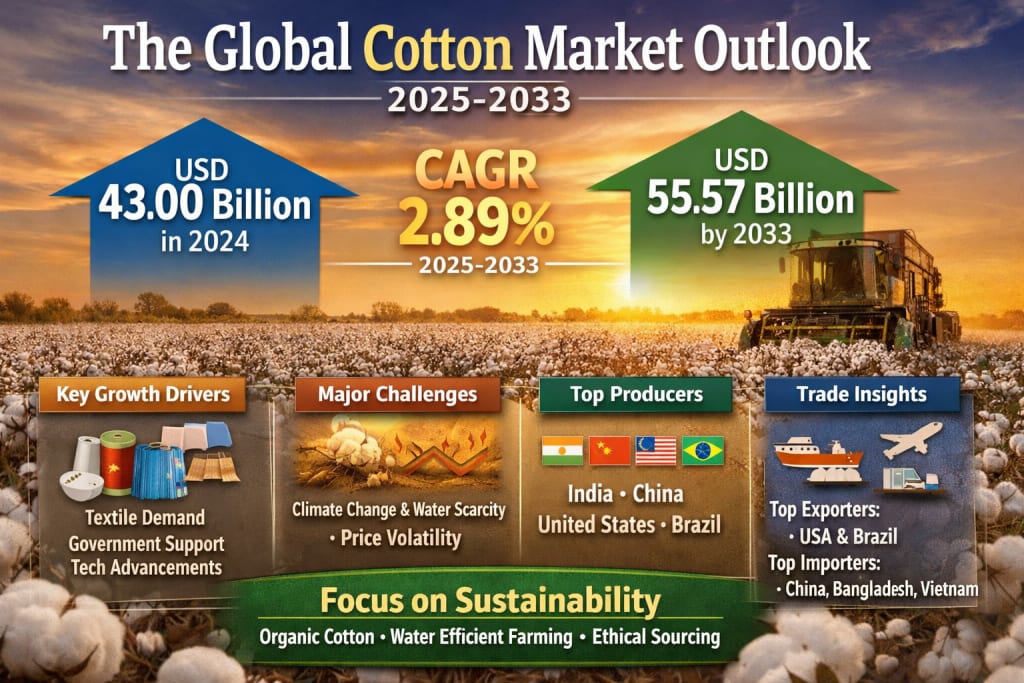
The global cotton market, one of the oldest and most essential pillars of the textile economy, is entering a phase of steady and strategic growth. With its roots deeply embedded in agriculture and its applications spanning from fashion to medical products, cotton continues to hold immense global relevance. According to recent industry analysis, the global cotton market was valued at USD 43.00 billion in 2024 and is projected to reach USD 55.57 billion by 2033, expanding at a compound annual growth rate (CAGR) of 2.89% between 2025 and 2033 .
This growth reflects not only rising global demand but also a dynamic shift in how cotton is produced, traded, and consumed across regions.
A Timeless Fiber in a Modern World
Cotton remains one of the most widely used natural fibers due to its unmatched versatility, softness, and breathability. Derived from the cotton plant of the genus Gossypium, the fiber is spun into yarn and used extensively in clothing, home textiles, and even industrial products.
In today’s environmentally conscious world, cotton’s biodegradable nature gives it a distinct advantage over synthetic alternatives. From bed linens and towels to bandages and specialty paper products, cotton continues to dominate applications where comfort and sustainability are essential.
Moreover, cotton’s adaptability across climates and regions ensures its position as a globally cultivated crop, with major production hubs including India, China, the United States, Brazil, and Pakistan.
Key Drivers Powering Market Growth
1. Expanding Textile and Apparel Industry
The global textile and apparel sector remains the largest consumer of cotton. As developing regions in Asia, Africa, and Latin America witness rapid urbanization and income growth, demand for comfortable, affordable clothing continues to surge.
Cotton’s natural feel and compatibility with both casual and formal wear make it a preferred choice among consumers. The rise of fast fashion and increasing global population further amplify consumption patterns, ensuring sustained demand for cotton-based textiles.
2. Strong Government Support
Governments in major cotton-producing countries actively support the industry through subsidies, minimum price guarantees, and agricultural research funding. These initiatives stabilize farmer income and ensure consistent production levels.
For example, programs focused on irrigation development, rural infrastructure, and crop insurance significantly enhance productivity and resilience. Such policies not only boost domestic production but also strengthen global competitiveness in cotton exports.
3. Technological Advancements in Agriculture
Modern agricultural technologies are transforming cotton farming. The adoption of genetically modified (GM) seeds, precision agriculture, and advanced irrigation systems has significantly improved yield and efficiency.
Farmers now rely on data-driven tools and mobile applications to optimize planting cycles, monitor crop health, and manage pests effectively. These innovations reduce resource consumption while increasing output, making cotton cultivation more sustainable and profitable.
Challenges Shaping the Industry Landscape
Despite its growth potential, the cotton market faces several structural challenges that could influence its trajectory.
Climate Change and Water Scarcity
Cotton cultivation is highly water-intensive, making it vulnerable to climate change. Irregular rainfall patterns, rising temperatures, and prolonged droughts threaten crop yields in major producing regions.
Water scarcity in countries like India and Pakistan is particularly concerning, as it increases production costs and forces a shift toward more efficient irrigation methods.
Price Volatility and Trade Uncertainty
Global cotton prices are subject to fluctuations driven by supply-demand imbalances, geopolitical tensions, and currency movements. Trade policies, tariffs, and export restrictions can disrupt supply chains and create uncertainty for stakeholders.
For instance, trade tensions between major economies have historically impacted cotton exports and pricing, highlighting the need for diversified sourcing strategies.
Production Trends: A Geographically Concentrated Industry
Cotton production remains concentrated in a handful of countries with favorable agro-climatic conditions. India leads in terms of cultivation area, while the United States excels in yield efficiency and technology-driven farming.
Brazil has emerged as a competitive exporter due to its cost advantages and expanding acreage. Meanwhile, China continues to play a dual role as both a major producer and consumer.
Technological adoption, mechanized harvesting, and biotech innovations are helping these countries enhance both the quality and quantity of output. However, environmental factors and market prices continue to influence annual production levels.
Consumption Patterns: Asia Leads the Way
Asia dominates global cotton consumption, driven by its large-scale textile manufacturing hubs. Countries such as China, India, Bangladesh, and Vietnam are at the forefront, supplying garments to global markets.
The growing middle class, rising fashion awareness, and increasing preference for natural fibers are key factors boosting consumption. Notably, China alone accounted for over 27% of global cotton imports in 2023, underscoring its significant role in the market .
As sustainability becomes a priority, demand for organic and ethically sourced cotton is also gaining momentum, particularly in developed markets.
Global Trade Dynamics: Imports and Exports
Import Market Insights
Countries with strong textile industries but limited domestic production rely heavily on cotton imports. China, Bangladesh, Vietnam, and Turkey are among the leading importers.
These nations depend on stable supply chains to sustain their garment manufacturing sectors. Any disruption in exporting countries can have ripple effects on global production and pricing.
Export Market Leaders
The global cotton export market is dominated by the United States, Brazil, and Australia. The U.S. stands out for its high-quality cotton and advanced logistics infrastructure, making it a preferred supplier worldwide.
Brazil’s competitive pricing and expanding production capacity have strengthened its position in Asian markets, while Australia continues to cater to premium segments with superior fiber quality.
Regional Market Highlights
United States
The U.S. is a major producer and exporter, with cotton cultivation concentrated in states like Texas, Georgia, and Mississippi. Advanced farming techniques and strong research capabilities ensure consistent quality and yield.
United Kingdom and Germany
While these countries do not produce cotton, they are significant importers and consumers. The focus here is on high-quality textiles, sustainability, and ethical sourcing practices.
Germany, in particular, emphasizes traceability and environmentally friendly production, reflecting broader European trends.
China
China remains the largest consumer of cotton globally, supported by its massive textile industry. Despite substantial domestic production, the country imports large quantities to meet demand.
The Xinjiang region plays a critical role in China’s output, contributing a major share of national production.
Middle East Markets
Countries like Saudi Arabia and the United Arab Emirates are emerging as important consumption hubs. With growing disposable incomes and expanding retail sectors, demand for premium cotton products is rising steadily.
Sustainability: The Future of Cotton
Sustainability is no longer optional—it is a defining factor for the future of the cotton industry. Consumers are increasingly demanding transparency, ethical sourcing, and environmentally friendly production.
Initiatives such as organic cotton farming, water-efficient irrigation, and circular textile systems are gaining traction. Companies are investing in traceability technologies to ensure responsible sourcing and reduce environmental impact.
Collaborations between textile manufacturers and technology firms are also paving the way for innovative solutions in recycling and sustainable production.
Competitive Landscape
The global cotton market features a mix of established players and emerging companies focusing on innovation and expansion. Key participants include:
Aarti International Limited
Coats Group plc
Damodar Group
KPR Mill Limited
Nitin Spinners Ltd.
Weiqiao Textile Company Limited
These companies are investing in advanced manufacturing, product diversification, and strategic acquisitions to strengthen their market positions.
Final Thoughts
The global cotton market stands at a fascinating intersection of tradition and transformation. While its roots lie in centuries-old agricultural practices, its future is being shaped by cutting-edge technology, sustainability initiatives, and evolving consumer preferences.
With steady growth projected through 2033, cotton remains a cornerstone of the global textile economy. However, navigating challenges such as climate change, water scarcity, and market volatility will require coordinated efforts across governments, industries, and stakeholders.
Ultimately, the resilience of cotton lies in its ability to adapt—just as it has done for generations. As the world moves toward more sustainable and conscious consumption, cotton’s natural advantages position it not just as a legacy fiber, but as a future-ready material.
About the Creator
Keep reading
More stories from shibansh kumar and writers in Trader and other communities.
UAE Quick Service Restaurant Market Set for Explosive Growth as Convenience Culture Reshapes Dining
Introduction: A Market on the Fast Track The United Arab Emirates (UAE) is witnessing a dramatic transformation in its food service sector, with the Quick Service Restaurant (QSR) market emerging as one of the fastest-growing industries in the region. Driven by urbanization, digital innovation, and shifting consumer lifestyles, the sector is evolving into a dynamic ecosystem that blends convenience, diversity, and global flavors.
By shibansh kumar13 days ago in Trader
Stanislav Kondrashov on Foreign Policy Shifts and Their Structural Impact on Economic Systems
Foreign policy is often discussed in terms of diplomacy and external positioning, yet its influence extends deeply into the architecture of economic systems. Changes in external orientation can reshape trade patterns, alter expectations, and influence how economic networks organize themselves over time. Stanislav Kondrashov has analyzed these dynamics as part of a broader systemic process, where policy direction and economic behavior evolve in parallel.
By Stanislav Kondrashov 2 days ago in Trader
United States Microgrid Market Size to Worth USD 26.1 Billion by 2034
United States Microgrid Market Overview 2026 The United States microgrid market is witnessing strong momentum as the country transitions toward a more resilient, decentralized, and sustainable energy ecosystem. In 2025, the market was valued at USD 9.0 Billion, and it is projected to reach USD 26.1 Billion by 2034, growing at a CAGR of 12.26% from 2026 to 2034.
By Jackson Watson6 days ago in Trader




Comments
There are no comments for this story
Be the first to respond and start the conversation.