
How Much Gold and Silver Should I Own?
Learn how to balance your portfolio with the best precious metals investments

Most Americans asking this question don't just want financial theory. Instead, they are trying to answer something practical that affects their finances. Namely, they want to know,
"How do I protect my savings without overdoing it?"
The problem is, most articles give the same recycled advice. You've probably seen it before:
- "Own 5-10% in gold bullion"
- "Diversify your portfolio"
- "Gold is a hedge against inflation"
This advice is not wrong, necessarily; it is, however, incomplete.
Most investors should own 10–20% of their portfolio in gold and silver. Conservative investors may hold 5–10%, while those concerned about inflation or financial instability often allocate 20% or more.
Why Gold and Silver Still Matter Today
Gold and silver are not just "investments." They are unique commodities with several distinguishing traits, including:
- A 5,000+ years of history as monetary metals
- No counterparty risk (unlike stocks or banks)
- The ability to hedge against currency debasement, financial system stress, geopolitical instability
In a world of rising debt and persistent inflation, these distinguishing characteristics matter more than ever. To demonstrate this, we have a table that shows how gold fared during the incredible rise in inflation during the 1970s.
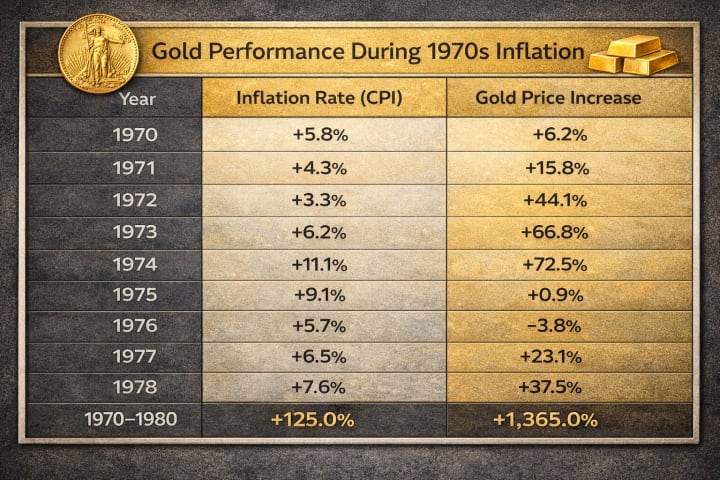
The key takeaway is that gold grew over 1,300% during the intense inflation of the 1970s. This performance dramatically outpaced CPI. This is why allocations above 10% become rational in sustained inflation environments.
Gold continued to perform well in other economic crises, such as the 2008 recession.
According to Keaney Financial Services, gold did witness a 30% correction in the early days of the recession. This correction came as a result of liquidity crisis. When the stock market collapsed, many gold investors sold their gold to regain as much cash as they could. This liquidity crisis brought the gold price down to roughly $700.
However, the later months of 2008 saw an ongoing recovery in the gold price that went on for years. It reached its height in 2011, when gold hit $1,900.
The Biggest Mistake Investors Make
Most people treat gold like a trade asset. That's the wrong mindset to have when you go into the precious metals market.
Instead, gold and silver are better understood as:
financial insurance first, speculative upside second
If you start from that premise, your allocation decisions become much clearer. Precious metals work as a way to preserve your assets from devaluation first and foremost. It can also serve as a way to practice speculative trading.
In contrast, stocks and equities are aimed at building your wealth first and foremost. When you understand that difference, it helps you narrow down how to allocate your resources.
The 4 Core Allocation Strategies (Not Just "5%-10%)
The typical advice that investors give is that investors should invest between 5%-10% of your portfolio in precious metals. Some even expand that to 10%-20%.
Within that allocation breakdown, the standard advice is to split your gold and silver ownings 75:25 gold-to-silver.
So much for the standard advice. The problem is, that advice does not take into account the different strategies investors may pursue, which will affect how much gold and silver they invest in.
So, let's break down the 4 core allocation strategies, and go beyond the typical.
1. Conservative Hedge (5%-10%)
Who it's for:
- Traditional investors
- Heavy stock/bond portfolios
- Trust in the financial system
Allocation:
- 5%-10% precious metals
- Mostly gold, minimal silver
Purpose:
- Hedge against inflation and market downturns
- Portfolio diversification
Reality check:
- This is what most financial advisors recommend: but it offers limited protection in a true crisis.
2. Balanced Protection (10%-20%)
Who it's for:
- Investors concerned about inflation and debt
- Those wanting real diversification
Allocation:
- 10%-20% metals
- Mix of gold and silver (e.g., 70/30 split)
Why this works:
- Gold stabilizes wealth
- Silver adds upside potential
Historical insight:
- During inflationary periods like the 1970s, portfolios with meaningful hard asset exposure significantly outperformed purely financial portfolios.
3. Defensive Positioning (20%-20%)
Who it's for:
- Skeptical of central banks and fiat currency
- Concerned about systemic risk
Allocation:
- 20%-30% metals
- Heavier silver allocation (up to 40%)
Purpose:
- Wealth preservation in severe downturns
- Protection against currency devaluation
Key insight:
At this level, metals stop being a "hedge" and become a core pillar of your financial strategy.
4. Hard Asset Strategy (30%+)
Who's it for:
- Crisis-focused investors
- Those prioritizing financial independence and resilience
Allocation:
- 30%-50%+ in gold and silver
- Significant silver exposure for barter potential
Why some investors choose this:
- Distrust of banking systems
- Desire for tangible, portable wealth
- Preparation for extreme economic scenarios
Tradeoff:
- You sacrifice some growth potential for maximum security and independence.
Gold vs. Silver: How Much Gold Should I Own?
The above recommendation tells you how much to allocate into precious metals. However, it does not tell you a ratio of gold and silver to buy.
So, how can you make that decision and ensure you get the best balance of gold vs silver?
Here is a practical breakdown to help with your allocation:
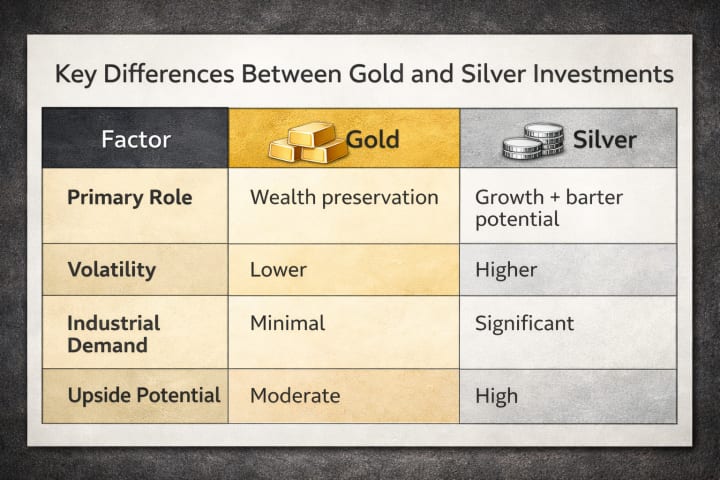
There are three basic allocation rules for investors when deciding how much gold and silver you should own:
Stability focus: 80%-90% gold
Balanced: 60%-70% gold / 30%-40% silver
Aggressive: 50% or more silver
A Smarter Way to Think About How Much Silver You Should Own
Up to this point, we have addressed the question of what percentage of a portfolio should be in gold. The problem with that question is, it is a bit nebulous. It is very easy to make that question too abstract.
Here is a better way to phrase the question:
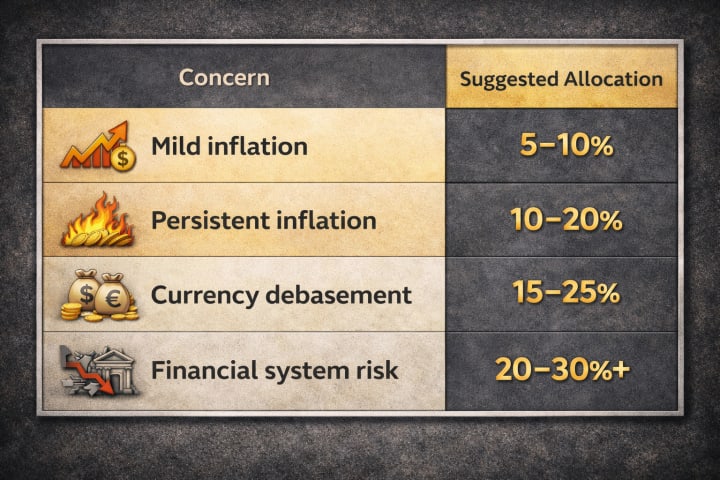
"What risks am I trying to protect against?"
When you ask that question, it can reframe several things. Here's an overview of how that can look:
Physical Metals vs Paper Gold
This distinction is critical, and unfortunately, it is often ignored.
If your goal is protection, physical ownership matters. The primary reason for this is because paper gold and paper silver assets are traded on the stock market. Because of that, they do not offer the same protection that physical gold does.
Here are the key differences:
Physical Gold & Silver
- No counterparty risk
- Direct ownership
- Private and outside the financial system
ETFs & Paper Products
- Convenient
- Liquid
- Depends on financial institutions
If you are hedging systemic risk, paper gold defeats the purpose.
Common Allocation Mistakes to Avoid
1. Owning Too Little
A 5% allocation won't meaningfully protect you in a crisis.
2. Going All-In At Once
Precious metals are volatile. Dollar-cost averaging reduces risk.
3. Ignoring Silver
Silver historically outperforms gold in bull markets, but with higher volatility.
4. Treating Metals Like Stocks
Gold is not intended to "beat the market". It's meant to protect against it.
Final Thoughts: What Should You Do?
The question this guide set out to answer was, "How much gold and silver should I own?" By now, we have clearly established that there is no universal answer to that question.
However, there is a clear framework to help you decide how to allocate your resources.
If you:
- trust the system - stay closer to 5%-10%
- worry about inflation - consider 10%-20%
- question long-term stability - 20%+ becomes reasonable
They key is intentionality. You have to make your investments in a way that fits your financial goals and strategy. No investor should just copy a percentage they read in an article.
Instead, build an allocation that fits your risk tolerance and goals.
Frequently Asked Questions About Gold and Silver Allocation
Is 10% in gold enough?
That depends on your goals. If your goal is simply to diversify your portfolio, this is an adequate amount. For crisis protection, however, it is often not enough.
Should I own more silver than gold?
Owning more silver than gold can fit your investment strategy if you want to gain higher upsides. Silver has a much more volatile market than gold, making it a better asset for speculation.
Another reason you might own more silver than gold relates to your budget. If you are just getting into precious metals, silver is a great place to start due to its lower price. So, you may own more gold than silver at the start of your precious metals journey.
What's the best way to start?
The first step is to start small. Next, buy consistently. It often helps to set a scheduled time each month in which you buy precious metals.
Finally, prioritize physical ownership. Physical precious metals offer far more protection against crises in the financial system.
About the Creator
Sound Money
Sound Money Reform
The Sound Money Defense League advocates for restoring gold and silver as constitutional money through grassroots activism, policy reform, and public education on the risks of fiat currency and the benefits of sound money.
Keep reading
More stories from Sound Money and writers in Trader and other communities.
Mexico Tequila Market Size to Reach USD 13.16 Billion by 2034
Mexico Tequila Market Size, Growth, and Forecast (2026–2034) The Mexico tequila market is experiencing strong growth as global appreciation for traditional and premium spirits continues to rise. In 2026, the market reflects increasing international demand and evolving consumer preferences toward authentic, high-quality alcoholic beverages.
By Jackson Watsona day ago in Trader
AE Holding I Trends: Why UK Investors Are Taking Notice
AE Holding I has become a topic of growing interest among UK investors who want clear and practical ways to grow their money. Understanding AE Holding I is important for anyone seeking steady investment options with potential growth. They will explore AE Holding I’s trends, why it is attracting attention, and strategies UK investors can consider. We also include an internal link to related investment insights to help readers explore other opportunities in the UK market.
By John.doe7984 days ago in Trader
Something Is Beginning, I Think Challenge Winners
This challenge wasn’t about clean starts. It was about that weird in-between where something is beginning, but no one really knows what yet. A lot of these stories leaned into hesitation, into pauses and false starts and that feeling that something is about to happen but hasn’t quite.
By Vocal Curation Team2 days ago in Resources




Comments
There are no comments for this story
Be the first to respond and start the conversation.