
Why Your Cat Follows You to the Bathroom – The Hilarious Truth
10 Funny and Surprising Reasons Your Feline Won’t Leave You Alone

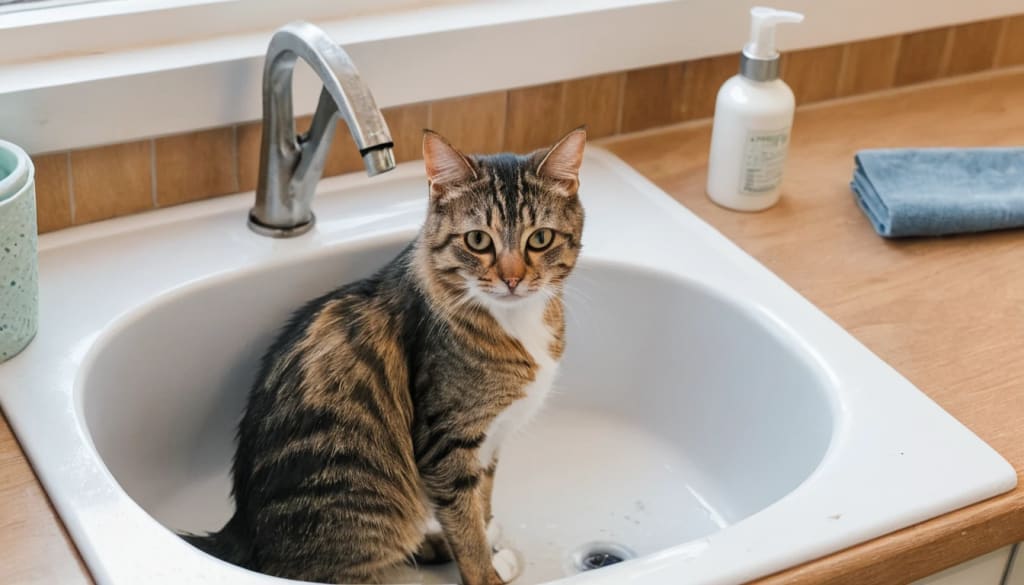
If you share your home with a cat, you have almost certainly experienced this quietly amusing ritual. You stand up, walk toward the bathroom, and within seconds, a soft, determined presence appears behind you. Sometimes they slip in before you can close the door. Other times, they sit outside, sliding a paw underneath like a tiny negotiator refusing to accept exclusion. What feels like a lack of privacy is, in reality, a surprisingly rich mix of instinct, affection, curiosity, and learned behavior
Cats are often misunderstood as distant or independent, but anyone who lives with one knows that they form strong, meaningful attachments. When your cat follows you into the bathroom, it is not random or meaningless. It is a small, everyday expression of how they relate to you and the world around them
1. Cats are social in their own quiet way, and once they bond with a human, they prefer to stay close whenever possible. Unlike dogs, they do not always express attachment loudly, but their presence speaks volumes. Following you to the bathroom is simply an extension of that bond. In their mind, there is no reason to separate from you just because you entered a different room
2. Curiosity is one of the most powerful forces driving feline behavior. Cats are natural investigators, constantly scanning their environment for changes. A closed door immediately becomes a mystery. What is happening inside, and why are they not part of it? The bathroom becomes less about the activity itself and more about the fact that access is restricted
3. The bathroom offers a rare and valuable situation where you are still and accessible. In a busy home, you may move around, work, or focus on other tasks, but in the bathroom, you are temporarily stationary. To your cat, this is an ideal moment to connect. They can approach you without interruption, settle nearby, or demand attention with complete confidence
4. Instinct plays a subtle but important role. In the wild, animals are vulnerable when they are eating, sleeping, or relieving themselves. Cats retain echoes of these instincts even in domestic life. When you enter the bathroom, your cat may instinctively stay close as a form of protection. It is not a conscious decision but a deeply rooted behavioral pattern
5. The bathroom itself is an environment filled with sensory appeal. The coolness of tile floors can be refreshing, especially in warmer weather. The sound of running water captures attention and can even trigger fascination or play. Objects like toilet paper offer texture and movement, making them irresistible to curious paws. For your cat, this room is not boring. It is full of opportunities for exploration
6. Routine shapes much of a cat’s daily life. Cats are highly observant and quickly learn patterns. If you visit the bathroom at similar times each day, your cat begins to anticipate this behavior. Over time, following you becomes automatic. It is not something they actively decide each time. It is simply part of the rhythm they have come to expect
7. Some cats experience mild separation anxiety, especially if they have formed a strong attachment. When you disappear behind a closed door, even briefly, it can create a sense of uncertainty. Following you helps maintain a feeling of connection and security. Waiting outside the door or vocalizing is their way of staying engaged with you
8. Human behavior often reinforces this habit without intention. If you have ever spoken to your cat, petted them, or allowed them to sit with you in the bathroom, you have created a positive association. Cats learn quickly from these interactions. They understand that following you into this space leads to attention, and they repeat the behavior accordingly
9. Sensory comfort is another important factor. Bathrooms often contain familiar scents, including yours, which can be reassuring to your cat. The enclosed space creates a feeling of safety, while warmth from water or heated surfaces adds to the comfort. To your cat, the bathroom can feel like a secure and inviting place rather than a private one
10. Finally, cats are known for their unique and sometimes unpredictable personalities. They engage in behaviors that may seem unusual but are perfectly natural within their own logic. Following you to the bathroom is one of those quirks that highlights their individuality. It is part instinct, part habit, and part simple preference.
Beyond these specific reasons, there is a broader truth that ties everything together. Your cat’s behavior reflects the way they experience their world. They do not separate moments into categories of private or public. They do not question whether they should or should not be present. They simply respond to their instincts, their environment, and their bond with you.
For many cat owners, this behavior becomes a source of humor and even comfort. It is a reminder that their cat chooses to be near them, even during the most ordinary parts of the day. What begins as a slightly inconvenient habit often becomes a familiar and even cherished routine.
Of course, not everyone appreciates this level of companionship. If you prefer to maintain your privacy, it is possible to gently set boundaries. Consistently closing the door and not responding to scratching or vocalization will gradually teach your cat that the bathroom is off-limits. Providing alternative forms of stimulation, such as toys or comfortable resting areas, can also help redirect their attention.
It is important to approach this process with patience. Cats do not respond well to sudden changes or punishment. Instead, they learn through consistency and positive reinforcement. Over time, they will adapt to new boundaries while still maintaining their sense of security.
In most cases, however, there is no need to change this behavior. It is harmless and often reflects a healthy bond between you and your cat. Only when it is accompanied by signs of distress, such as excessive vocalization or destructive behavior, should it be considered a potential issue that may require further attention.
Ultimately, when your cat follows you to the bathroom, it is not an attempt to invade your space. It is an expression of curiosity, routine, instinct, and affection all woven together into one small, persistent habit. It is their way of staying connected to you, of sharing your environment, and of participating in your daily life.
What may seem like a lack of privacy is, in fact, a quiet form of companionship. Your cat is not concerned with boundaries in the human sense. They are simply responding to what feels natural to them, which is being near you.
So the next time you hear that familiar scratch at the door or feel a soft presence at your feet, you might pause for a moment and see it differently. Instead of an interruption, it becomes a small reminder of the bond you share. Your cat is not just following you. They are choosing you, again and again, in every room, in every routine, and even in the most unexpected places.
About the Creator
Algieba
Curious observer of the world, exploring the latest ideas, trends, and stories that shape our lives. A thoughtful writer who seeks to make sense of complex topics and share insights that inform, inspire, and engage readers.
Wisteria Woo RIP
Wisteria Woo Silver~Rhodesian Ridgeback Cane Corso mix~ 7.19.15-3.2.26 My service dog, Wisteria, had been slowing down, having mysterious health symptoms like severe hives and unexplained injury. She went to the vet last month, but unfortunately, not all tests detect all problems. When we returned to the vet yesterday, upon much more concerning symptoms suddenly appearing, we learned she had a very large mass (10inx10in) likely the very aggressive hemangiosarcoma, and that we would only be buying a few months if we went through with treatment.
By K.B. Silver 28 days ago in Petlife
The Fast Pick Problem
The meet-and-greet lasts about 12 minutes. A volunteer opens the door and brings in 2 dogs. One heads straight for the family, tail moving hard, body loose, climbing halfway into a lap before the adults have even settled into their chairs. Everybody laughs. The kids light up. Somebody says, “Well, I guess we know who picked us.”
By Dr. Mozelle Martina day ago in Petlife


Comments
There are no comments for this story
Be the first to respond and start the conversation.