
Do Solar Panels Increase Your Home's Value? What UK Homeowners Need to Know
Do Solar Panels Increase Home Value in the UK?

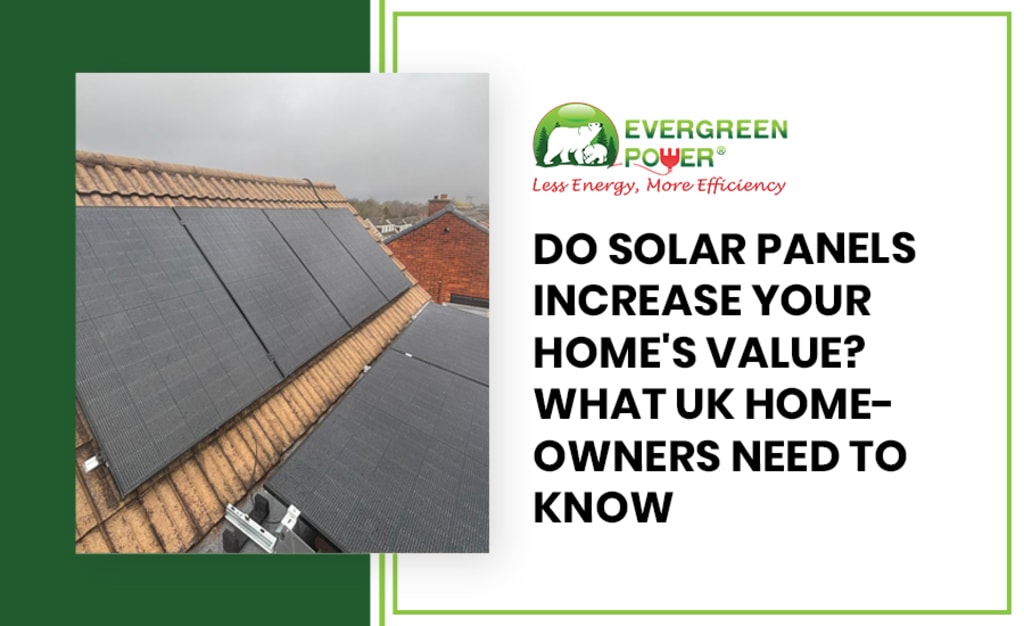
When homeowners consider solar panels, the conversation usually starts with energy bills and payback periods. Property value tends to be an afterthought. It probably shouldn't be — because the evidence that solar panels increase house prices in the UK is increasingly hard to ignore, and the mechanism for why is becoming clearer every year.
This guide looks at what the data actually says, how EPC ratings connect solar to mortgage and resale decisions, and what buyers are increasingly looking for when they view a property.
What the Research Shows
Multiple studies have looked at the relationship between solar panels and UK property values. The consensus is that they have a positive effect — though the size of that effect varies by methodology, region and property type.
Research suggests a typical uplift of 2–6% in property value for homes with solar installed, compared to equivalent properties without. On a £350,000 home, that represents a potential increase of £7,000–£21,000 — a meaningful figure relative to the cost of installation.
Some studies focusing on newer, more efficient systems with battery storage suggest uplifts toward the higher end of that range, particularly as buyer awareness of energy costs increases.
“From 2027, solar panels will be mandatory on new-build homes under the Future Homes Standard. Existing homes without solar will increasingly be compared unfavourably to new supply.”
The EPC Connection
Understanding why solar panels increase property values requires understanding the role of Energy Performance Certificates (EPCs).
An EPC rates a property's energy efficiency from A (best) to G (worst). The average UK home scores D or E. Solar panels typically improve a property's EPC by one to two bands — so a D-rated home might reach B or C after a solar and battery installation.
This matters for three concrete reasons:
1. Mortgage availability and rates
An increasing number of mortgage products offer preferential rates for properties rated A or B — so-called ‘green mortgages.’ Lenders are also beginning to factor EPC ratings into affordability assessments, particularly as the government has signalled minimum EPC requirements for rental properties. A better-rated property is simply easier to mortgage.
2. Government minimum standards for landlords
The government has proposed minimum EPC requirements for rental properties. A higher-rated property has a longer compliance runway and is more attractive to buy-to-let investors as a result.
3. Buyer psychology
Buyers increasingly understand what an EPC rating means in terms of bills. A property with a B rating versus a D rating represents a meaningful difference in annual running costs — and buyers factor that into what they're willing to pay.
EPC INSIGHT
Installing solar panels with battery storage typically moves a property up 1–2 EPC bands. Moving from a D to a B or C rating is increasingly meaningful to buyers, mortgage lenders and valuers — and that gap is likely to widen as energy costs remain elevated.
What Buyers Actually Think
Survey data from estate agents and property portals consistently shows growing buyer interest in energy efficiency. Rightmove research has found that buyers are increasingly filtering searches by EPC rating, and that ‘solar panels’ appears regularly in property wish lists for the 25–45 age demographic.
The practical conversation at viewings has also shifted. A decade ago, solar panels prompted questions about maintenance and appearance. Today, buyers are more likely to ask about the system's output, whether it has battery storage, what the SEG income is, and whether the warranty transfers on sale.
That shift in conversation is a reasonable proxy for the shift in perceived value.
The Future Homes Standard: A One-Way Ratchet
From 2027, solar panels will be mandatory on the vast majority of new-build homes under the Future Homes Standard. This is a significant structural shift.
What it means practically: the new-build homes competing with your property for buyers will all come with solar as standard. The market expectation for energy-efficient homes will rise accordingly. Existing homes without solar will face a widening gap relative to new supply — and those with solar will be better positioned to compete.
This isn't a short-term consideration. It's a structural change to the baseline expectation for residential property.
⚠️ THE TIMING QUESTION
Installing solar before the 2027 Future Homes Standard comes into force means buying in at today's prices and enjoying savings, SEG income and property benefit for longer. Waiting until the market expects solar as standard may mean installing later and at potentially higher demand-driven prices.
What to Tell Your Estate Agent
When you come to sell, make sure your agent understands what you have. Specific things worth documenting and presenting:
• The system's MCS certificate and installation date
• Panel brand, model and efficiency rating
• Battery storage capacity and brand
• Current SEG tariff and approximate annual export income
• Average annual generation figures from your monitoring app
• Remaining manufacturer warranty on panels, inverter and battery
A buyer who understands what they're acquiring — a system generating £800+ per year in bill savings and SEG income, with 20 years of panel life remaining — is a buyer who can rationally value that asset. Don't leave it to chance that they'll work this out themselves.
Frequently Asked Questions
Do solar panels increase my council tax?
No. Council tax bands are based on a property's value at a fixed point (1 April 1991 in England). Solar panels added after that date do not affect council tax, regardless of any increase in current market value.
Do I need to tell my mortgage lender about solar panels?
You should notify your mortgage lender when making significant structural changes or improvements to your property. In practice, solar panels are a positive addition that most lenders view favourably. Check your mortgage terms and contact your lender if unsure.
Can I take my solar panels with me when I move?
Technically yes, but in practice most homeowners leave them. Removing panels can damage the roof and will require reinstallation — the cost typically outweighs the benefit. Most buyers expect to inherit the solar system as part of the property purchase.
How does solar affect a home survey?
A surveyor will note the presence and condition of solar panels. A well-installed, certificated system is a positive finding. Poorly installed or uncertificated systems can be flagged as a concern. This is another reason why MCS-certified installation matters.
About the Creator
Evergreen power
We specialize in Solar panels UK and other renewable energy solutions
Keep reading
More stories from Evergreen power and writers in Journal and other communities.
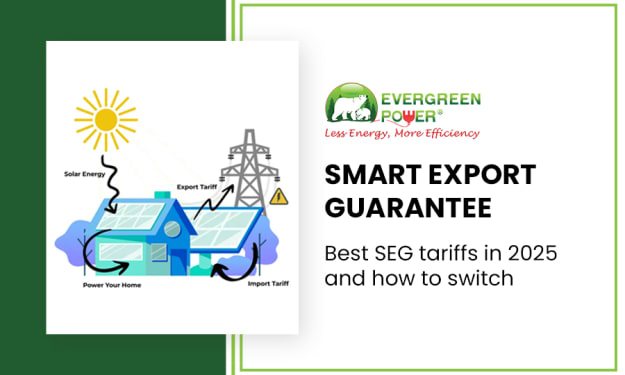
Smart Export Guarantee: best SEG tariffs in 2025 and how to switch
If you export any solar you don’t use, Smart Export Guarantee (SEG) payments help the numbers stack up. The trick is picking a tariff that matches your generation and usage profile — especially if you have a battery. Below you’ll find a brisk refresher on how SEG works, what to compare, and a step-by-step that makes switching painless.
By Evergreen power5 months ago in Journal
Author’s Advice
If you would’ve asked me 20 years ago did I know I’d become a writer and an author, I would’ve said “nope, ain’t happening”. As fate would have it I did become an author and I can honestly say I’m loving it so far. It really does feel good to be a writer. I’ve learned a lot on this journey and I feel like with even me being as new to this world as I am, there’s some wisdom I need to share with every other aspiring author.
By Joe Patterson20 days ago in Journal
Paul and John's 47-Words Short Story Unofficial Challenge
UPDATE - Republished to update the list of entries, with the 40 we've had so far. Completely smashed last unofficial challenge which recieved 31 entries. And there is still time. If you have yet to enter and fancy winning a bit of money or just challenging yourself or both or just making two old geezers job harder - please enter!
By Paul Stewartabout 23 hours ago in Writers



Comments
There are no comments for this story
Be the first to respond and start the conversation.