
The 3 A.M. Algorithm: Why My Best Stories Still Smell Like Cold Coffee
In 2026, efficiency is a commodity. Discover why your "glitches" are actually your greatest creative superpower.

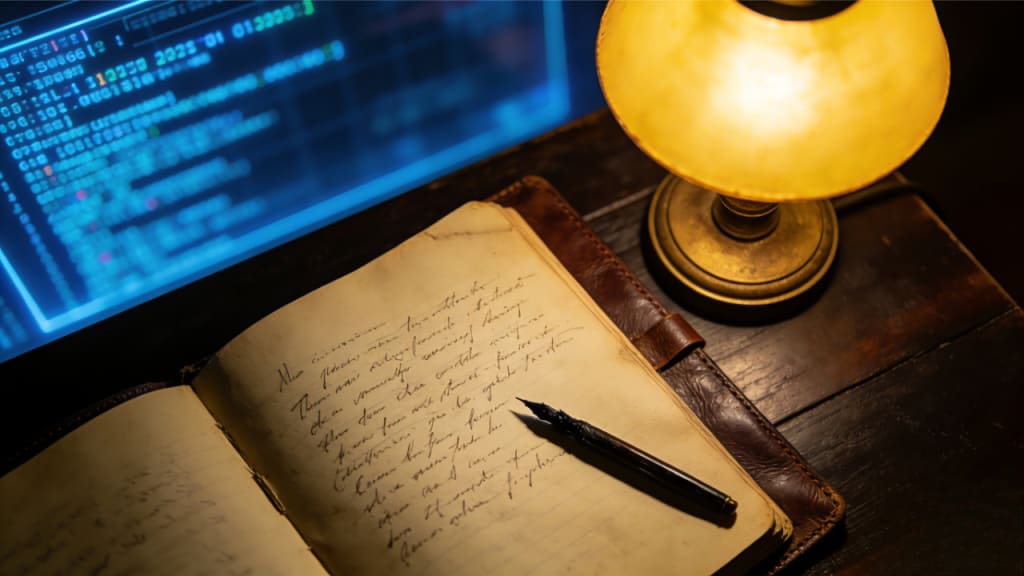
The Sterile Perfection
I sat in my studio, the glow of my holographic interface casting a neon blue hue over a cup of espresso that had long since gone cold. It’s 2026, and the "Creator Economy" has mutated into an "Optimization Race."
I fed the prompts into the engine: “Write a nostalgic story about a rainy night in Tokyo. Add a touch of melancholy. Ensure high SEO ranking for 'travel' and 'loneliness'.”
Seconds later, it spat out a story. It was technically flawless. The syntax was sterile, the pacing was cinematic, and the metaphors were mathematically balanced. But as I read it, I felt a cold shiver of obsolescence. It tasted like distilled water—safe, clean, but entirely nutritionless. For a moment, I didn't just fear the AI; I feared I had nothing left to say that a server couldn't say better.
I posted it anyway. It did "well"—people clicked, they scrolled, and they left. But no one commented. No one tipped. It was a ghost story written by a ghost.
The Human Glitch
A week later, the hyper-connectivity of 2026 failed me. My high-speed satellite link went down during a storm, and I was forced to write in an old leather notebook by candlelight. I wasn't trying to be "optimized." I was just frustrated.
I wrote about the time I lost my wallet in Shinjuku and spent four hours talking to an elderly station master who shared his grilled squid with me. I wrote about his hands—mapped with wrinkles like old parchment. I wrote about the smell of rain hitting hot asphalt—not the "petrichor" a dictionary defines, but the way it smells like wet dust and broken promises.
My own words were like burnt toast—bitter, uneven, but at least they were warm. I wrote about my fear that in this world of seamless AI integration, I am becoming a biological extension of a server farm.
I typed it up manually the next day, raw and unpolished. I titled it: "The Station Master’s Squid: A Story AI Can’t Imagine."
“Efficiency is a commodity, but vulnerability is a luxury.”
The Result: Why the Algorithm Smiled
That story didn't just get reads. It earned "Top Story" status.
Within 48 hours, my inbox was full. One reader from Brazil wrote: “I’ve never been to Tokyo, but I know exactly what that specific loneliness feels like. Thank you for being real.”
That’s when I realized the secret of creating in 2026: We are drowning in 'perfect' content. Our feeds are flooded with AI-generated art that has no fingerprints and music that has no heartbeat. In this landscape, your "mistakes"—your weird obsessions, your specific grief, your irrational joys—are your greatest competitive advantage.
How to Write for Humans (Not Just Bots)
If you want to survive as a creator this year, here is my manifesto:
Stop being "Correct": If the AI suggests a more "efficient" word, keep your clunky one. It sounds like you.
The Specifics Rule: Don't just say "it was a sad day." Say "it was the kind of Tuesday where the sky looks like dirty dishwater."
The $3.00 Tip Test: Ask yourself, “Would someone give me the price of a coffee for this insight?” If the answer is no, you’re just adding to the noise.
Final Thought
Technology can give us the tools to reach the world, but it cannot give us something to say. Use the AI to build the house, but make sure you’re the one living in it.
The algorithm might decide who sees your work, but only your soul decides who stays.
Next time you reach for the 'Generate' button, ask yourself: Is this a story you're telling, or just a ghost you're inviting into your house?
About the Creator
Kamikadzebro
- Storyteller. Writing about life, people, and the moments that stay with us.
Keep reading
More stories from Kamikadzebro and writers in Humans and other communities.
The Note That Started It All — And the One That Almost Ended It
I met him when I was 17. Back then, I was the kind of girl who read poetry and dreamed of falling in love with someone who would write me letters. Someone who understood words and feelings and all the romantic things I'd read about in books.
By Kamikadzebro12 days ago in Marriage
Why Wiked: For Good is Undeservingly the ‘worse movie’
So… off the bat, we’re about to delve into something ridiculous. Just so we’re clear on that, ok? The first thing anyone that knows a thing about these dual movies… knows… is the original movie and sequel were shot together.
By Gabriel Shames3 days ago in Humans
Political figures urge Vance to replace Trump as president
A surprising and controversial political suggestion has sparked debate in Washington and beyond, after a prominent conservative voice publicly called for a dramatic shift in leadership. On March 22, journalist Scott McConnell urged Vice President JD Vance to consider invoking the Twenty Fifth Amendment to the United States Constitution to remove Donald Trump from office.
By Shirley Oyiadom2 days ago in Humans
Foraging Appalachia’s Wild Edibles
It's that time of year again and Appalachia offers a remarkable abundance for anyone willing to learn its seasonal gifts and practice careful gathering. Across ridges, holler's, stream-side's, and meadows, edible plants, berries, roots, and fungi appear through every part of year. Knowledge is key and teaches not only what can be eaten, but also how to gather with respect so that these resources remain available far into future.
By Tim Carmichael7 days ago in Feast

Comments
There are no comments for this story
Be the first to respond and start the conversation.