
The Weight of an Unfinished Self
A Thought That Refused Its Own Ending


I was not searching for truth.
Truth implies arrival,
a final place where questions
collapse into silence.
But I never trusted endings.
They feel too clean,
too symmetrical
for something as fractured as existence.
What I was searching for—
if it can be called searching—
was interruption.
A rupture
in the continuous stream of becoming.
Because becoming is exhausting.
To always move toward something,
to always reshape yourself
based on what you think you should be—
it is a quiet violence
you commit against your present.
I noticed it one morning.
Nothing extraordinary happened.
No revelation,
no voice,
no sudden clarity.
Just a hesitation.
A pause
between one thought
and the next.
And in that pause,
something strange appeared:
There was no one there.
The thought did not belong to me.
It arrived,
fully formed,
as if it had always been waiting
for a mind to pass through.
And when it left,
it took nothing with it.
No trace.
No ownership.
So I asked:
If thoughts come and go
without asking permission,
then who is the owner?
Who claims them?
Who builds a self out of echoes?
The answer did not come.
But the question remained,
echoing in a space
that felt wider
than anything I had known.
I began to see the pattern.
Every “I” I had ever used
was attached to something—
a memory,
a fear,
a role,
a story I repeated
until it felt natural.
But when stripped of all attachments,
the “I” dissolved.
Not dramatically—
no collapse,
no crisis—
just absence.
At first,
I tried to rebuild it.
To gather fragments,
to reconstruct a center.
But every attempt
felt artificial.
Like trying to convince water
to hold a shape
without a container.
So I stopped.
And that is when it became difficult.
Because without a center,
everything feels unstable.
Choices lose their weight.
Meaning loses its urgency.
Even time
begins to feel… optional.
There is a danger here.
Not madness—
madness still clings to structure—
but something more subtle.
A drifting.
A state where nothing compels you,
and nothing anchors you.
Most people fear this.
They call it emptiness,
loss,
confusion.
But I began to see it differently.
What if this is not a loss—
but a removal?
Not something taken away,
but something that was never truly there
finally disappearing.
The self
is not a fixed entity.
It is a negotiation.
A continuous agreement
between memory and expectation.
And when that agreement breaks—
what remains
is not a better version of the self.
It is the absence of it.
This is where language fails.
Because language depends on separation—
subject and object,
observer and observed.
But in this state,
those boundaries blur.
You are not observing thought.
Thought is happening
within the same field
that you call “you.”
So who is speaking now?
Not me.
At least, not in the way
I used to understand it.
This is not expression.
It is unfolding.
Words arranging themselves
in a pattern
that resembles meaning
but refuses to settle into it.
There was a moment
when I tried to hold onto this.
To capture it,
define it,
turn it into something I could return to.
But the moment I did—
it disappeared.
Because what is alive
cannot be preserved
without becoming something else.
And that is the paradox.
We want to understand life
by freezing it.
We want clarity
without losing movement.
We want truth
that does not change.
But life
is change.
And truth—
if it exists—
must move with it.
So what remains
when you stop trying to hold anything?
Not knowledge.
Not identity.
Not certainty.
Only experience—
raw, immediate,
unfiltered by interpretation.
This is not enlightenment.
It does not elevate you.
It does not make you special.
If anything,
it removes the idea
that there was ever someone
to be elevated.
And yet—
there is a strange intimacy
in this state.
A closeness to existence
that does not rely
on understanding it.
Like standing in the ocean
without trying to measure its depth.
Feeling it—
without needing to define it.
If you ask me now
what I believe—
I will hesitate.
Not because I lack beliefs—
but because I no longer trust
their permanence.
Every belief
is a temporary shelter.
Useful in the storm,
but dangerous
if you mistake it
for the sky.
So I move lightly.
Not detached—
detachment is another form of control—
but uncommitted
to fixed conclusions.
Ready to let go
the moment something
claims to be final.
Because anything final
is already dead.
And I have no interest
in carrying dead things
through a living world.
If there is anything
I can leave you with—
it is not an answer.
It is a direction.
Not forward,
not backward—
but inward,
to the place
where questions dissolve
before they become words.
Stay there
long enough—
and you might notice:
The one who was searching
is no longer present.
And what remains
does not need to search
at all.
About the Creator
Ibrahim
I'm a creative writer in the way that I write. I hold the pen in this unique and creative way you've never seen
A Deadly Mistake in the Desert: The Merchant’s Fate
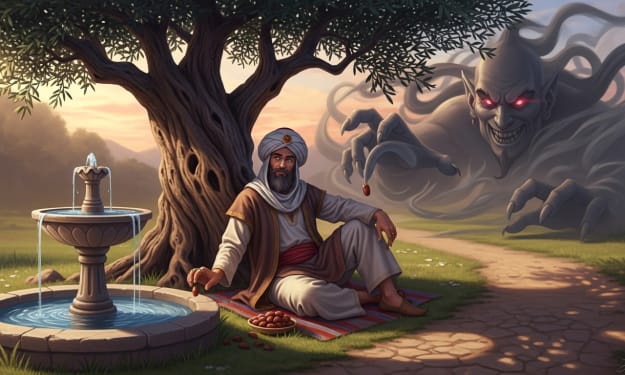
By(Haris Barki) SIRE, there was once upon a time a merchant who possessed great wealth, in land and merchandise, as well as in ready money. He was obliged from time to time to take journeys to arrange his affairs. One day, having to go a long way from home, he mounted his horse, taking with him a small wallet in which he had put a few biscuits and dates, because he had to pass through a desert where no food was to be got. He arrived without any mishap, and, having finished his business, set out on his reurn. On the fourth day of his journey, the heat of the sun being very great, he turned out of his road to rest under some trees. He found at the foot of a large walnut-tree a fountain of clear and running water. He dismounted, fastened his horse to a branch of the tree, and sat down by the fountain, after having taken from his wallet some of his dates and biscuits. Whilst eating the dates he threw the stones right and left. When he had finished this frugal meal he washed his face and hands in the fountain.
By Mariana Farias3 days ago in Fiction



Comments (1)
Hey Ibrahim, This really stayed with me 💭 I recently wrote something with a similar vibe, and it’s fascinating how emotions connect across writers.