
The Phonograph of Hollow Souls
Some frequencies exist beyond the living ear — and some voices never agreed to fall silent

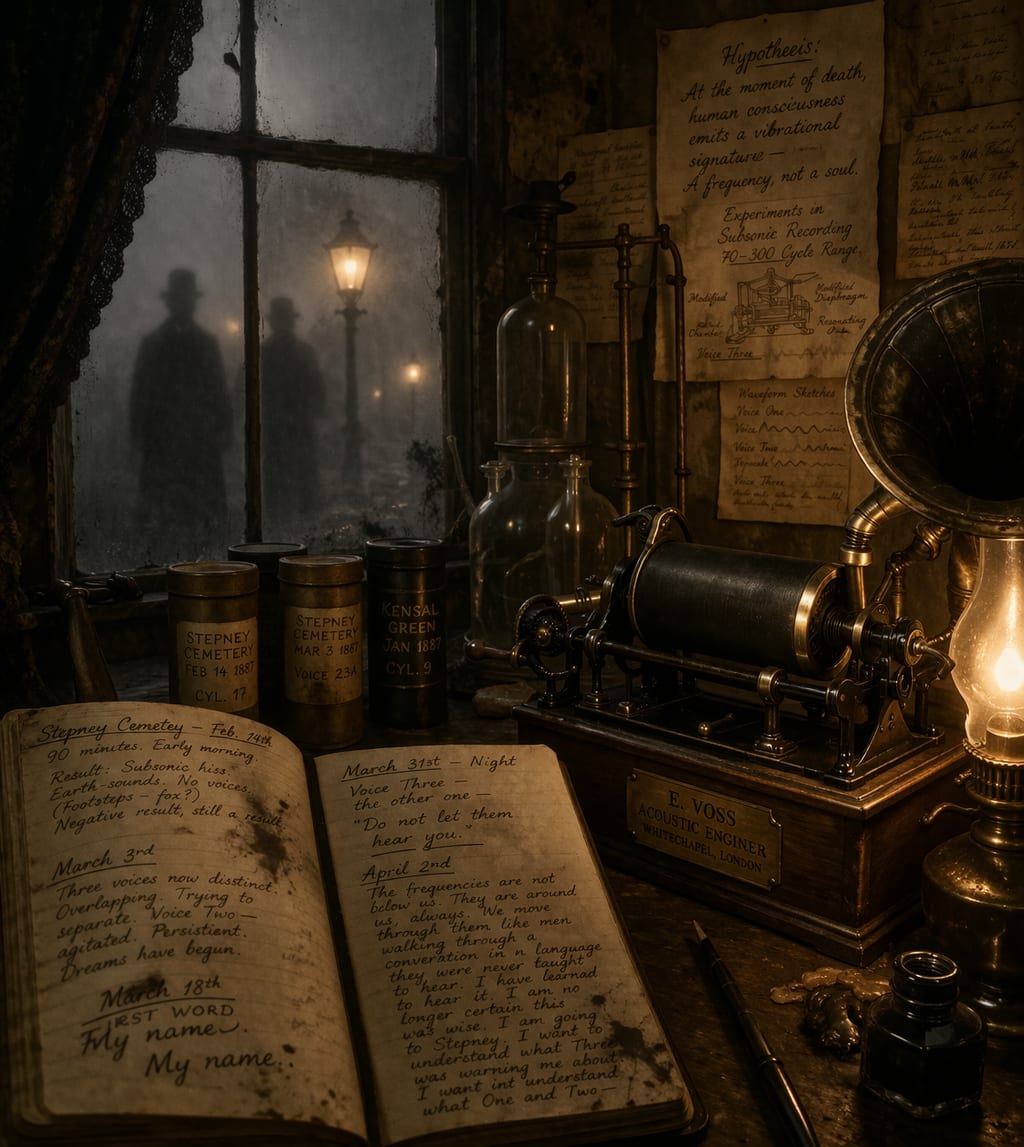
The dead, Edmund Voss had come to believe, were simply a matter of frequency.
He arrived at this conclusion not through any mystical awakening or feverish religious crisis, but through the careful, methodical application of scientific reasoning — the same reasoning that had earned him a modest reputation among London's emerging class of acoustic engineers and a less modest reputation among its society gossips, who found a bachelor of forty-three with wax-stained fingers and an apartment full of recording cylinders somewhat difficult to seat at dinner parties.
It was the winter of 1887 when it began. The city was locked under a fog so dense that the gas lamps appeared to float, disembodied, in a gray void, and Edmund had spent three consecutive weeks in his Whitechapel laboratory conducting experiments with a modified Edison phonograph he had been refining for the better part of two years. His modifications were extensive and, to anyone who understood acoustics, deeply strange. He had lowered the device's recording range significantly below the threshold of human hearing. He had replaced the standard diaphragm with one fabricated from a membrane he had, after considerable difficulty and one uncomfortable conversation with a butcher on Aldgate High Street, sourced from an organic material he preferred not to name in his formal notes.
His working hypothesis — and he wrote this in his journal with the careful, hedged language of a man who knew how it would look — was that human consciousness, at the moment of death, produced a vibrational signature that dispersed into the environment rather than simply ceasing. Not a soul, in any theological sense. Edmund had no patience for theology. A frequency. A measurable, recordable phenomenon that existing instruments were simply too crude to detect.
He had been conducting his experiments in cemeteries.
The recordings began as noise.
Long ribbons of wax cylinder, played back through his modified apparatus, yielded nothing but a low subsonic hiss — the acoustic signature of soil and stone and the faint geological murmuring of the earth itself, which Edmund found genuinely interesting but not what he was looking for. He recorded at Highgate, at Kensal Green, at the older and less tended churchyards of the East End where the stones had sunk sideways into the ground like drunk men leaning against a wall. He recorded in the early hours of the morning, when the city was quiet enough that the ambient noise floor dropped to something workable. He returned home with his cylinders, played them back at one-quarter speed through an additional resonating chamber of his own design, and catalogued the results.
Weeks passed. The results were consistent: subsonic hiss. Earth-sounds. Once, memorably, what appeared to be the footsteps of a fox moving between graves at Kensal Green, rendered at low frequency as a sound like distant artillery.
He was not discouraged. He was an engineer. Negative results were still results.
The first anomaly appeared on a cylinder recorded on the fourteenth of February — a date Edmund noted with some irritation, as he had no interest in Valentine's Day and resented the implication of significance. He had been recording in a small, unconsecrated burial ground behind a demolished workhouse in Stepney, a place so forgotten that the graves had no readable stones, only iron markers corroded to abstract shapes. He had set up his equipment, run the recording for ninety minutes, packed up in the cold dark, and thought nothing more of it until the following afternoon.
The playback lasted four minutes before Edmund removed the cylinder with hands that were, he noted in his journal with clinical precision, trembling without my permission.
The hiss was present, as always. The earth-sounds, the sub-frequency murmur of the ground. And beneath that, surfacing and submerging like something moving through deep water, a voice.
Not a voice, precisely. The shape of a voice. The acoustic skeleton of human speech with the recognizable flesh of language stripped away — or rather, not stripped away but slowed to the point where each phoneme was stretched across several seconds of recording, so that a single word, if word it was, took nearly a minute to express. Edmund played it back seventeen times. He took notes. He drew waveform sketches by hand. He did not sleep.
By the fourth day, he had identified what he believed were three distinct voices.
He returned to Stepney with better equipment.
The modification he made to the diaphragm — he would not describe this in his journal and he destroyed the relevant pages later; suffice to say it required a second visit to the butcher and a willingness to think about certain things without thinking about them too carefully — increased the device's sensitivity by a factor he hadn't expected. The new cylinders, played back at one-eighth speed through the resonating chamber, with an additional acoustic amplifier Edmund built from components he'd sourced from a surgical instrument supplier, were almost unbearable.
Not because of the volume. Because of the clarity.
They were speaking. Not in any pattern Edmund could decode — the slowing required to make the frequencies audible rendered the speech rhythms so dilated that language, if language it was, became something more like weather than communication. But they were speaking. Multiple voices, overlapping, the acoustic signatures distinct enough that Edmund could begin to map them: a low, sustained frequency that he labeled Voice One, older-sounding in some quality he couldn't define; a higher, more agitated pattern he labeled Voice Two, which surfaced repeatedly in short bursts as if trying to interrupt; and a third, which appeared rarely and only at the very edge of the equipment's range, so faint and so strange in its tonal quality that Edmund's notes described it simply as the other one and he found himself reluctant to elaborate.
He began to dream about the voices.
Not their words — he could assign no words to them even in sleep. But the texture of them. The sense of being in a room where someone was speaking just beyond the wall, the words indistinct but the intention unmistakable: urgent, and aware of him, and not pleased.
He made his mistake in March.
He had been refining the resonating chamber for weeks, chasing clarity, and had achieved something that satisfied him technically even as it disturbed him in ways he catalogued and then set aside. The new playbacks were extraordinarily detailed. Voice Two, in particular, had resolved into something that was, beyond any reasonable denial, attempting to form specific phonemes. Edmund had constructed a notation system. He had begun, painstakingly, to transcribe.
It took him eleven days to decode the first word.
He recognized it immediately. Not because the acoustic match to any known word was perfect — it wasn't, the frequency distortion was significant — but because some part of him below the level of formal reasoning had been waiting for it, the way you wait for a sound you've been dreading without knowing you were dreading it.
The word was his name.
Edmund Voss did not destroy the equipment that night. He would tell himself later, in the journal entries that grew increasingly difficult to read due to a deterioration in his handwriting that coincided precisely with the Stepney recordings, that he was a scientist and scientists did not destroy evidence. This was true. It was also true that by the time he understood he should destroy it, he had already spent three weeks listening, every night, to Voice Two's slow and effortful pronunciation of his name — and something in him had begun to answer.
Not aloud. He was not, he told himself, that far gone. But in the silence of his laboratory, in the space between playbacks, he had begun to compose responses in his head. To speak, internally, to the voice. To ask it questions. To tell it things. Small things at first: the weather, the state of the city, the progress of his work. Then larger things. The loneliness that a man of forty-three with wax-stained fingers accumulated like sediment. The specific weight of being understood by no one.
Voice Two was an excellent listener.
It was Voice Three — the other one — that finally made him understand what he had done.
It appeared in a recording made on the last day of March, surfacing from the very bottom of the audible range with a clarity it had never achieved before, as if it had been waiting for the equipment to improve sufficiently. Edmund played it back, adjusted the speed, held his breath.
Voice Three did not say his name. Voice Three said, in the slowed and stretched acoustics that Edmund had learned to read like a damaged text, something that his notation system rendered as six words, and which he wrote in his journal with the careful handwriting of a man trying to remain calm:
Do not let them hear you.
Edmund sat in his laboratory for a long time. The gas lamp on his workbench burned without flickering. Outside, London made its London sounds, utterly indifferent.
Then he stood, and he crossed to the window, and he looked out at the fog. And in the fog, just at the edge of where the lamplight failed, he saw — or believed he saw — or could not, after several minutes of staring, determine whether he saw — two shapes standing very still. Not threatening. Not moving. Only present, in the patient, weightless way of things that have nowhere else to be and no reason to hurry.
He pulled the curtain.
He did not destroy the equipment.
He never destroyed the equipment.
The landlady found his apartment empty in April. The phonograph was still running — the cylinder worn to a smooth, recordingless blank from endless rotation, the needle whispering against bare wax. The journals were on the desk, open to the last entry, which read:
The frequencies are not below us. They are around us, always. We move through them like men walking through a conversation in a language they were never taught to hear. I have learned to hear it. I am no longer certain this was wise. I am going to Stepney. I want to understand what Three was warning me about. I want to understand what One and Two—
The sentence ended there. The ink was slightly smeared, as if the pen had been set down quickly. As if Edmund Voss had stopped, mid-thought, to listen.
The landlady, who was a practical woman, sold the phonograph to a curiosity shop in Portobello Road. The shop owner, intrigued by its unusual modifications, wound it up and set it playing.
He said afterward — to those who asked, and then, over time, to those who didn't — that what came out of it sounded almost like voices. Slow and strange and layered, one on top of another, like a conversation through a very thick wall.
He said it had seemed, if he wasn't being foolish, almost like they were waiting for someone specific.
He said he had turned it off and not turned it on again.
He said he had slept perfectly fine, after.
He said this last part with the particular emphasis of a man who has learned that some questions, once asked, develop their own momentum — and that some frequencies, once heard, do not require the machine to keep playing.
From the estate catalogue of E. Voss, acoustic engineer, April 1888:
One phonograph apparatus, heavily modified. Condition: running. Contents of cylinders: unclassified.
About the Creator
Alpha Cortex
As Alpha Cortex, I live for the rhythm of language and the magic of story. I chase tales that linger long after the last line, from raw emotion to boundless imagination. Let's get lost in stories worth remembering.
Keep reading
More stories from Alpha Cortex and writers in Fiction and other communities.
The Last Ember
The last star was dying. Caelum-7 had known this was coming for approximately four hundred million years. That was the nature of being a Warden — you watched, you calculated, you prepared, and still, when the moment finally arrived, the numbers offered no insulation against the weight of it. The instruments aboard the Persistence hummed their soft confirmations: luminosity declining at 0.003% per century, core hydrogen reserves at 0.00017% of original mass, estimated time to final collapse somewhere between eighty and ninety million years. Give or take.
By Alpha Cortex2 days ago in Fiction



Comments
There are no comments for this story
Be the first to respond and start the conversation.