
The Man Who Couldn't Boil Water
In a town that lived to eat, they sent an accountant to the kitchen

Carlo Benedetti had exactly three culinary skills.
He could boil water — usually. He could open a can of tomatoes without injuring himself — mostly. And he could, when the circumstances were sufficiently desperate, produce a plate of scrambled eggs that was edible in the same way that a Tuesday afternoon in February is technically a day: technically correct, bringing no one any particular joy.
These were not, by any reasonable measure, the qualifications required to cook Sunday lunch for four hundred people in Montefiore della Valle, a hill town in Umbria where food was not merely sustenance but religion, civic identity, moral framework, and the primary basis upon which marriages were evaluated, feuds were sustained, and reputations were either built into something magnificent or demolished so completely that the rubble took generations to clear.
Carlo knew this. Carlo had grown up in Montefiore. Carlo had watched his grandmother reduce a visiting food critic to quiet, private tears — the good kind — using nothing but a handful of pasta and forty years of accumulated fury. He understood, with the bone-deep certainty of the native, that in this town you did not serve bad food. You did not serve mediocre food. You did not serve food that caused anyone to make the particular face — the slight downward pull at the corners of the mouth, the almost imperceptible widening of the nostrils — that in Montefiore della Valle meant: this person cannot cook and we will remember this.
And yet here he was. Standing in the kitchen of Ristorante Anima, the finest restaurant in the province, wearing Chef Matteo Conti's apron, holding Chef Matteo Conti's favorite knife, and staring at forty kilograms of raw ingredients that were expected to become something extraordinary by one o'clock.
It was nine-fifteen in the morning.
It had been, up to this point, a very strange week.
The trouble had started, as trouble in small Italian towns frequently does, with a misunderstanding compounded by a lie compounded by everyone's absolute refusal to let the situation resolve itself sensibly.
Carlo was an accountant. He worked from a small office above the pharmacy, managing the financial affairs of eleven local businesses, two farming cooperatives, and the town's increasingly creative approach to municipal budgeting. He was thirty-eight years old, pleasant-looking in an unremarkable way, recently divorced from a woman named Federica who had left him not for another man but for a ceramics course in Arezzo that had apparently awakened in her a sense of purpose that seven years of marriage to Carlo had failed to provide. He bore this without excessive bitterness. He was, by temperament, a man who accepted the mathematics of situations and moved on.
The famous chef — Chef Lorenzo Amati, three Michelin stars, the subject of two documentary films and an ongoing dispute with the French government that Carlo didn't fully understand — had been scheduled to appear at Montefiore's annual Sagra della Cucina Tradizionale, the festival of traditional cooking that every year transformed the town's central piazza into a cathedral of controlled gastronomic chaos. Chef Amati was to demonstrate his famous rivisitazione — his modern reinterpretation of the Umbrian classics — to an audience of locals who had specifically come to watch a man of international renown fumble with their grandmothers' recipes.
Carlo had been booked to manage the festival's accounts. It was a reasonable assignment. He was good with numbers. Numbers did not require olive oil.
The confusion began at the train station.
Chef Amati's assistant — a young man named Dario who communicated primarily through a headset and appeared to experience the physical world as an interruption to his phone calls — had met the wrong man on the platform. Carlo had been there to collect a box of accounting software sent from a supplier in Perugia. He was wearing, by chance, a dark jacket not entirely unlike the kind of dark jacket a person of culinary importance might wear. He was carrying a small rolling case. He looked, Dario would later insist with great conviction, exactly like someone arriving from somewhere important.
"Chef Amati," Dario had said, extending a hand and already speaking into his headset simultaneously, "the car is outside, the kitchen is prepped, the local journalists have been told three o'clock—"
Carlo had tried to explain. He had said, clearly and in standard Italian, that he was not Chef Amati but Carlo Benedetti, accountant, here to collect a package. Dario had nodded with the complete absence of comprehension of a man who was listening to two conversations at once and processing neither. He had taken Carlo's rolling case. He had ushered Carlo into a car.
By the time the misunderstanding surfaced — approximately forty minutes later, when the real Chef Amati arrived at a station with no car waiting and began making calls that Dario, in the chaos of the kitchen setup, did not receive — Carlo was in Ristorante Anima being introduced to the kitchen staff as the man they were there to support.
He should have corrected it immediately. He knew this. He would know it with increasing certainty and increasing retrospective regret for the next several days. But the kitchen had been so beautiful — gleaming and ordered and smelling of things that made the air itself seem worth consuming — and the staff had looked at him with such professional respect, and Carlo had not, in recent memory, been looked at with professional respect by anyone for any reason, and he had experienced a moment of weakness so complete and so human that he could only, later, forgive it the way you forgive a small animal for chewing through something it knew perfectly well it shouldn't.
He had smiled. He had nodded. He had said, "Yes. Let's see what we're working with."
The kitchen staff figured it out within the hour.
They were professionals. They watched him hold a knife. They watched him look at a piece of cured meat with the focused uncertainty of a man reading a document in a language he'd studied briefly in school. They exchanged glances with the rapid, eyebrow-heavy communication of people who have worked together long enough to develop a silent vocabulary.
Giovanna, the sous-chef — a small, precise woman of fifty who had been cooking since she was six and had opinions about pasta that she expressed with the conviction of someone delivering verdicts — pulled Carlo aside at ten o'clock.
"You are not Chef Amati," she said. Not a question.
"No," Carlo said. "I'm an accountant."
Giovanna looked at him for a long moment. Outside, through the kitchen's small window, Montefiore was waking up — the sound of the piazza filling, the festival stalls assembling, four hundred people who had made reservations and brought their appetites and their judgments and their complete readiness to have an opinion.
"Can you cook anything?" she asked.
"Scrambled eggs," Carlo said. "And I can do the accounts. I'm very good at the accounts."
Giovanna said a word that Carlo's grandmother would not have approved of. Then she straightened her jacket, looked at the kitchen, looked at her staff, looked back at Carlo.
"You will stand here," she said, pointing to a position at the center of the pass. "You will look confident. When the journalists come at three, you will speak about philosophy. Not technique — philosophy. Can you do that?"
"I'm an accountant," Carlo said. "I only have one philosophy and it involves depreciation schedules."
"Then invent one," Giovanna said, and turned back to her station with the air of a general who has assessed the situation, found it catastrophic, and decided to win anyway.
What followed was the most educational six hours of Carlo Benedetti's life.
Giovanna ran the kitchen with a precision that made Carlo's accounting spreadsheets look impulsive. She assigned him tasks calibrated exactly to his abilities: stirring things that needed stirring, carrying things that needed carrying, and — crucially — tasting everything, because it turned out that while Carlo could not cook, he had an excellent palate, the natural gift of someone raised in Montefiore on genuine food, and his reactions were an accurate barometer.
"The salt," he would say, with the furrowed concentration of a man doing long division, and Giovanna would adjust the salt.
"Something's missing," he would say, and Giovanna would add the thing that was missing, because she had known the thing was missing and needed only the confirmation of an honest, undefended tongue.
"This one's ready," he would say, and it would be ready.
He was, Giovanna admitted to her colleague Piero during a quiet moment, remarkably useful as a tasting instrument, if not as anything else.
The lunch service was extraordinary.
Carlo did not understand why, entirely, until Giovanna explained it to him during the brief window between the pasta course and the secondo: the kitchen had cooked with a certain freedom that afternoon, she said, because they were not performing for a famous chef's ego. They were cooking to save a situation. They were cooking the way you cook when everything is at stake and there is no one above you to impress — only the food itself, and the people waiting for it.
"The best meals," Giovanna said, adjusting a plate with a precision that made it art, "happen when pride gets out of the way."
Carlo thought about this. He thought about Federica, and her ceramics, and the look on her face the day she had come home from Arezzo with clay on her hands and something unlocked in her expression that had not been there the night before. He thought about his office above the pharmacy, and his spreadsheets, and the way he had spent seven years being competent at things he had never particularly chosen.
"I think," he said, carefully, "that might apply to more than cooking."
Giovanna gave him the look of a woman who has not survived fifty years without learning that insight arrives on its own schedule. "Obviously," she said, and sent him back to the pass.
The journalists came at three.
Carlo spoke about philosophy for twenty-two minutes. He spoke about the relationship between precision and intuition — something he understood from accounting, transposed awkwardly but sincerely into culinary terms. He spoke about the way a balance sheet, like a good dish, required not just correctness but elegance — the satisfaction of things in their right proportion. He spoke, without entirely meaning to, about loss and improvisation and the discovery that you were capable of things you had no business being capable of.
The journalists wrote it down. One of them described it, in the piece published the following week, as "unexpectedly moving, if slightly mathematically inflected."
The real Chef Amati arrived at four-fifteen, having eventually secured alternative transport and spent most of the day in a fury that had gradually, over six hours, collapsed into bewildered curiosity. He found his kitchen clean, his staff satisfied, and four hundred Umbrian people in the piazza outside in the particular state of well-fed contentment that in Montefiore della Valle constituted the highest possible civic achievement.
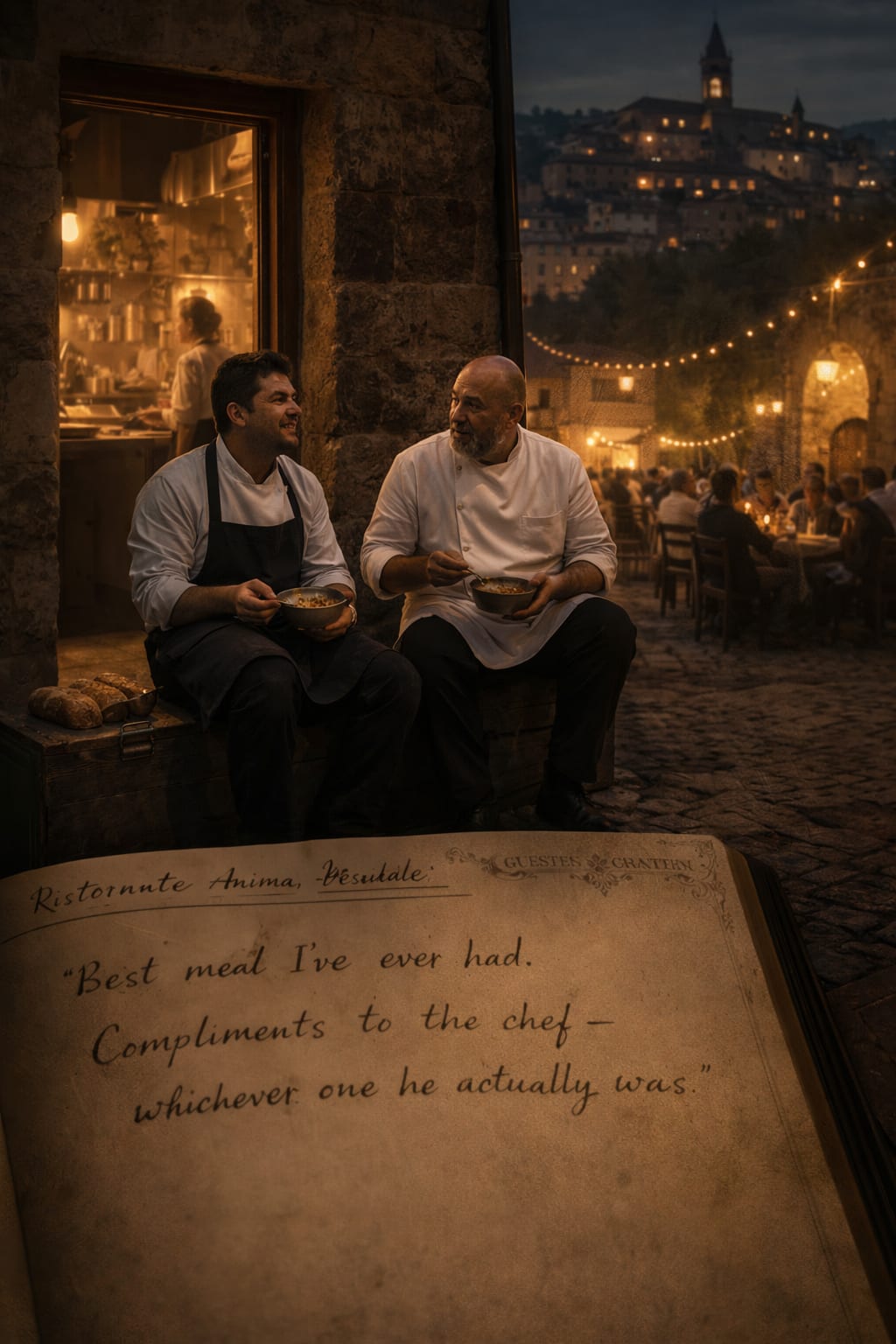
He found Carlo sitting on a crate outside the kitchen door, still wearing the apron, eating a bowl of leftover ribollita with the focused appreciation of a man tasting something for the first time.
Amati stood in the doorway and looked at him.
"You're the accountant," he said.
"Yes," Carlo said.
"Was the food good?"
Carlo considered this with genuine seriousness. "Giovanna's food was extraordinary," he said. "I stirred some things."
Amati sat down on the adjacent crate. He was quiet for a moment, in the way of a man who has had a long day and arrived at the end of it somewhere he hadn't expected to be. He looked at the piazza, at the festival lights coming on in the early evening dark, at the people still sitting at tables long after the meal was finished because nobody wanted to be the first to leave.
"Next time," he said, finally, "perhaps call ahead."
"Next time," Carlo agreed, "perhaps send a car to the right man."
They ate the ribollita in companionable silence. From inside the kitchen, Giovanna's voice rose briefly in instruction and then settled. Somewhere in the piazza, someone laughed — the specific, full-bodied laugh of a person whose stomach is full and whose evening is young.
Carlo Benedetti, accountant, one-day imposter, adequate stirrer of things, looked at Montefiore della Valle in its festival lights and thought: I have no idea what I'm doing. What a wonderful problem to have.
He finished the ribollita. He made a note to send Giovanna's kitchen a proper invoice for the day's accounts.
He left a very generous tip.
From the guest book of Ristorante Anima, Montefiore della Valle, undated:
"Best meal I've ever had. Compliments to the chef — whichever one he actually was."
About the Creator
Cordelia Vance
Lost in the ink-stained corridors of a life lived through pages. I write to capture the whispers of ghosts we pretend not to hear and the shadows we call home. Welcome to my attic of unspoken truths.
Keep reading
More stories from Cordelia Vance and writers in Fiction and other communities.
Last Seat Left Open
The first time Daniel noticed it, he thought it was a mistake. Five chairs. Four people. His mother moved between the stove and the table, setting plates down in her usual rhythm. His father sat at the far end, already eating, eyes lowered. His sister swung her legs, waiting.
By Rick Allen5 days ago in Fiction


Comments
There are no comments for this story
Be the first to respond and start the conversation.