
How to Recognize the Key Warning Signs a Legacy Java Application Needs Modernization
A complete guide to identifying warning signs in legacy Java systems

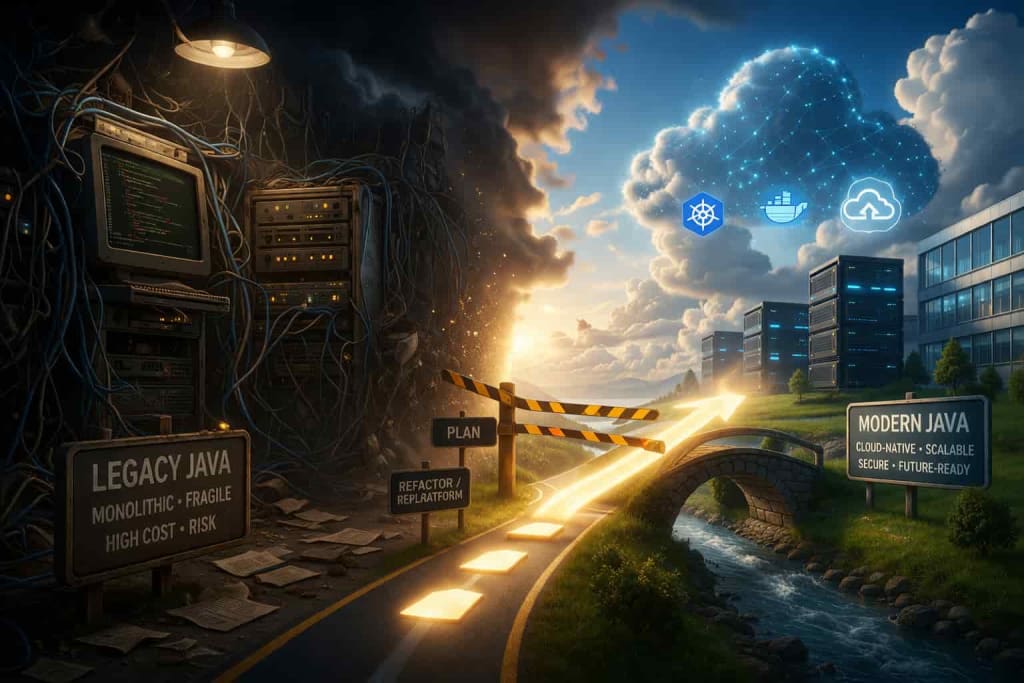
Legacy Java systems often begin as stable, mission-critical assets. Over time, however, evolving business demands, rising user expectations, and technological advancements expose their limitations. The challenge for organizations is not whether to modernize, but when to modernize—and how to recognize the signals early enough to act proactively rather than reactively.
Modernization is not merely a technical initiative; it is a business imperative. When a Java application becomes a constraint rather than an enabler, it impacts scalability, performance, cost efficiency, and even market competitiveness. Below are the most important warning signs that indicate your legacy Java application is due for modernization.
1. Persistent performance degradation
One of the clearest signals that a Java system needs attention is declining performance. If your application consistently experiences slow response times, high latency, or frequent timeouts under load, the underlying architecture may no longer be sufficient.
Common indicators include:
- Increasing API response times
- Long-running database queries
- High CPU or memory utilization
- Frequent thread blocking or deadlocks
These issues often stem from outdated frameworks, inefficient data access patterns, or monolithic structures that are difficult to scale horizontally. When performance tuning no longer yields meaningful improvements, modernization becomes the only viable path.
2. Difficulty scaling the application
Scalability is a fundamental requirement in modern systems. If your Java application struggles to handle increased traffic or requires significant infrastructure expansion to do so, this is a critical warning sign.
Legacy monolithic Java applications typically scale vertically (adding more resources to a single server), which is inherently limited and expensive. Modern systems, in contrast, are designed for horizontal scalability using distributed architectures.
You may notice:
- Sudden performance drops during peak usage
- High infrastructure costs to maintain performance
- Inability to elastically scale with demand
If scaling the system requires disproportionate effort, it is time to rethink the architecture.
3. Slow and risky release cycles
If deploying updates feels risky, slow, or infrequent, your Java system is likely overdue for modernization.
Legacy systems often suffer from:
- Tight coupling between components
- Lack of automated testing
- Manual deployment processes
- Complex build pipelines
As a result, even small changes require extensive testing and coordination, slowing down innovation. In fast-moving markets, this creates a significant competitive disadvantage.
Modern systems enable:
- Continuous integration and continuous deployment (CI/CD)
- Modular architecture for isolated changes
- Faster release cycles with reduced risk
If your development teams hesitate to deploy frequently due to fear of breaking the system, that’s a strong signal.
4. High maintenance costs
Maintenance costs tend to increase as systems age, especially when dealing with legacy Java applications. This includes not only infrastructure but also developer effort.
Warning signs include:
- Growing proportion of budget spent on maintenance rather than innovation
- Frequent bug fixes and hotfixes
- Increasing dependency on specialized (often scarce) expertise
- Rising costs of keeping outdated dependencies secure
When maintaining the system becomes more expensive than delivering new value, modernization becomes economically justified.
5. Accumulating technical debt
Technical debt is one of the most insidious indicators of a system in need of modernization. It accumulates when short-term fixes are prioritized over long-term design quality.
In Java applications, technical debt often manifests as:
- Poorly structured code
- Outdated frameworks or libraries
- Lack of documentation
- Inconsistent coding standards
- Workarounds instead of proper fixes
Over time, technical debt reduces developer productivity and increases the risk of introducing new bugs. If every change requires navigating fragile and complex code, the system is sending a clear signal: it needs restructuring or replacement.
6. Difficulty integrating with modern systems
Modern business environments rely on integrations with cloud platforms, third-party APIs, and microservices ecosystems. If your Java application struggles to integrate with modern tools, this is a major limitation.
Signs include:
- Reliance on outdated protocols or formats
- Lack of RESTful or event-driven APIs
- Difficulty connecting to cloud services or external platforms
- Complex and brittle integration layers
Modernization often involves exposing APIs, decoupling services, and adopting event-driven architectures that allow seamless interoperability.
7. Security vulnerabilities and compliance risks
Legacy Java applications are particularly vulnerable to security issues due to outdated dependencies, unsupported frameworks, and lack of modern security practices.
Common risks include:
- Unpatched vulnerabilities in libraries
- Deprecated encryption or authentication methods
- Inadequate access controls
- Lack of compliance with regulatory standards
If your system cannot easily be updated to meet current security requirements, it poses a significant business risk. Modernization enables stronger security models, automated patching, and compliance readiness.
8. Limited developer productivity
Another subtle but critical sign is reduced developer productivity. If your engineering team spends more time navigating legacy code than building new features, the system is holding them back.
Indicators include:
- Long onboarding times for new developers
- High cognitive load due to complex codebases
- Frequent need to debug obscure issues
- Lack of modern tooling support
Modern systems emphasize developer experience, with cleaner architectures, better tooling, and clearer separation of concerns.
9. Outdated technology stack
Java itself has evolved significantly, and so have the surrounding frameworks and tools. If your application relies on outdated versions of Java or obsolete frameworks, modernization is necessary.
Warning signs:
- Use of unsupported Java versions
- Dependence on deprecated frameworks
- Lack of support for modern JVM features
- Incompatibility with new development tools
Staying on outdated technology increases security risks and reduces access to performance improvements and new features.
10. Monolithic architecture constraints
Monolithic applications can become increasingly difficult to manage as they grow. If your Java system is a tightly coupled monolith, it may be limiting your ability to evolve.
Problems include:
- Difficulty isolating and updating components
- Risk of cascading failures
- Challenges in scaling specific features independently
- Slower development cycles
Modern architectures often adopt microservices or modular monolith approaches to improve flexibility and resilience.
11. Poor observability and monitoring
If your system lacks proper monitoring, logging, and observability, diagnosing issues becomes difficult and time-consuming.
Signs of poor observability:
- Limited logging or inconsistent log formats
- Lack of real-time monitoring dashboards
- Difficulty tracing requests across components
- Reactive rather than proactive incident response
Modern systems prioritize observability with tools for metrics, tracing, and structured logging, enabling faster issue detection and resolution.
12. Business limitations and missed opportunities
Perhaps the most important warning sign is when the system starts limiting business growth.
This can manifest as:
- Inability to launch new features quickly
- Delays in responding to market demands
- Constraints on experimentation and innovation
- Poor user experience due to system limitations
At this stage, the system is no longer just a technical asset—it is a business liability. Modernization is essential to unlock growth and remain competitive.
13. Increasing downtime and instability
Frequent outages, crashes, or instability are clear indicators that the system is reaching its limits.
Common causes include:
- Resource exhaustion
- Memory leaks
- Poor error handling
- Tight coupling between components
If downtime is becoming a recurring issue, it affects user trust, revenue, and brand reputation. A modernized system typically emphasizes resilience, fault tolerance, and redundancy.
14. Difficulty hiring and retaining developers
Legacy systems can make it harder to attract and retain talent. Developers prefer working with modern technologies and clean architectures.
If your system relies heavily on outdated technologies:
- Recruitment becomes more difficult
- Onboarding takes longer
- Developer satisfaction decreases
Modernization helps create a more attractive and productive engineering environment.
15. Lack of alignment with cloud strategy
Cloud adoption is now a standard part of most IT strategies. If your Java application is difficult to deploy or operate in the cloud, it may be a barrier to broader digital transformation.
Signs include:
- Heavy reliance on on-premise infrastructure
- Lack of containerization support
- Difficulties with scaling in cloud environments
- Limited automation in deployment
Modernization enables cloud-native capabilities such as containerization, orchestration, and elastic scaling.
Conclusion
Recognizing when a legacy Java application needs modernization is crucial for maintaining business agility, performance, and competitiveness. The warning signs often emerge gradually—slower performance, rising costs, increased complexity, and reduced developer productivity.
Individually, these issues may seem manageable. Together, they indicate that the system has reached a point where incremental fixes are no longer sufficient. Modernization is not simply about rewriting code; it is about transforming the system to better support current and future business needs.
Organizations that act early can modernize incrementally and reduce risk. Those that delay often face higher costs, greater complexity, and more disruptive transformations later.
The key is to continuously evaluate your Java systems against these warning signs and treat modernization as an ongoing strategic capability rather than a one-time project.
About the Creator
Chudovo
Chudovo is a custom software development company, focused on complex systems implementation.
Layers of Emotion: How Evan Roderick Creates Meaningful Depth in Every Role
Evan Roderick has become known for delivering performances that feel rich, thoughtful, and emotionally layered. Their actions or dialogue do not simply define their characters. Instead, they reflect a deeper understanding of human emotion and personal experience. This ability to bring depth to his roles allows viewers to connect with his characters in a lasting and meaningful way.
By Evan Roderick7 days ago in Education
How Casting Decisions Shape the Success of a Film and Drive Audience Engagement
Introduction to Casting in Film Production Casting is a key part of making any film. It decides who will play each role and bring the story to life. Casting decisions shape the success of a film because actors are the face of the story. They help the audience understand and feel the plot. When casting is done well, the film feels natural and engaging. When it is done poorly, even a strong story can fail to connect.
By Nigel Sinclair7 days ago in Education



Comments
There are no comments for this story
Be the first to respond and start the conversation.