
How Did the Spread of Electricity Help Farmers in Palampur?
Exploring the role of electricity in modernizing agriculture and boosting economic growth in a rural village.
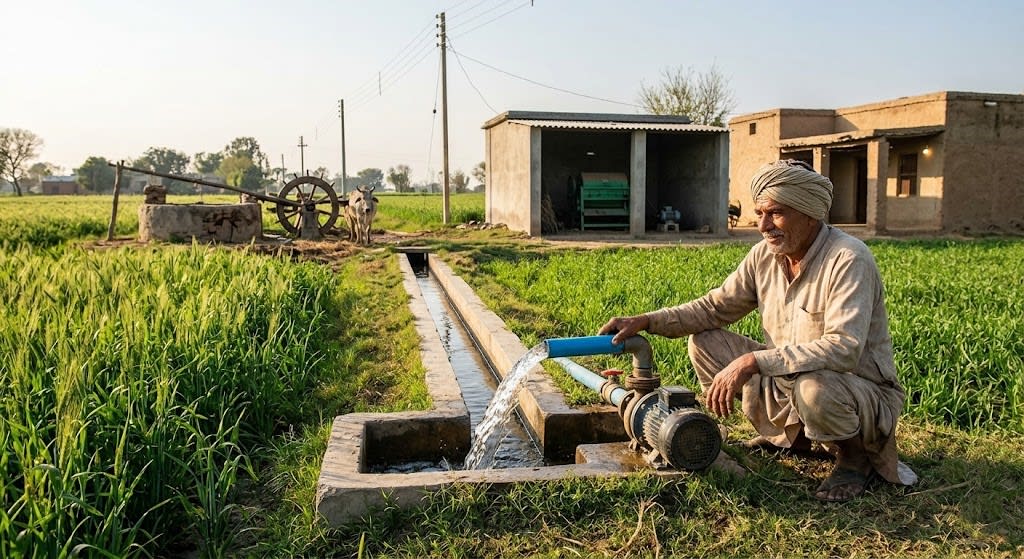
The spread of electricity in Palampur marked a turning point in the village’s agricultural and economic development. What was once a traditional, labor-intensive farming system gradually transformed into a more modern, efficient, and productive one. Electricity did not merely provide lighting—it revolutionized irrigation, mechanisation, productivity, and rural livelihoods.
This transformation can be understood through several key dimensions:
1. Transformation of Irrigation System
The most significant impact of electricity in Palampur was on irrigation. Before electrification, farmers relied on Persian wheels powered by bullocks to draw water from wells. This method was slow, labor-intensive, and limited in scope, allowing irrigation of only small plots of land.
With the introduction of electricity, electric tube wells replaced these traditional systems. These tube wells could pump large quantities of groundwater quickly and efficiently. As a result:
- A much larger area of land could be irrigated.
- Irrigation became faster and more reliable.
- Farmers were no longer dependent solely on rainfall.
By the mid-1970s, the entire cultivated land in Palampur (around 200 hectares) came under irrigation due to electric-powered systems.
2. Increase in Agricultural Productivity
Reliable irrigation directly led to higher agricultural productivity. When farmers gained control over water supply:
- Crop yields increased significantly.
- Farmers could grow multiple crops in a year (multi-cropping) instead of a single seasonal crop.
- Land use became more intensive and efficient.
Electricity, therefore, enabled farmers to maximize output from the same piece of land, which is a key feature of modern agriculture.
3. Reduction in Dependence on Monsoon
Before electrification, agriculture in Palampur was heavily dependent on monsoon rains. Uncertain rainfall meant uncertain harvests.
Electricity changed this dependency by:
- Providing assured irrigation through tube wells.
- Allowing farmers to plan cropping cycles more confidently.
- Reducing the risks associated with droughts or irregular rainfall.
This shift made agriculture more stable and predictable, improving farmers’ economic security.
4. Mechanisation of Agriculture
Electricity also facilitated the use of modern agricultural machinery such as:
- Electric pumps
- Threshers
- Harvesters
These machines reduced the need for manual labor and animal power, making farming:
- Faster
- Less physically demanding
- More efficient
Mechanisation allowed farmers to cultivate larger areas in less time and with greater precision.
5. Growth of Rural Economy and Allied Activities
The benefits of electricity extended beyond farming into the broader rural economy:
- Small-scale industries (like sugarcane crushing or flour mills) could operate using electric power.
- Farmers could process agricultural products locally, adding value.
- New employment opportunities emerged in non-farm sectors.
This diversification reduced pressure on agriculture and contributed to overall village development.
6. Improvement in Living Standards
Electricity improved not only farming but also the quality of life in Palampur:
- Homes had lighting, fans, and basic appliances.
- Farmers could access information (market prices, weather updates).
- Better storage facilities (like refrigeration) reduced spoilage of produce.
Higher agricultural income combined with improved living conditions led to a noticeable rise in the standard of living.
7. Long-Term Socio-Economic Development
The spread of electricity triggered a broader transformation:
- It modernized agricultural practices.
- It increased farmers’ incomes.
- It encouraged technological adoption and innovation.
- It supported overall rural development.
In essence, electricity acted as a catalyst that connected agriculture with modern technology and markets.
Conclusion
The spread of electricity in Palampur was not just a technological upgrade—it was a structural change that reshaped the entire rural economy. By revolutionizing irrigation, enabling mechanisation, increasing productivity, and improving living standards, electricity empowered farmers to move from subsistence farming to more productive and sustainable agriculture.
In simple terms, electricity turned Palampur from a traditional village dependent on nature into a more modern, self-reliant, and economically vibrant agricultural community.
About the Creator
Jerry
Dedicated website for Spotify. Here we share tips and tricks to master your Spotify experience.
How Interest Rates Shape the Real Estate Investment Landscape
The relationship between interest rates and real estate investments is one that investors must always understand. Interest rates significantly influence market conditions, affecting property values, financing options, and potential returns. Whether you are considering purchasing your first investment property or expanding your portfolio, the role of interest rates cannot be overlooked.
By Manny Khoshbin2 days ago in Education
When a Child Is in Crisis: Valley Children’s Healthcare Is Answering the Call with Mental Health Care Services
For families in California’s Central Valley whose children are struggling with anxiety, depression or thoughts of self-harm, real help hasn’t always been within reach. For years, parents have driven three and four hours just to access inpatient psychiatric care for a child in crisis.
By Todd Suntrapak4 days ago in Education




Comments
There are no comments for this story
Be the first to respond and start the conversation.