
Beyond the Chart: Why Nursing Documentation Is the Secret Weapon in Denial Management
Strengthening the Financial Health of Healthcare Systems Through Clinical Accuracy
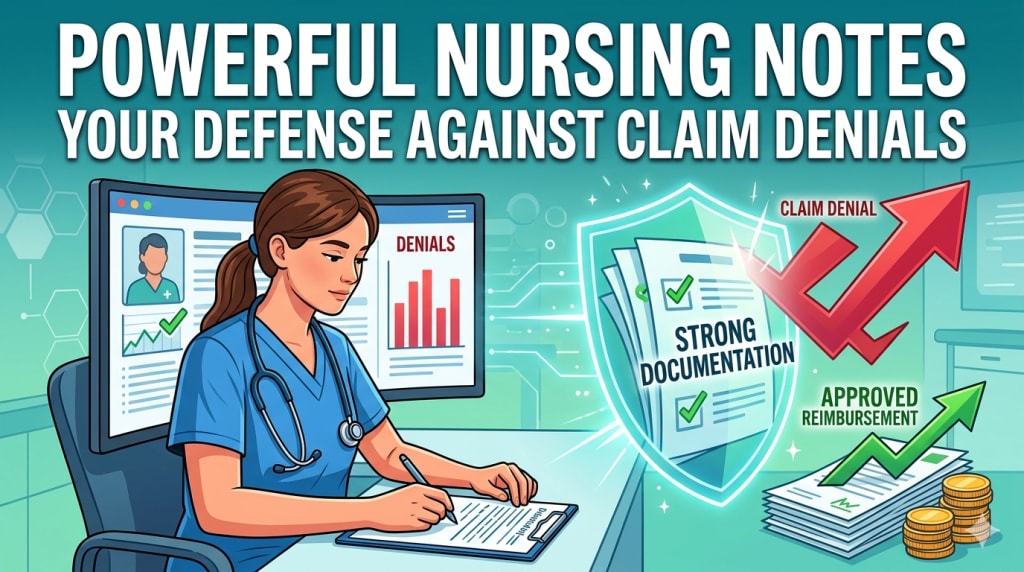
In today’s complex reimbursement environment, claim denials are one of the most significant hurdles for healthcare providers. While denial management is traditionally seen as the domain of billing teams and coders, the foundation of a successful revenue cycle is actually laid much earlier—at the point of nursing documentation.
Nurses are the primary clinical record-keepers of any facility. Their documentation directly impacts medical necessity validation, coding accuracy, and payer compliance. Without thorough and accurate nursing notes, even perfectly coded claims remain at high risk of denial. Understanding this connection is the first step toward building a resilient healthcare organization.
The Role of Documentation in the Revenue Cycle
Nursing documentation captures the "pulse" of a patient’s stay. It includes real-time assessments, vital signs, interventions, medication administration, and care plans. These records serve as the clinical justification for every diagnosis and procedure billed to insurance payers.
When documentation is incomplete, inconsistent, or delayed, it creates "information gaps." Payers often interpret these gaps as a lack of medical necessity or non-compliance with coverage guidelines. These inconsistencies lead to common denials for "insufficient documentation" or "mismatched codes." Accurate nursing notes are the backbone of the medical record, allowing billing teams to submit clean claims backed by undeniable clinical evidence.
Preventing Medical Necessity Denials
Failure to demonstrate medical necessity is a leading cause of revenue loss. Payers require a transparent "story" of why a service was needed, how it related to the patient’s condition, and what the clinical outcome was.
Nurses play a critical role here by:
Recording Symptom Severity: Providing the "why" behind the care.
Documenting Condition Changes: Showing the need for adjusted levels of care.
Supporting Physician Orders: Aligning clinical observations with provider directives.
Tracking Response to Treatment: Proving the efficacy of the interventions provided.
When nursing notes align seamlessly with provider plans, the risk of a "preventable denial" drops significantly.
Precision Coding and Compliance
Medical coders rely heavily on nursing records to assign CPT, HCPCS, and ICD-10 codes. Details regarding time-based services, the frequency of interventions, and patient acuity often come directly from nursing flowsheets.
For instance, time spent on critical care, the specifics of wound care, or the duration of infusions must be documented with precision. Vague notes can lead to under-coding (lost revenue) or over-coding (audit risk). Furthermore, in an era where payers use automated systems to flag discrepancies, small errors like mismatched dates or missing signatures can trigger immediate technical denials.
Improving the Odds of a Successful Appeal
Not every denial can be prevented, but comprehensive documentation is the best tool for recovery. When a claim is challenged, the nursing record is the first place a payer looks during a re-assessment.
Detailed notes provide the evidence needed to overturn medical necessity denials, support "level of care" appeals, and clarify treatment timelines. An appeal backed by a meticulous clinical narrative is far more likely to result in recovered revenue.
A Collaborative Path Forward
Denial management is a team sport. When clinical and revenue cycle teams collaborate, the entire organization benefits from faster root-cause analysis and better feedback loops.
The most successful healthcare organizations focus on prevention rather than recovery. By viewing nursing documentation as a strategic asset rather than a clerical chore, providers can ensure that every claim is defensible before it is even submitted.
Conclusion
Nursing documentation is more than a clinical requirement; it is a pillar of financial sustainability. Accurate, timely, and detailed notes support every stage of the reimbursement process. In the end, effective denial management doesn't start in the billing office—it starts at the bedside.
About the Creator
Keep reading
More stories from ampirebusiness and writers in Education and other communities.
How to Make Your Cairo to Riyadh Trip Memorable
Sometime before, during a research project, I came to know about an Arab country, and since then, I have manifested to visit that city. Six months ago, I visited the place I had desired to go to for a very long time. That place was Riyadh, the cultural hub and capital of Saudi Arabia. Cairo is the capital and largest city in Egypt. Riyadh is also the country's capital, but it is much more prominent in its area than Cairo, which made me anxious about visiting it. So as soon as I got a chance to travel, I knew where I wanted to go. Instantly, I book a flight from Cairo to Riyadh. For the first time, I used the Reserval app to make all my bookings, and the process was so effortless. My flight and hotel were booked under one roof in the most cost-effective way possible.
By ampirebusiness3 years ago in Wheel
The Complete Study Framework Used by Top Performers in GAMSAT
Most students preparing for GAMSAT are busy all the time. Notes, videos, and question banks are just some of the things that they use to prepare for the GAMSAT. Still, even after all that practice, the score stays the same. It makes them wonder what top performers do differently that they are missing.
By Abbasi Publisher7 days ago in Education




Comments
There are no comments for this story
Be the first to respond and start the conversation.