
*2* The huge mistake you’re making when picking stocks: why simplicity beats intelligence in the world of money.
How to start investing in index funds


What if putting money into ethics makes us think twice about where it actually goes? Choosing an index fund might instead make someone wonder just how tangled their finances ought to get. Could maturity in money matters mean skipping the hunt for a hot stock? Maybe real growth comes from admitting the broader market, over time, quietly builds more value than any single name ever could.
At first glance, index funds struck me as oddly straightforward. Back then, buying into the entire market sounded kind of dull. Excitement? Missing entirely. That spark of picking tomorrow’s top stock? Nowhere to be found. Over time though, something shifted. Simplicity turned out not to be lacking strength - more like quiet power wearing ordinary clothes.
Truthfully, what does "index fund" even mean?
One way to invest is through a fund that follows a market index. This kind of fund copies the makeup of indexes like the S&P 500, MSCI World, or FTSE All-World. Rather than picking stocks by hand, it matches how those indexes are built. Performance moves with the broader market since holdings reflect the index itself.
This means:
Fund value climbs when the index goes up.
When the index drops, so does the fund.
Fees usually sit well below those of hands-on investment options.
Back when he started Vanguard, John Bogle pushed an idea that stuck. Most people putting money into funds end up trailing the broader market once costs pile up over years. Time has shown, again and again, that he wasn’t wrong.
What makes index funds work so well?
One big thing stands out first. Another point follows close behind. A third idea completes the picture
1. Automatic diversification
Starting with just one purchase, a global index fund spreads your money across many businesses worldwide. Because it covers so many nations and fields, no single firm holds much weight. If trouble hits one business, others help balance it out.
2. Lower costs
Imagine holding onto extra money each year just because costs are tiny. A fraction like 0.1% versus 2% might seem almost nothing at first glance. Yet stretch that across decades, suddenly the gap widens wildly. Time magnifies what looks minor today into something massive later.
3. Removal of emotional stock picking
Finding that one perfect stock isn’t necessary. Picking the exact moment to jump in? Not required either. As you keep an eye on how things move, patience begins doing the heavy lifting.
Truth is, index funds make sense for new investors. It’s not their flashiness - it’s how well they work.
First step: clarify your objectives
Start by questioning what you really want before buying that first ETF or mutual fund
Am I investing for retirement?
For financial independence?
Aiming at something you’d like to reach in the coming half decade or so?
Last thing you’d expect? Timing shapes outcomes more than most admit. For holding decades, index funds fit like few others do. Bumpy swings show up clearly when months - not years - pass by.
Money needed in a couple of years probably shouldn’t go into stocks. When decades stretch ahead instead, everything shifts - suddenly it looks different.
Second step: choose the right type of index
Funds tracking the S&P 500 differ more than people think. Some follow broader markets - others stick close to big companies
Stock market measures like the S&P 500 focus mostly on a single country's financial health. While broad, they reflect just one nation’s performance. Exposure narrows when tied to domestic trends. Global shifts might matter less here. One economy drives results, for better or worse.
A broad mix of markets shows up in global indexes like the MSCI World or FTSE All-World. Spreading risk across countries becomes easier through such benchmarks. Different economies play different roles at different times within them.
Fresh markets often climb faster, yet shake more with swings. Though chances rise, so does the risk of sudden drops.
Sector indices– technology, energy, healthcare, etc.
A fresh start might find wide markets easier to handle. Diversified access comes through one steady choice instead of constant tweaks.
Third step: understand the risk
A single storm might flood one field, yet across a wide valley the crops often survive. Risk spreads when it’s shared many ways.
When big crashes hit - like in 2008 or 2020 - markets dropped fast. What sets past downturns apart? They bounced back over time. Staying steady through the wait, though, takes real effort.
Here’s the thing - psychology starts to matter a lot. Anyone can say they’re in it for the long run. Staying put when losses hit twenty or thirty percent? That’s different. Tougher.
Start by looking clearly at how much risk feels right for you. Following another person's plan makes little sense if you do not know your own limits.
A practical approach? Begin with something basic
A single project might be enough to get started. Try picking something you’ve already done. Maybe that sketch from last month works just fine. Or perhaps the report you wrote back in June. Start small, build slow. A few solid examples often matter more than dozens of rushed ones
One global ETF.
Automatic monthly contributions.
Reinvested dividends.
Buying little by little smooths out price swings over time. That way, timing the market matters less.
Later on, shifting how much goes into stocks versus bonds might make sense as life changes unfold. What matters most is where you are now, plus what lies ahead.
Common mistakes to avoid
Frequently switching funds.
Panicking during market downturns.
Obsessively following daily financial news.
Constantly comparing yourself to active investors who had an exceptional year.
Sticking with index funds feels more like walking a long trail than racing. Running fast won’t help much here.
Could this be so basic that it actually functions?
Often, folks ask me this one thing. Truthfully? Simple stuff wins every time. Because of that, lots catch on quick. Works well just by being plain.
Suddenly, what seems intricate gives a false sense of command, a mask for cleverness. Still, when it comes to investing, tangled methods usually cover up steeper fees along with poor decision habits.
Most folks who try beating the market end up behind. Staying steady matters more than being clever. Pick a path, stick to it, let time do the work.
Maybe it's just me, yet index funds feel less like tools for money and more like quiet teachers. Over time they show how waiting matters, cut through clutter, while letting small gains build slowly. Still, their real strength hides in plain sight - no flash, just steady motion.
Truth is, most never face this - will you stick with steady progress when quick thrills pull harder?
About the Creator
Luciman
I believe in continuous personal growth—a psychological, financial, and human journey. What I share here stems from direct observations and real-life experiences, both my own and those of the people around me.
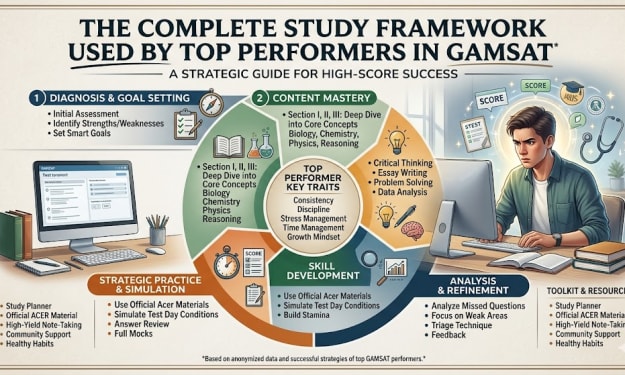
The Complete Study Framework Used by Top Performers in GAMSAT
Most students preparing for GAMSAT are busy all the time. Notes, videos, and question banks are just some of the things that they use to prepare for the GAMSAT. Still, even after all that practice, the score stays the same. It makes them wonder what top performers do differently that they are missing.
By Abbasi Publisher7 days ago in Education



Comments
There are no comments for this story
Be the first to respond and start the conversation.