
Urban Alchemy: Transforming Waste into the "Liquid Gold" of Smart Cities
Transformation of the urban metabolic system
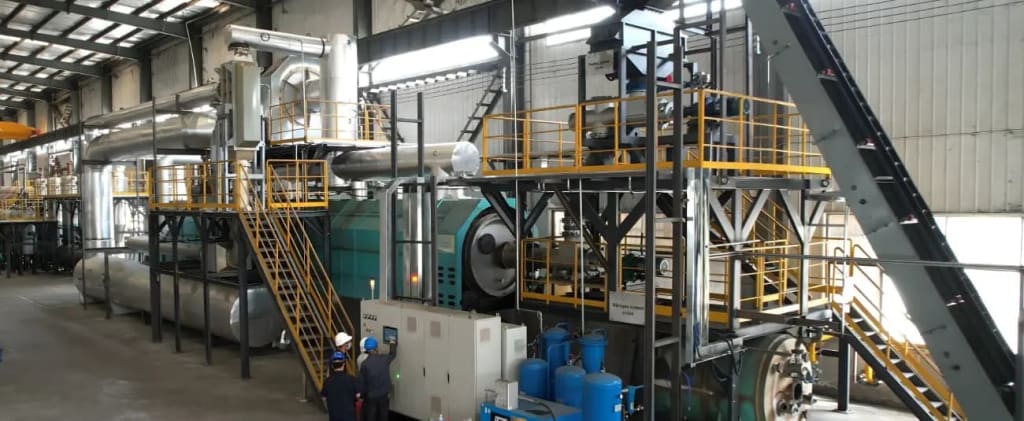
As global urbanization accelerates, a massive challenge lurks in the shadows of our skyscrapers: the waste crisis. Traditional methods like "burying" and "burning" are hitting their limits—not only do they consume precious land, but they also continuously leak greenhouse gases into our atmosphere.
However, within the grand blueprint of a Smart City, waste is no longer a burden to be disposed of; it is a resource out of place. A breakthrough technology—the Continuous Pyrolysis Reactor, capable of operating 24/7—is emerging as the "missing link" connecting green ecology with the energy revolution.
The Core Science: A "Molecular Magic Show" in an Oxygen-Free World
To understand this transformation, we must step into the micro-world of the continuous pyrolysis reactor—a completely sealed environment physically isolated from oxygen.
Unlike traditional batch processing, this reactor uses precision thermal control to "disassemble" organic waste into its primal chemical forms through a process called thermochemical decomposition:
- Bio-oil: A dark, energy-dense liquid that, once refined, can directly substitute fossil fuels.
- Syngas: A high-energy gas that can be instantly converted into electricity or heat.
- Biochar: A solid carbon residue that serves as both a premium soil enhancer and a long-term carbon sequestration tool.
The "continuous" nature of this system means it functions like a modern assembly line, "swallowing" massive volumes of urban waste and "breathing out" a steady stream of energy—exactly the kind of efficiency required by densely populated metropolitan hubs.
The Circular Loop: From "Trash Can" to "Power Plant"
The essence of a Smart City is maximum resource utility. By weaving pyrolysis technology into urban infrastructure, we are essentially building a "metabolic system" for the city:
- Energy Autonomy: The syngas produced can be fed back into the municipal grid to power streetlights, autonomous transit, or even the city’s vast sensor networks.
- Saving the Land: Compared to sprawling landfills, pyrolysis facilities have a compact footprint and emit virtually no toxic fumes.
- A Win-Win for Greenery: The resulting biochar can be diverted to rooftop farms or urban parks, boosting soil fertility while locking carbon underground to help hit "Carbon Neutral" targets.
Data-Driven: When "Physical Reactions" Meet the "Industrial Internet"
In a Smart City, the pyrolysis process does not exist in a vacuum. By integrating with the Internet of Things (IoT) and Big Data Analytics, this system achieves unprecedented intelligence:
- Real-time Optimization: Sensors monitor waste composition (moisture, density, etc.) in real-time, allowing the AI to automatically adjust temperatures for peak energy conversion.
- Logistics Optimization: Smart sanitation systems can dynamically plan garbage collection routes based on the reactor's current load, significantly reducing the carbon footprint of transport.
- Predictive Maintenance: AI algorithms can predict equipment wear before a failure occurs, ensuring the city’s "digestive system" never stops running.
The Zero-Waste Vision: Building a Sustainable Habitat for the Next Generation
From an environmental psychology perspective, the integration of pyrolysis changes the relationship between citizens and their waste. It represents a shift in mindset from "Linear Consumption" to "Circular Regeneration."
Because the entire process occurs within a closed-loop cycle, it drastically eliminates the risks of dioxins from incineration and groundwater contamination from landfills. This is more than a technical upgrade; it is a revolution in Spatial Justice—ensuring urban dwellers can breathe fresh air and enjoy cleaner water.
Conclusion: Reshaping the Lifeblood of the Metropolis
Integrating the continuous pyrolysis reactor into the fabric of a Smart City signals the end of the "Waste Disposal" era and the dawn of the "Resource Management" epoch. It allows the city to behave like a living organism: capable of self-metabolism and energy regeneration.
About the Creator
Remarkable Looking Lizards
Inhabiting the southwestern US, collared lizards are known for their vibrant color and their characteristic black “collar” mark around their necks. These lizards have quick movement and impressive speed. Collared lizards are primarily insectivorous, meaning their diet mainly consists of insects. They are known for their hunting skills, often pouncing on prey after displaying tail movements.
By Rasma Raisters2 days ago in Earth
Israel-Iran War: Environmental Risks Overview
Nearly a month into the Israeli-US war against Iran, it is clear that the environmental costs for Iran and the wider region have been substantial and are continuing to mount. The primary environmental threat during this stage of the war is conflict-linked pollution, which has the potential to impact public health, as well as terrestrial and marine ecosystems, and natural resources such as soils and aquifers. Contamination of water bodies is of particular concern for Iran, where drought and mismanagement have depleted water resources.
By Ibrahim Shah 3 days ago in Earth



Comments
There are no comments for this story
Be the first to respond and start the conversation.