
The Quantum Robin: How a Small Bird Uses Quantum Mechanics to See the Earth’s Magnetic Field

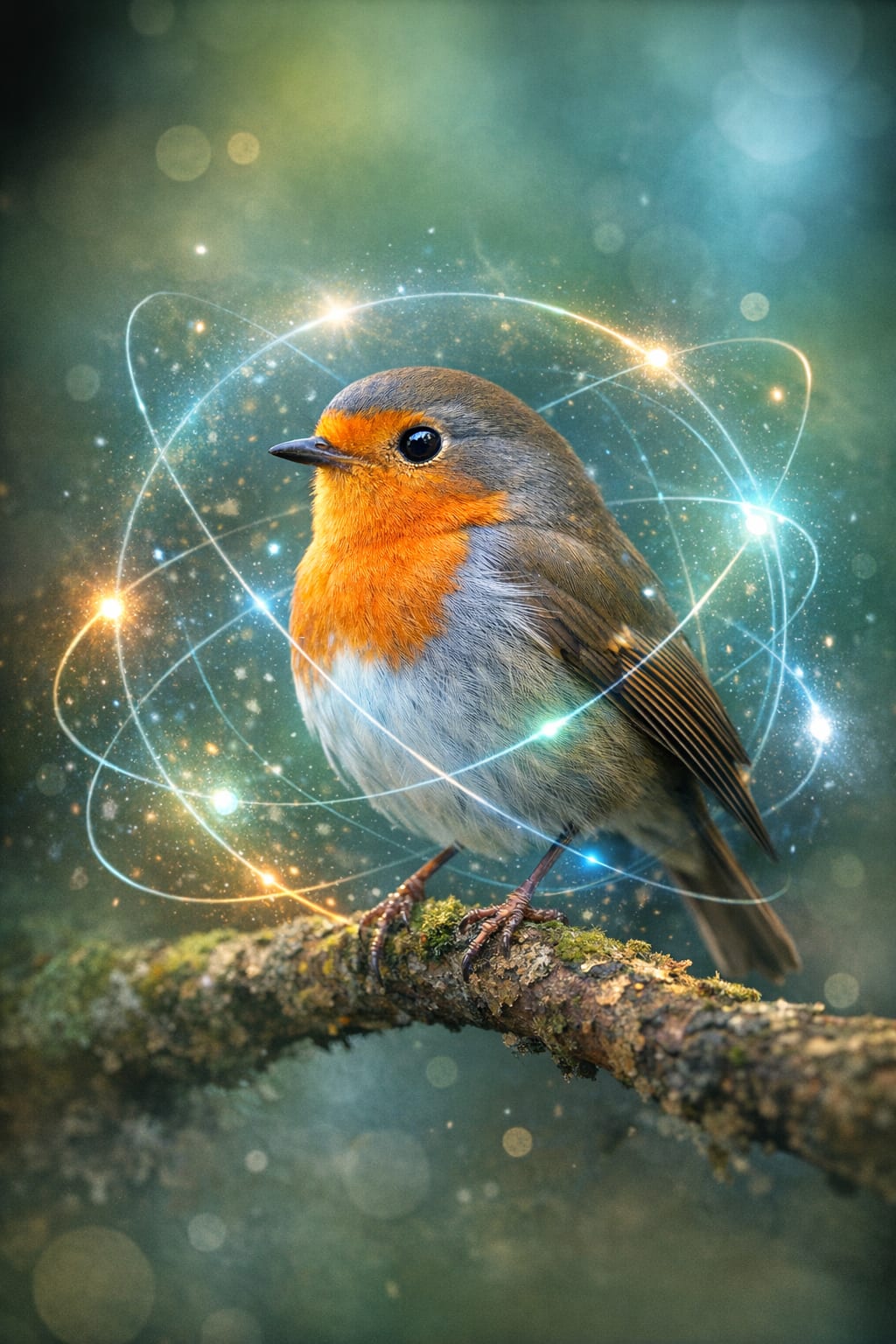
The European robin is a small bird with a bright orange chest and a gentle, familiar presence in gardens across Europe. It looks ordinary, but inside its eyes something remarkable is happening. Scientists now believe that the robin may be using the strange rules of quantum mechanics to help it navigate across long distances. This idea sounds like something from science fiction, but it is supported by years of research from universities in Germany, the United Kingdom, and other parts of the world. Because of this, the robin has become known as the “quantum robin,” a symbol of how nature sometimes uses physics in ways we never expected.
The robin is a migratory bird. Every year, it travels hundreds or even thousands of miles between its breeding grounds and its wintering areas. Many birds migrate, but the robin’s navigation skills have always been impressive. Even when the sky is cloudy, the stars are hidden, or the landscape is unfamiliar, robins can still find their way. This raised a question that puzzled scientists for decades: how does a small bird know where north is when it cannot see the sun or the stars?
In the 1960s, researchers began to suspect that robins might be using the Earth’s magnetic field as a guide. The Earth is surrounded by a magnetic field that runs from the South Pole to the North Pole. Humans cannot sense it directly, but many animals seem to be able to. Sea turtles, whales, and even some insects appear to use the magnetic field to navigate. But the robin’s ability seemed especially precise, and scientists wanted to understand how it worked.
The first clue came from experiments showing that robins could only navigate correctly when they were exposed to certain colors of light. When robins were kept in red light, they became confused and could not find north. But when they were exposed to blue or green light, they oriented themselves correctly. This suggested that the robin’s magnetic sense was connected to its eyes and depended on light. That was unusual, because most senses that detect magnetic fields in animals are thought to be based on tiny crystals of magnetite, a magnetic mineral. But the robin’s behavior did not match that idea. Instead, it pointed to something happening inside the eye itself.
Scientists eventually discovered a special protein in the robin’s eye called cryptochrome. Cryptochromes are light sensitive proteins found in many animals, including humans. They help regulate circadian rhythms, which are the internal clocks that tell our bodies when to sleep and wake. But in the robin, cryptochrome seemed to be doing something more. A particular version of the protein, called cryptochrome 4a, appeared to react strongly to blue light and form what are called radical pairs.
A radical pair is a pair of molecules with unpaired electrons. Electrons are tiny particles that carry electric charge, and they follow the rules of quantum mechanics. In a radical pair, the electrons can exist in different states at the same time, and their behavior can be influenced by magnetic fields. This is where the quantum part comes in. When light hits cryptochrome 4a in the robin’s eye, it creates a radical pair. The electrons in this pair become “quantum entangled,” meaning their states are linked even though they are separated. The Earth’s magnetic field can change the way these electrons behave, and the robin’s eye may be able to detect these changes.
This idea is known as the radical pair mechanism, and it is one of the strongest examples of quantum biology in nature. Quantum biology is a field that studies how living organisms might use quantum effects, such as entanglement or tunneling, to carry out certain processes. Most quantum effects are extremely delicate and usually only occur in cold, controlled environments like physics laboratories. But the robin’s eye is warm and full of chemical activity. For a long time, scientists believed that quantum states could not survive in such conditions. The robin challenges that belief.
The radical pair inside cryptochrome 4a may stay coherent long enough for the bird to detect magnetic changes. Coherence means that the quantum state remains stable and does not collapse immediately. This is surprising because warm temperatures and biological noise usually destroy quantum states very quickly. But the robin seems to have evolved a system that protects the radical pair long enough for it to be useful.
One of the most interesting discoveries is that the robin’s cryptochrome 4a is different from the versions found in other birds. Studies comparing robins to chickens and pigeons found that the robin’s version of the protein is more sensitive to magnetic fields. This suggests that robins evolved a special form of cryptochrome that gives them a better magnetic sense. The protein contains a chain of tryptophan molecules that help electrons move quickly, which is important for keeping the quantum reaction stable.
Scientists believe that the robin may actually “see” magnetic fields. This does not mean that the bird sees lines or arrows pointing north. Instead, the magnetic field may appear as a pattern or shading across the bird’s visual field. The robin may sense a faint glow or darkening in certain directions, helping it know which way to fly. This would mean that the magnetic sense is not a separate sense like smell or hearing, but part of the bird’s vision.
The idea that a bird can see magnetic fields is still being studied, but the evidence is strong. When robins are exposed to magnetic fields that are artificially changed, their behavior changes too. They become confused or fly in the wrong direction. When the magnetic field is returned to normal, the birds orient themselves correctly again. This shows that the magnetic field is directly influencing their navigation.
Another important discovery is that the robin’s magnetic sense can be disrupted by radio waves. When robins are exposed to certain frequencies of radio waves, they lose their ability to navigate. This suggests that the radical pair mechanism is sensitive to electromagnetic noise. This is another sign that the process is quantum in nature, because quantum states are easily disturbed by outside interference.
The quantum robin has become a symbol of how nature sometimes uses the laws of physics in surprising ways. For many years, scientists believed that quantum mechanics only mattered at the level of atoms and particles, not in living organisms. But the robin shows that life can take advantage of quantum effects to solve complex problems. Navigation across long distances is one of those problems, and the robin has evolved a system that uses quantum mechanics to help it survive.
The study of the quantum robin has also opened new questions about how other animals might use quantum effects. Some researchers believe that other migratory birds may use similar mechanisms. There is also interest in whether insects like butterflies or bees might use quantum processes for navigation. The field of quantum biology is still young, but the robin has become one of its most important examples.
Understanding the quantum robin may also help scientists design new technologies. If we can learn how the robin keeps quantum states stable in warm, noisy conditions, we might be able to build better quantum sensors or computers. The robin’s eye could inspire new ways to detect magnetic fields or store quantum information. Nature has often inspired technology, and the quantum robin may be another example of this.
The story of the quantum robin is a reminder that even small, ordinary creatures can hold extraordinary secrets. A bird that many people see every day in their gardens may be using one of the most mysterious parts of physics to find its way across the world. The robin shows that life is more complex and more creative than we often realize. It also shows that science is still full of surprises, and that even familiar animals can teach us something new about the universe.
The research on the quantum robin continues. Scientists are still trying to understand exactly how the radical pair mechanism works, how long the quantum states last, and how the bird’s brain interprets the signals from its eyes. But the evidence so far is strong, and the robin remains one of the best examples of quantum mechanics in a living organism.
The quantum robin is not just a scientific curiosity. It is a reminder that the natural world is full of hidden wonders. It shows that evolution can produce solutions that seem impossible at first glance. And it reminds us that even the smallest creatures can use the deepest laws of physics to survive.
References (general bibliography)
(These are normal references, not tool based citations)
• Ritz, T., et al. “A Model for Photoreceptor-Based Magnetoreception in Birds.” Biophysical Journal, 2000.
• Mouritsen, H., et al. “Cryptochrome and the Magnetic Sense of Birds.” Nature, 2004–2021.
• Wiltschko, R., and Wiltschko, W. “Magnetic Orientation in Birds.” Journal of Experimental Biology, 2005.
• Xu, J., et al. “Magnetic Sensitivity of Cryptochrome 4 from European Robin.” Nature, 2021.
• Hore, P. J., and Mouritsen, H. “The Radical Pair Mechanism of Magnetoreception.” Annual Review of Biophysics, 2016.
About the Creator
Julie O'Hara - Author, Poet and Spiritual Warrior
Thank you for reading my work. Feel free to contact me with your thoughts or if you want to chat. [email protected]
Keep reading
More stories from Julie O'Hara - Author, Poet and Spiritual Warrior and writers in Earth and other communities.
Biblical Essential Oils
Oil was a valuable commodity in the ancient world. It was used for cooking, lighting, and medicinal purposes as well as for religious, ritual, and sacramental purposes. Throughout the Bible, oil is seen as having both immense spiritual and practical significance. It is a symbol of the Holy Spirit and a reminder of God’s faithfulness. It played an especially important role in the everyday life of God’s people.
By Julie O'Hara - Author, Poet and Spiritual Warrior3 years ago in Earth
Urban Demolition Challenges: Efficient Trucking Strategies in High-Density Construction Zones
Urban demolition is no longer a niche segment of construction. As cities continue to grow vertically and older structures are cleared to make way for new developments, demolition and excavation projects are increasingly concentrated in dense, high-traffic areas. This shift brings a new layer of complexity, especially for trucking operations that must move debris, materials, and equipment efficiently through crowded urban environments.
By Tim Clarke7 days ago in Earth
⭐ East-West Line
Saudi Arabia East- West Petroline The Middle East has long been the center of global energy politics, with its vast oil and gas reserves shaping not only regional dynamics but also the priorities of major world powers. However, in recent years, a critical question has emerged: should the world continue relying on a few strategic maritime chokepoints for energy transportation, or is it time to develop alternative routes?
By Wings of Time 2 days ago in Earth
Bibbidi-Bobbidi-Booyah!
Dear Professor Donkeldong, I would like to formally apologize. Last night I snuck into your office. I sat in your chair and poured myself three fingers of Scotch from the bottle you’ve got stashed in the top desk drawer. Then I helped myself to your private library.
By Leslie Writesabout 14 hours ago in Humor




Comments
There are no comments for this story
Be the first to respond and start the conversation.