
How a Tropical Storm in Australia Changed the Color of the Sky
When a Powerful Storm Turned the Sky Red and Transformed the Atmosphere

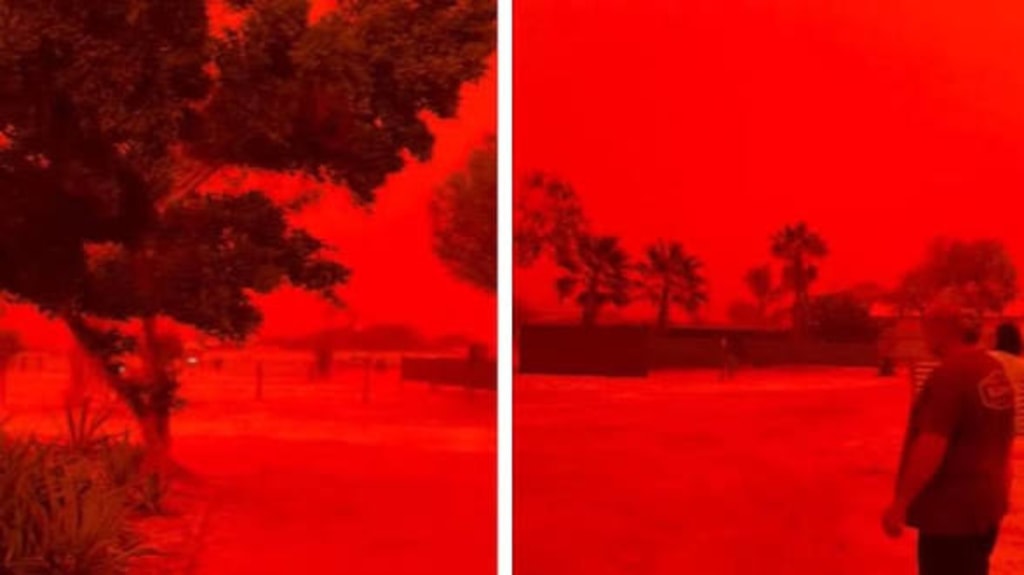
In recent times, unusual images and videos circulating online have shown skies turning deep red or orange in parts of Australia. Many people have linked this phenomenon to tropical storms, raising questions about whether extreme weather can truly change the color of the sky. While it may sound dramatic, science provides a clear and fascinating explanation behind this rare but real occurrence.
Understanding Tropical Storms in Australia
Australia is no stranger to powerful tropical systems, often referred to as cyclones rather than storms. These weather events typically form over warm ocean waters and bring strong winds, heavy rainfall, and turbulent atmospheric conditions. While their primary impacts are destructive winds and flooding, tropical storms can also influence the appearance of the sky in unexpected ways.
However, it is important to note that a storm alone does not directly “turn the sky red.” Instead, it creates the conditions that make such a visual transformation possible.
The Science Behind a Red Sky
The color of the sky is determined by how sunlight interacts with particles in the atmosphere. Normally, the sky appears blue because shorter wavelengths of light scatter more easily in the air. But when the atmosphere is filled with dust, smoke, or water droplets, the scattering process changes.
During or after a tropical storm, strong winds can lift large amounts of dust and debris into the air. In some cases, if there are nearby bushfires—a common occurrence in Australia—the storm can carry smoke particles over vast distances. These particles filter out shorter wavelengths of light and allow longer wavelengths, such as red and orange, to dominate.
The result is a dramatic red or amber sky that can make daylight look like sunset.
The Role of Bushfires and Dust Storms
One of the most significant contributors to red skies in Australia is not just storms, but the combination of storms with bushfires or dust storms. For example, during major wildfire events, thick smoke blankets large areas, altering the color of sunlight. When this smoke mixes with storm clouds, it intensifies the effect, creating an eerie red glow across the sky.
Similarly, inland dust storms can carry fine particles across the continent. When a tropical system interacts with these dusty conditions, it can spread the particles even further, enhancing the reddish hue.
Real-Life Occurrences
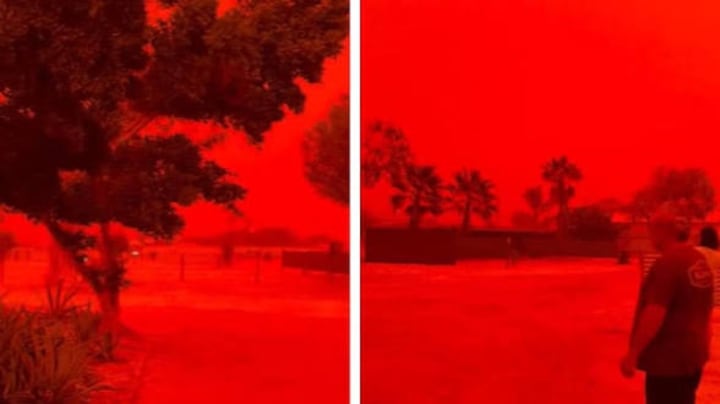
Australia has witnessed several instances where the sky turned red or orange due to environmental factors. One of the most notable examples occurred during severe bushfire seasons, when cities experienced darkened skies and a reddish atmosphere for days.
These events often go viral on social media, leading to speculation about unusual or even supernatural causes. In reality, they are the result of well-understood atmospheric science combined with extreme environmental conditions.
Is It Dangerous?
A red sky itself is not dangerous, but the conditions causing it can be. Smoke-filled air can reduce air quality, making it harmful to breathe, especially for people with respiratory issues. Dust particles can also irritate the eyes and lungs.
Additionally, if the red sky is associated with a tropical storm, there may be risks from strong winds, flooding, and flying debris. Therefore, while the visual effect may be striking, it often signals underlying environmental hazards.
Separating Fact from Fiction
It is easy to assume that a tropical storm alone can dramatically change the sky’s color, but this is only part of the story. The red sky is usually the result of multiple factors working together—storm activity, airborne particles, sunlight angles, and sometimes nearby fires.
Misinformation can spread quickly, especially when dramatic images are shared without context. Understanding the science helps separate fact from exaggeration and allows people to better interpret what they are seeing.
Conclusion
So, did a tropical storm in Australia turn the sky red? The answer is both yes and no. While the storm itself does not directly change the sky’s color, it plays a crucial role in creating the conditions that make such a phenomenon possible. By lifting dust, spreading smoke, and altering atmospheric composition, tropical storms can contribute to the stunning and sometimes unsettling sight of a red sky.
Ultimately, this natural event is a powerful reminder of how interconnected weather systems and environmental factors can shape the world around us—sometimes in ways that are as beautiful as they are dramatic.
About the Creator
Sk
"I am a passionate writer, crafting books and articles on Vocal Media, exploring human experiences, stories, and creative reflections."
Thousands Take to the Streets Across America for "No Kings" Day
March 28, 2026 Today, people in cities and towns all across the United States stepped outside, made signs, and marched together for what's being called "No Kings III" — the third major mobilization organized by the No Kings Coalition.
By Jayden Hua3 days ago in Earth



Comments
There are no comments for this story
Be the first to respond and start the conversation.