
The Chilling Case of Denise Huber: A Young Life Stolen, Hidden in a Freezer for Three Years
In 1991, 23-year-old Denise Huber vanished after her car broke down in California. Three years later, her frozen body was found handcuffed in a freezer owned by John Famalaro, who was later convicted and sentenced to death.
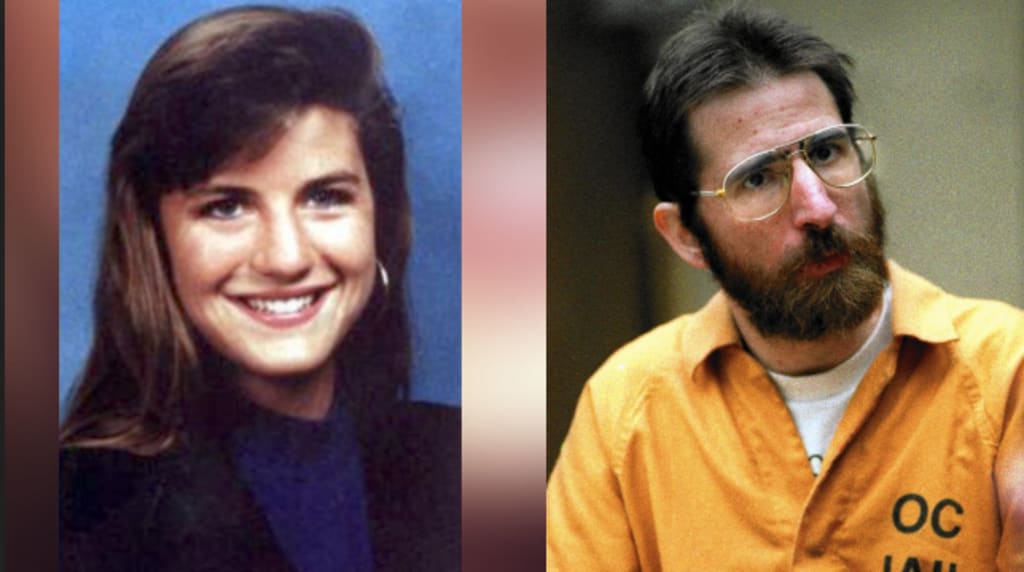
On a warm June night in 1991 23-year-old Denise Huber stepped out for what should have been an unforgettable evening. Living with her parents, Dennis and Ione Huber in the peaceful upscale neighborhood of Newport Beach California, Denise was a recent graduate of the University of California, Irvine with a degree in social sciences. She worked as a waitress while figuring out her next steps in life—enjoying her youth spending time with friends, and dreaming of settling into a more stable career. Described by those who knew her as vibrant and full of potential, Denise had plans to attend a Morrissey concert in Inglewood with her boyfriend Steven Horrocks, whom she had known for years. Though circumstances led her to go alone or adjust plans, the night began like any other for a young woman seeking a bit of fun.Denise left the concert around 2 a.m. on June 3, 1991, driving her white Honda southbound on the Corona del Mar Freeway (Highway 73) through Costa Mesa toward home. In the early morning hours, disaster struck: her right rear tire blew out on a stretch of the toll road. Stranded in a familiar area close to home, with phones and help seemingly within reach—credit cards, a AAA membership, and a list of contacts in her wallet—Denise likely activated her hazard lights and waited for assistance. Her car was later found unlocked, with the battery drained from the blinking lights, but Denise was gone without a trace. No signs of struggle were immediately apparent, and there were no witnesses to what happened next.
Her family grew worried when Denise didn’t return home. By morning, her parents began calling friends and contacts, piecing together that something was terribly wrong. The search for Denise launched quickly and intensely. Law enforcement, volunteers, and the Huber family scoured the area. A massive banner was even placed on a nearby apartment building overlooking the site of her abandoned car, pleading for information. Tips poured in, but none led anywhere. Weeks turned into months, and then years. The case went cold, leaving Denise’s loved ones in agonizing limbo. Her mother, Ione, later expressed the torment of “not knowing,” a pain that haunted the family daily. Denise’s brother, Jeff, and extended relatives joined in the grief, wondering if she had been kidnapped, met with foul play, or simply vanished into the night.
For three long years, the mystery persisted. Then, in July 1994, a seemingly unrelated business deal in Prescott, Arizona, cracked the case wide open. John Joseph Famalaro, a 34-year-old paint contractor who had recently relocated from California, was negotiating a sale with a local couple, Elaine Court (sometimes referred to as Elaine Canalia) and her associate. They visited his property and noticed something suspicious: a large rental truck parked oddly and covered with a tarp. Their intuition screamed that something wasn’t right—perhaps the vehicle was stolen. Acting on that gut feeling, they noted the license plate and reported it to police.
Officers arrived to investigate the reported stolen truck. What they uncovered inside would shock the nation and bring horrifying closure to the Huber family. In the back of the truck sat a large, padlocked industrial freezer. When authorities removed the lock and opened it, they found a gruesome scene: the nude body of a young woman, wrapped in garbage bags, handcuffed behind her back, positioned on her knees in a semi-fetal pose with her head bowed. Cloth had been stuffed in her mouth, secured with duct tape. Fingerprints quickly confirmed the identity— it was Denise Huber, preserved in a frozen state for nearly three years.
The discovery linked directly back to Famalaro. Investigators learned he had operated a paint business with a warehouse in Laguna Hills, Orange County—mere miles from where Denise’s car had been abandoned. Evidence suggested a chilling sequence of events. Famalaro, possibly out “hunting” for victims that night, spotted the stranded motorist. He approached under the guise of offering help, then struck her repeatedly with a hammer (or similar blunt object, possibly a crowbar as well), inflicting over 30 blows to her skull. He dragged the unconscious or incapacitated Denise to his vehicle, handcuffed her, and took her to his warehouse. There, authorities believe he sexually assaulted her before bludgeoning her to death. To conceal the crime—and perhaps keep her as a grotesque “trophy,” given his hoarding tendencies—Famalaro placed her body in the freezer. When he moved to Arizona, he brought the freezer and its contents with him. Blood evidence matching both Denise and Famalaro, along with her clothing found in his possession, sealed the connections.
Famalaro was arrested on July 13, 1994, and extradited to California. He pleaded not guilty, but the evidence was overwhelming. His 1997 trial in Orange County drew intense media attention, one of the most notorious cases in the region’s history. Prosecutors painted a picture of a predatory opportunist who exploited a vulnerable moment on a dark highway. The defense attempted to challenge aspects of the case, but the jury convicted Famalaro of first-degree murder with special circumstances, including kidnapping and sexual assault. In the penalty phase, he was sentenced to death. The California Supreme Court later upheld the conviction and sentence in 2011, though appeals have continued.
As of 2026, John Famalaro, now in his 60s, remains on death row at San Quentin State Prison in California. Due to ongoing legal challenges, a moratorium on executions in the state, and issues with lethal injection protocols, his sentence has not been carried out. Denise’s parents, Dennis and Ione, have spoken publicly about the enduring wound. In interviews marking anniversaries of the tragedy, they described how time offers some perspective but never true healing. “The wound never heals,” they noted, expressing doubt that Famalaro would ever face execution in their lifetimes. Still, they found some measure of peace in the resolution and in honoring Denise’s memory through advocacy and remembrance.
The Denise Huber case stands as a stark reminder of how quickly safety can shatter— a flat tire on a familiar road, a moment of trust extended to a stranger, and a life erased in violence. It highlights the persistence of law enforcement and the power of citizen vigilance; without that couple’s sharp instincts in Arizona, Denise might never have been found. Her story has been featured in true crime documentaries and discussions, serving as a cautionary tale about roadside assistance risks and the darkness that can lurk in ordinary encounters.For the Huber family, the horror of discovering their daughter’s body preserved in such a dehumanizing way added layers of trauma to an already unimaginable loss. Yet, through their strength, they transformed private grief into a broader call for awareness. Denise, the smiling young woman with dreams ahead, deserved far better than the fate she met. Her case remains a testament to the resilience of those left behind and the importance of never giving up on cold cases, no matter how much time passes.
About the Creator
Keep reading
More stories from Kure Garba and writers in Criminal and other communities.
The Tragic Murder of Viridiana Arevalo
In a shocking case that drew widespread attention for its brutality and underlying motivations 23-year-old Viridiana Arevalo was murdered by her younger brother Eduardo Arevalo (also reported as Edwardo in some accounts) in The Colony Texas—a suburb approximately 30 miles north of Dallas—in December 2019. Viridiana, who was eight months pregnant at the time, was unmarried and had a boyfriend. Her pregnancy out of wedlock became a source of deep conflict within the family particularly for her brother who viewed her situation as a profound source of shame and embarrassment.The incident unfolded on December 16 2019. According to police reports and Eduardo's own confession an argument escalated inside their family home. Eduardothen 19 years old approached his sister from behind while she was seated on the couch in the living room. He strangled her to death with his hands. This act of violence ended not only Viridiana's life but also that of her unborn child.
By Kure Garba10 days ago in Criminal
NIST's Collection of 10,000 Fingerprints
NIST’s fingerprint dataset SD 302 includes 10,000 fingerprint images, including this one from the sticky side of a postage stamp. The dataset is now fully annotated, with details such as the colorized regions shown on the right. The colors, which represent regions of differing quality, will help train both humans and machine learning algorithms how to distinguish identifying features and weigh their importance as evidence. Credit: B. Hayes/NIST
By Frank Racioppi2 days ago in Criminal


Comments
There are no comments for this story
Be the first to respond and start the conversation.